
“Teach us to number our days, that we may apply our hearts to wisdom.”
— Psalm 90:12
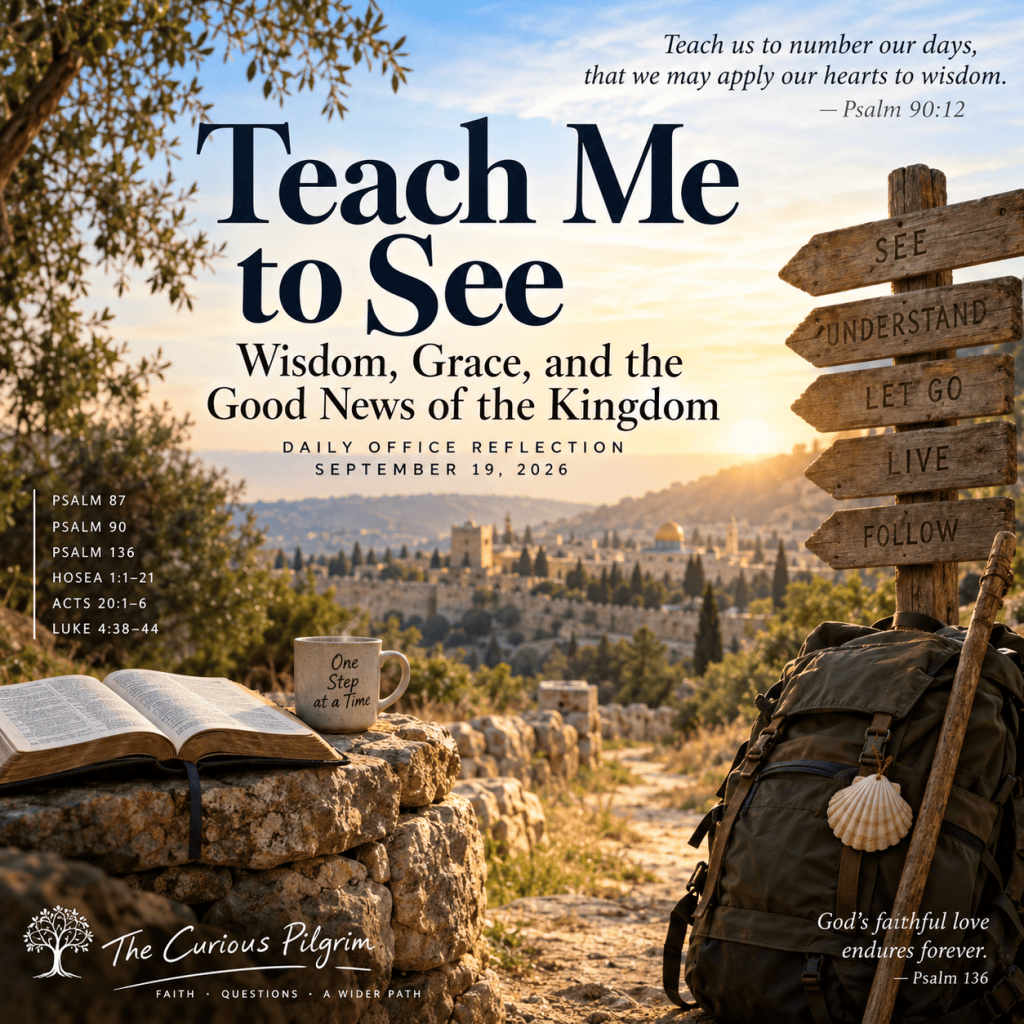
I have been thinking about wisdom.
What is it? Is wisdom subjective? Is it simply knowing more than I knew yesterday? Is it having the right answers?
The longer I travel this pilgrimage, the less I think wisdom is about having all the answers. Perhaps wisdom is learning to see—to recognize what is real, what matters, what needs to be carried forward, and what needs to be left beside the road.
Psalm 90 reminds me why this matters. My days are limited. So are yours. We do not have forever to learn how to live.
“Teach us to number our days.”
Teach us to see.
Psalm 87 speaks of Zion as the place of God’s presence, while Psalm 136 repeats its great refrain: God’s faithful love endures forever. Again and again:
His faithful love endures forever.
There is no expiration date on God’s love.
Then we come to Hosea, and suddenly things become uncomfortable.
Hosea’s marriage becomes a shocking symbol of the relationship between God and God’s people. Israel thought of itself as God’s chosen people, but the way the people were living did not reflect the relationship they claimed to have with God.
That reminds me of Isaiah 1.
The people were offering sacrifices. They observed their religious festivals. They gathered for worship. They did the religious things they were supposed to do.
And God essentially told them, Enough.
Their worship had become disconnected from the way they lived.
“Learn to do good; seek justice, rescue the oppressed, defend the orphan, plead for the widow.”
That makes me uncomfortable because I can point the finger at Israel only so long before I have to turn it around.
I am guilty too.
There have been years when I went through the motions. I preached sermons. I attended church. I prayed prayers. I did religious things.
But did I always live what I proclaimed?
No.
Even during my years in the pulpit, I wrestled with the purpose of preaching. My father had a rule that a preacher shouldn’t preach longer than twenty minutes. I have heard sermons considerably longer than that, and I am sure I preached a few myself.
But perhaps the real question isn’t whether a sermon lasts twenty minutes or an hour.
What is the sermon supposed to accomplish?
Paul speaks in 1 Corinthians about what some translations call “the foolishness of preaching.” Jesus gives us an even clearer answer in today’s Gospel:
“I must proclaim the good news of the kingdom of God to the other cities also; for I was sent for this purpose.”
The Good News of the Kingdom.
That is more than scaring the hell out of people.
It is more than selling spiritual fire insurance so we can escape punishment when we die.
Jesus proclaimed a Kingdom—and then showed people what that Kingdom looked like.
In Luke 4, he heals Simon’s mother-in-law. People bring the sick to him, and he heals them. When the people want him to remain with them, Jesus says he must take the Good News elsewhere.
His words and his life belonged together.
That makes me think about Matthew 25.
I was hungry.
I was thirsty.
I was a stranger.
I needed clothing.
I was sick.
I was in prison.
It makes me think about Galatians 5 and the fruit of the Spirit: love, joy, peace, patience, kindness, generosity, faithfulness, gentleness, and self-control.
It makes me think about Galatians 3:28 and the barriers human beings construct between one another.
And it makes me think about Romans 12–15—humility, hospitality, love, enemies, disagreements, conscience, judgment, peace, and accepting one another.
Going to church matters.
Worship matters.
The Eucharist matters.
Prayer matters.
Sacred Writings matter.
Preaching matters.
But if all those things never affect the way I live when I walk out the church door, something is missing.
I can sing about love and refuse to love.
I can hear Matthew 25 and walk past someone in need.
I can read Galatians 3:28 while continuing to build walls between myself and other people.
I can recite the fruit of the Spirit while producing anger, resentment, hostility, and division.
I can listen to sermons about Jesus without ever seriously asking:
How do I live the way Jesus lived in the world in which I live today?
That was something I wanted to accomplish when I preached. I didn’t always succeed.
I wanted to take these ancient writings and ask: What do they say to us now? How does this apply to me? To us? What are we seeing?
People need to see.
I need to see.
And that brings me back to wisdom.
Wisdom isn’t merely knowing what Hosea meant historically or understanding Paul’s travel itinerary in Acts. Those things are important. But wisdom asks another question:
Now that I have heard the Word, what am I seeing that I didn’t see before?
And then comes an even harder question:
Now that I see it, how will I live?
That could become crushing if everything depended upon me.
Thank God it doesn’t.
Grace.
God’s grace brought me to the porch before I even understood what was happening. Grace brought me to the door. Grace invited me across the threshold.
And grace didn’t stop there.
Sanctifying grace continues working.
Praise God.
I am still human. I still get things wrong. I still discover attitudes, assumptions, habits, and baggage that I have carried much farther than necessary.
But grace keeps teaching me.
Sacred Writings teach me.
Tradition teaches me.
Experience teaches me.
Reason teaches me.
And somewhere in that continuing conversation, wisdom begins to emerge.
Hebrews speaks about laying aside every weight that keeps us from running the race before us.
A pilgrim eventually discovers that he doesn’t have to carry everything he picked up along the road.
Some things need to be released.
Old fears.
Old prejudices.
Old assumptions.
Old understandings of God that no longer resemble the God Jesus shows us.
The need to appear righteous.
The baggage of yesterday.
Maybe wisdom is learning what to carry and what to put down.
Maybe sanctifying grace is God’s patient work of helping us do exactly that.
I don’t want merely to go through the motions anymore.
I want the real thing.
I want to follow Jesus.
I won’t do that perfectly. None of us will. But perhaps perfection isn’t the next step.
Perhaps the next step is simply the next faithful step.
Psalm 90 reminds me that I have only so many days left to take those steps.
So today my prayer is simple:
Lord Jesus Christ, teach me to see.
Teach me to recognize what is real.
Give me wisdom to recognize what I need to release.
Give me grace to put it down.
Teach me to see your Kingdom.
And then teach me how to live what I see.
One step at a time.
The pilgrim is still learning.
And God’s faithful love still endures forever.
 The Curious Pilgrim
Leave a comment