
Saints — September 20, 2026
Jackson Kemper, Episcopalian (December 24, 1789–May 24, 1870)
Source: A Year with American Saints, G. Scott Cady and Christopher L. Webber, Church Publishing, 2006.
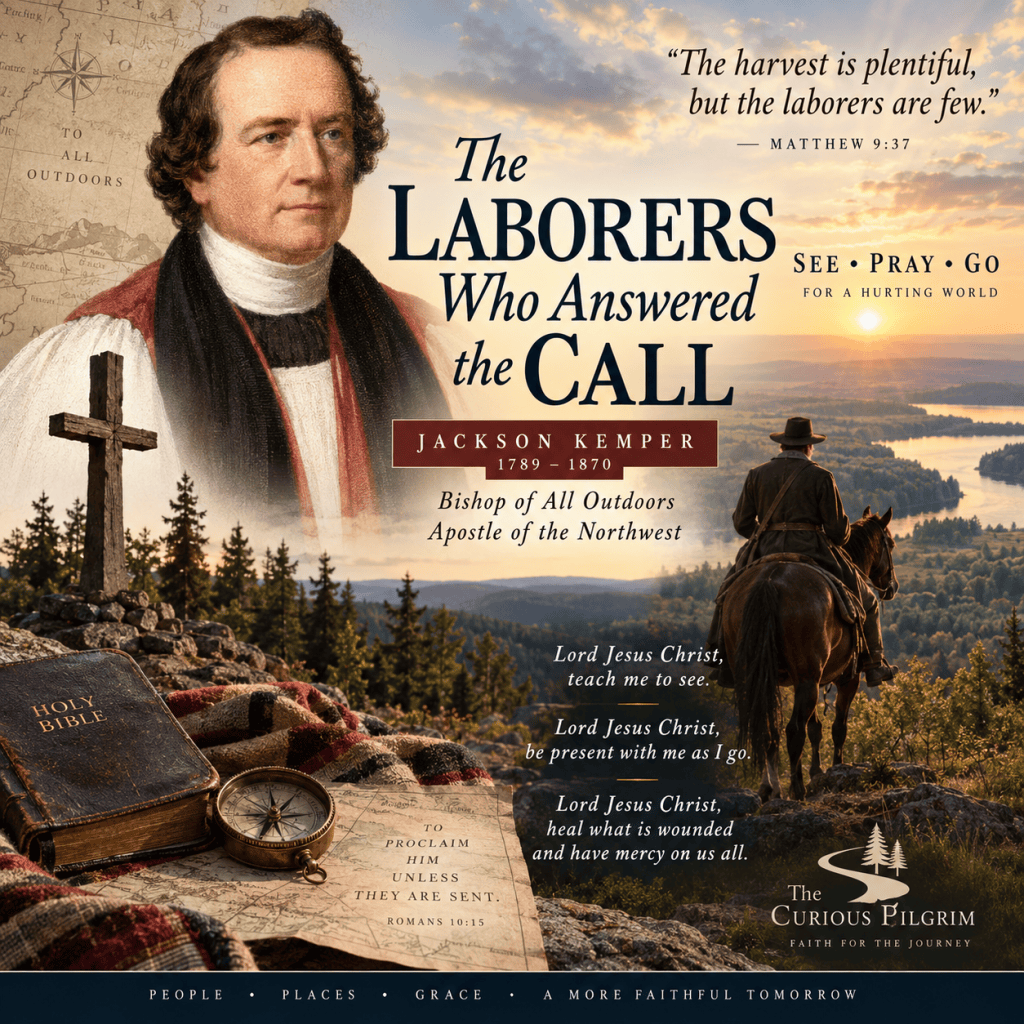
Jesus looked at the crowds and saw the need.
“The harvest is plentiful, but the laborers are few.”
Then he told his disciples to pray that the Lord of the harvest would send laborers into the harvest.
That prayer has been answered again and again throughout the history of the Church because men and women have been willing to answer the call and go.
Jackson Kemper was one of them.
Ordained an Episcopal deacon in 1811 and a priest in 1814, Kemper might have spent his ministry among the established churches of the East. Instead, he developed a passion for carrying the Gospel into places where the Episcopal Church was not yet firmly established.
In 1835, the Episcopal Church consecrated Kemper as its first missionary bishop and sent him west.
And he went.
He became affectionately known as the “Bishop of All Outdoors” and the “Apostle of the Northwest.” During his long missionary ministry, he traveled enormous distances, consecrated churches, ordained clergy, confirmed thousands of people, and helped establish institutions for preparing future ministers.
His ministry also included Native American communities. I want to be careful how I describe that part of his story. Christian mission among Native peoples took place within the much larger and often tragic history of American westward expansion, displacement, prejudice, and attempts to replace Native cultures with European-American ways of life.
Kemper’s story contains another dimension worth remembering. He encouraged translation of Scripture and the Church’s worship into Native languages. His ministry among the Oneida included a relationship with Chief Daniel Bread, who invited him to the Oneida community at Duck Creek. Kemper also ordained Enmegahbowh, an Ottawa man, as a deacon in 1859.
That does not erase the difficult history surrounding Christian missions and Native peoples. Neither should that history prevent us from recognizing Native Christians as participants with their own faith, leadership, choices, and voices.
Perhaps that is another reason I keep praying:
Lord Jesus Christ, teach me to see.
Kemper understood that the expanding country needed laborers.
When clergy from the established East were slow to answer the call to the frontier, Kemper worked to prepare clergy in the West. Not everything he attempted succeeded. A training college he established in St. Louis eventually failed for lack of funding. But Kemper did not abandon the mission. He continued working to establish places where future clergy could be prepared, including Nashotah House in Wisconsin.
Kemper once challenged the Episcopal Church’s Board of Missions. Were Christians doing even one tenth of what they were capable of doing? Could their faith, generosity, and self-denial increase?
Those weren’t merely the words of a bishop sitting behind a desk.
Kemper was already on the road.
His story reminds me of Paul’s words:
“How are they to hear without someone to proclaim him? And how are they to proclaim him unless they are sent?”
That story began long before Jackson Kemper.
Jesus sent the disciples.
Paul and Barnabas went.
As Christianity spread across the developing United States, people such as Francis Asbury, Thomas Coke, Jackson Kemper, the circuit riders, and countless missionaries whose names most of us will never know answered the call.
They went.
Perhaps this part of Kemper’s story speaks so strongly to me because calling has been part of my own story almost from the beginning.
My father was a farmer and a preacher. As a little boy, I followed him around and watched him. When I was five years old, Minnie Wally patted me on the head and told me that someday I would be a preacher just like my daddy.
I told her, “No way.”
I wanted to be a teacher.
Then my father died when I was fourteen.
Not long afterward, I began wrestling with a call to preach. At sixteen, I was licensed as a Free Will Baptist minister.
I certainly didn’t know where that calling would take me. I could not have imagined the denominations, churches, classrooms, seminary, pastoral ministry, disappointments, failures, questions, changes, and discoveries that would become part of my pilgrimage.
My understanding of calling has changed along the way. So has my understanding of God.
But the call never meant that I had everything figured out. It meant taking the next step I believed God was asking me to take.
That helps me understand something about these missionaries.
Different denominations. Different centuries. Different places. Different people.
Yet each generation encounters the reality Jesus described:
The harvest is plentiful.
The laborers are few.
Pray for laborers.
Send them.
And someone must be willing to go.
That brings me back to the three prayers that have increasingly become part of my pilgrimage.
Lord Jesus Christ, teach me to see.
Mission begins with seeing. Jesus saw the crowds. Those who answered the missionary call saw needs around them. Before I can respond, I must learn to see what is actually in front of me—including people whom history and even the Church have sometimes failed to see clearly.
Lord Jesus Christ, be present with me as I go.
Seeing is not enough. There comes a time when someone has to take the next step.
Going does not necessarily mean traveling hundreds of thousands of miles like Jackson Kemper. My mission field may be across the country, across town, across the street, or across the room.
Calling begins when God says, “Come.”
Mission begins when God says, “Go.”
And discipleship means learning to answer both.
Finally:
Lord Jesus Christ, heal what is wounded and have mercy on us all.
That last word matters to me:
All.
The missionary needs grace just as much as the person the missionary hopes to serve. The preacher needs grace. The bishop needs grace. The people in the pews need grace. I need grace.
None of us stands above another.
We are fellow pilgrims in a wounded world, dependent upon the mysterious grace and mercy of God.
Jackson Kemper answered the call in his generation.
So did Paul and Barnabas.
So did Asbury and Coke.
So did the circuit riders whose horses carried them from settlement to settlement.
And so did thousands of ordinary people whose names were never written into history books.
They saw the harvest.
They prayed.
They heard the call.
They were sent.
And they went.
Perhaps that is the question Jackson Kemper leaves on the front porch for us today:
What need has God taught me to see, and where is Christ asking me to go?
Lord Jesus Christ, teach me to see.
Lord Jesus Christ, be present with me as I go.
Lord Jesus Christ, heal what is wounded and have mercy on us all.
The Curious Pilgrim
 The Curious Pilgrim
Leave a comment