
Project: The Pilgrim Continues His Way
Series: With Christ in the School of Prayer
Unceasing Prayer, Part 2
Source: The Pilgrim Continues His Way, Author Unknown, translated by Olga Savin, Shambhala, Boulder, 2001.
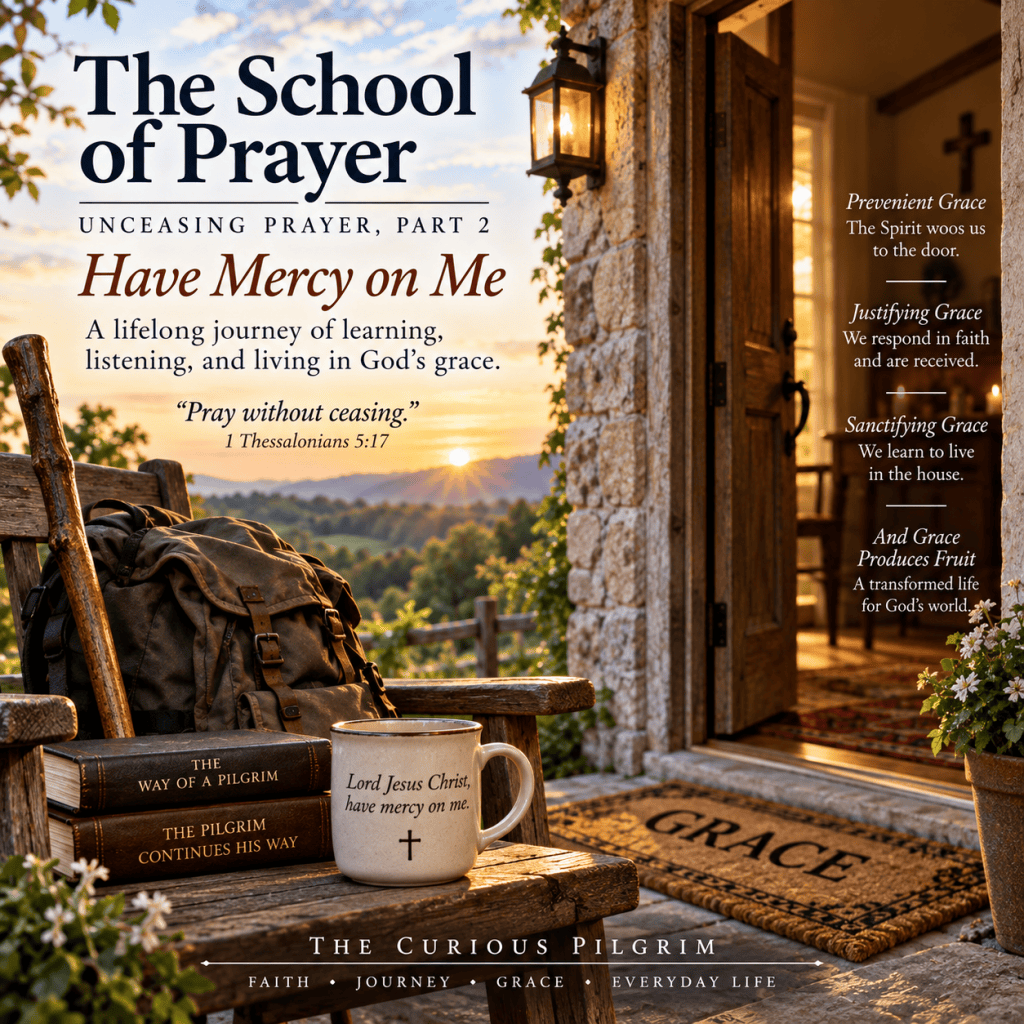
In the Sixth Meeting of The Pilgrim Continues His Way, the Pilgrim and the Professor find themselves in a school of prayer.
Their teacher is the Skhimnik.
As I read their conversation, I found myself returning to another classroom from many years ago.
I spent a semester at Free Will Baptist Bible College in a class called With Christ in the School of Prayer. My teacher was Laura Belle Barnard, who had served for more than thirty years as a missionary.
I thought I knew how to pray.
I had been going to church since I was two weeks old. I had heard prayer after prayer. I had memorized the Lord’s Prayer. Prayer was part of the world in which I had grown up.
Then I sat in Professor Barnard’s classroom.
When she prayed, I felt as though I were in the presence of God.
There was something different about her prayer. It wasn’t simply the words she used. Prayer seemed to come from a relationship with God that went deeper than words.
I was amazed by what I experienced.
But when the semester ended, something happened.
My prayer life gradually returned to many of the routines and practices I had followed before taking the class.
I had been in the School of Prayer.
But I had not graduated.
It has taken me many years to understand that perhaps none of us ever does.
Becoming a Child Again
Jesus told his disciples in Matthew 18 that they must change and become like children.
A child is still learning.
A child asks questions.
A child depends upon another.
A child receives.
And perhaps most importantly, a child can still be taught.
I have always had a hunger and thirst for righteousness. I have wanted to live as I should.
I haven’t always done that.
But the grace of God has continued to teach me.
That is something I understand better today than I did when I was sitting in Professor Barnard’s classroom.
The Christian life is not a course we complete.
We grow in grace.
And apparently, the School of Prayer lasts a lifetime.
The Lesson That Troubled Me
There was one teaching about prayer that remained especially difficult for me.
Paul writes in 1 Thessalonians 5:16–18:
Rejoice always. Pray without ceasing. Give thanks in all circumstances.
Pray without ceasing.
I understood the words.
I just didn’t know how to do it.
How can anyone pray all the time?
There is work to do.
There are people who need our attention.
There are meals to eat, places to go, responsibilities to meet, problems to solve, conversations to have, books to read, and ordinary tasks that fill our days.
How am I supposed to spend time with God when there are so many other things I must do?
For years, “pray without ceasing” seemed almost impossible.
Then, during the last few years, I became more conscious than ever that I am a pilgrim on a journey.
And somehow my journey brought me to another classroom.
This time my classmates were a Russian Pilgrim and a Professor.
Our teacher was a Skhimnik.
And once again the lesson was prayer.
Back in the School of Prayer
The Way of a Pilgrim and The Pilgrim Continues His Way introduced me more deeply to the Jesus Prayer:
Lord Jesus Christ, have mercy on me.
As I have been reading the Sixth Meeting, I have begun to see something I could not see before.
I am learning how to pray without ceasing.
Notice what I said.
I did not say:
I have learned how to pray without ceasing.
I said:
I am learning.
I am still the child.
I am still the student.
I am still the pilgrim.
And the Holy Spirit is still the teacher.
Have Mercy on Me
In the first reflection in this series, I came to an important realization:
Before there is unceasing prayer, there is unceasing grace.
The Holy Spirit woos us into prayer.
I picture grace as a house.
Prevenient grace woos me from the street, brings me up the steps, onto the porch, and toward the door.
And there I stand.
What should I pray?
Perhaps the first prayer in the School of Prayer is one of the simplest:
Lord Jesus Christ, have mercy on me.
It echoes the publican in Jesus’ parable in Luke 18.
He didn’t approach God with a list of accomplishments.
He simply recognized his need for mercy.
And Jesus said that he went home justified.
That word matters to me.
Justified.
Standing at the door, I am not trying to earn God’s love.
Grace brought me here.
The Spirit has already been wooing me.
My prayer is a response:
Lord Jesus Christ, have mercy on me.
In faith, I open the door and step across the threshold—not because my prayer has earned my entrance, but because God’s justifying grace receives me and restores the relationship.
The prayer isn’t a password that opens a locked door.
It isn’t an incantation.
It isn’t a formula that forces God to do something.
It is the prayer of a child responding to grace.
And once I have crossed the threshold, grace does not stop. I have entered a house in which I will spend the rest of my life learning how to live. That is sanctifying grace.
The Spirit Helps Us
There is another Scripture that means more to me now.
Paul tells us in Romans 8 that we do not know how to pray as we ought.
After all these years, I find those words comforting.
I don’t have to pretend that I have mastered prayer.
Paul continues by telling us that the Spirit helps us in our weakness.
There is grace again.
The Holy Spirit doesn’t simply command me to pray and then leave me alone to figure out how.
The Spirit who woos me into prayer also teaches me how to pray.
That changes the question.
Instead of asking:
How can I possibly stop everything and pray every minute of every day?
I am beginning to ask:
How can prayer become part of the way I live everything else?
That is a very different question.
Prayer Like Breathing
I am beginning to understand why the Jesus Prayer can become unceasing prayer.
I can pray:
Lord Jesus Christ, have mercy on me
while walking.
While driving.
While waiting.
Before a difficult conversation.
When I am frustrated.
When I am frightened.
When I realize I have done something wrong.
When I am grateful.
When I simply become aware that God is near.
And sometimes I don’t need words at all.
I can sit quietly.
I can listen.
I can breathe.
Prayer is not always speaking.
Sometimes prayer is emptying myself and becoming aware of the God who is already present.
The Spirit—the Breath of God—sustains me.
Perhaps prayer can become something like breathing.
I don’t stop living in order to breathe.
Breathing accompanies everything else I do.
Maybe that is part of what I have been missing about Paul’s words:
Pray without ceasing.
Prayer does not have to remove me from ordinary life.
Prayer can become part of how I live ordinary life in relationship with God.
Still a Student
Many years ago, I sat in Laura Belle Barnard’s classroom and experienced something I did not fully understand.
When she prayed, I felt that I was in the presence of God.
Then the semester ended.
Life continued.
Years became decades.
But grace continued teaching me.
Now my pilgrimage has brought me into another classroom with the Pilgrim, the Professor, and the Skhimnik.
And somehow I find myself back where I was all those years ago.
With Christ in the School of Prayer.
Only now I understand something I didn’t understand then.
I don’t have to graduate.
I don’t have to master prayer.
I don’t even have to pretend that I know how to pray as I ought.
The Spirit helps me.
The Spirit teaches me.
Grace continues to form me.
And I am learning.
One prayer.
One breath.
One step at a time.
So today I will begin again with the prayer of a child standing at the door:
Lord Jesus Christ, have mercy on me.
I am still a student.
I am still a pilgrim.
And by the grace of God, I am still learning to pray.
 The Curious Pilgrim
Leave a comment