Daily Office Readings — Tuesday, September 15, 2026
Psalms 61, 62, 68; Job 40:1, 41:1–11; Acts 16:6–15; John 12:9–19
Source: The Book of Common Prayer, Proper 19, Year Two
Sometimes we think we know what power looks like.
Power wins battles. Power controls circumstances. Power gets its way. Power removes obstacles.
But today’s readings invite us to look again.
In Psalm 61, David is overwhelmed and desperate.
“Listen to my cry, O God, and hear my prayer.”
David does not pretend to be strong when he isn’t. He asks God to lead him to the rock that is higher than he is. He describes God as a strong tower—a safe place, a refuge from everything surrounding him.
David can trust God in the present because he remembers God’s faithfulness in the past.
Psalm 62 takes us a little further.
David has discovered that people, wealth, and human power cannot provide lasting security. People deceive. Wealth disappears. Positions of power change.
So David says, “Put your trust in him always, O people.”
There are things we cannot control.
There are people we cannot control.
There are circumstances we cannot control.
But we can choose where we place our trust.
Then Psalm 68 celebrates the tremendous power of God. But notice how God’s power is used.
God is the father of the fatherless and defender of widows. God gives the lonely a home and leads prisoners into freedom.
God’s power is not simply power used to dominate others.
God’s power protects the vulnerable.
Then we meet Leviathan in Job 41.
Job is confronted with something he cannot control. He cannot defeat Leviathan. He cannot tame it. He cannot master it.
But God can.
Job is learning something all of us eventually have to learn: there are realities greater than we are.
Sometimes chaos seems overwhelming.
Sometimes life presents us with something we cannot fix.
Faith does not mean chaos isn’t real.
Faith means chaos isn’t God.
What overwhelms me does not overwhelm God.
Then we travel with Paul, Silas, and Timothy on Paul’s second missionary journey.
Paul has plans.
He tries to go into Asia, but the Holy Spirit prevents him. He tries another direction toward Bithynia, and that door closes too.
Eventually they arrive at Troas.
During the night, Paul has a vision. A man from Macedonia is pleading with him:
“Come over to Macedonia and help us.”
Paul and his companions conclude that God is calling them to Macedonia.
So they go.
But here is something fascinating.
Paul sees a man in his vision.
When he arrives in Macedonia, one of the first people God places before him is a woman named Lydia.
They find her beside a river with other women who have gathered for prayer.
Paul speaks.
Lydia listens.
And the Lord opens her heart.
Grace is working, but Lydia still responds. She believes, is baptized with her household, and opens her home to Paul and his companions.
Paul had received guidance, but he did not receive the entire itinerary.
He had to walk the road before he discovered where it led.
Finally, John takes us to Jerusalem.
Passover is approaching.
Crowds are gathering around Jesus, partly because they have heard what happened to Lazarus. Lazarus is alive, and his very presence testifies to what Jesus has done. The religious authorities are so disturbed that they begin considering how to get rid of Lazarus too.
Then Jesus enters Jerusalem.
The people wave palm branches.
“Hosanna!”
“Blessed is the King of Israel!”
Here comes the King.
But look at him.
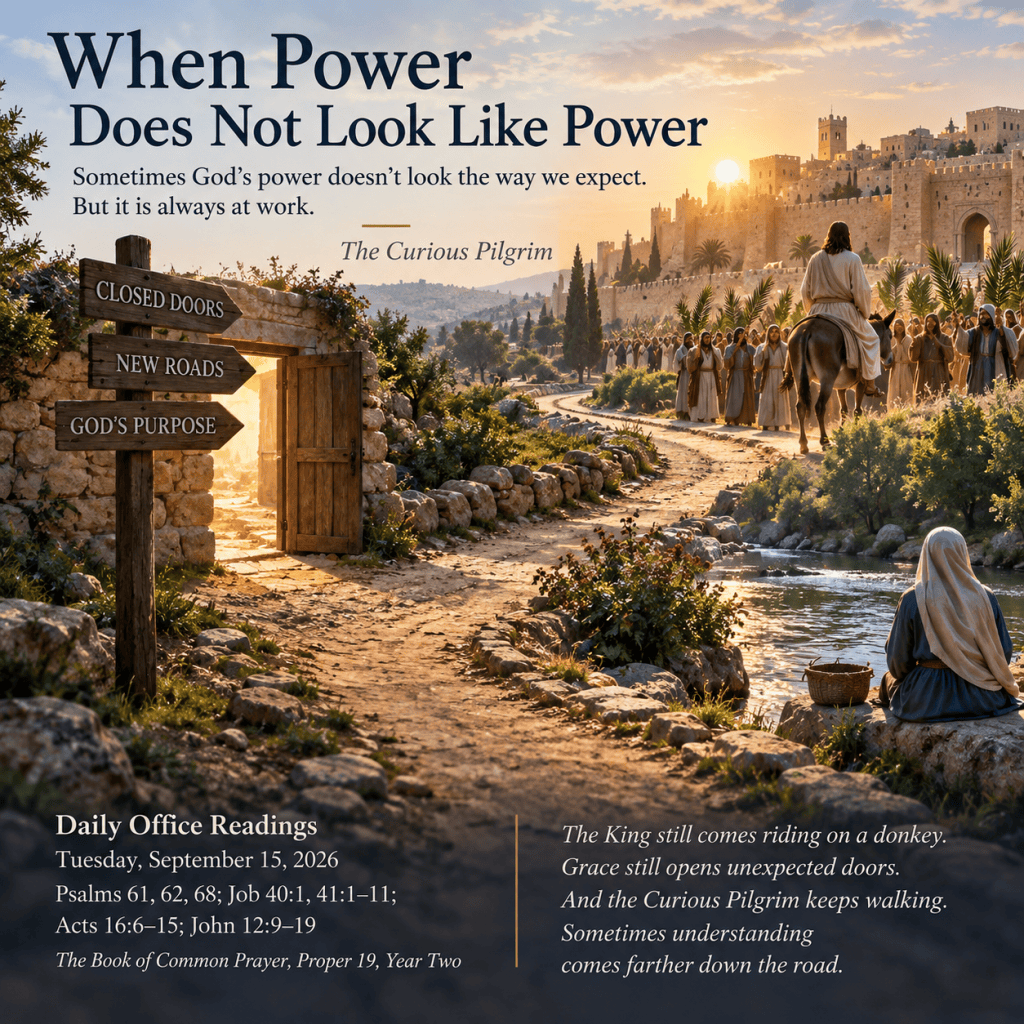
He isn’t riding a warhorse.
There isn’t an army marching behind him.
He is riding a young donkey.
The people recognize a king, but they do not yet understand what kind of King is riding past them.
In fact, John tells us that even Jesus’ disciples did not understand everything they were witnessing at the time. Only later would they put the pieces together.
And perhaps that is where all these readings meet.
God’s power does not always look the way we expect power to look.
David discovers power while seeking refuge.
Job discovers power when confronted by something he cannot control.
Paul discovers power through closed doors, an unexpected vision, and a woman praying beside a river.
The crowd in Jerusalem sees power riding toward them on a donkey.
And the disciples discover that sometimes we recognize what God was doing only after we have traveled farther down the road.
That has certainly been true on my pilgrimage.
There have been times when I wanted God to remove the obstacle, change the circumstances, open the door, or show me exactly what was going to happen next.
Sometimes the door opened.
Sometimes it remained closed.
Sometimes another door appeared where I wasn’t even looking.
And sometimes I understood what God was doing only much later.
Perhaps faith is not having enough power to control everything around us.
Perhaps faith is learning to trust the One who is our rock when we are overwhelmed, our refuge when human security fails, the One greater than the chaos we cannot master, and the One who continues working even when we cannot yet understand what is happening.
The King still comes riding on a donkey.
Grace still opens unexpected doors.
And the Curious Pilgrim keeps walking.
Sometimes understanding comes farther down the road.
 The Curious Pilgrim
Leave a comment