
Daily Office Readings — Monday, September 14, 2026
Psalms 56, 57, 58, 64, 65; Job 40:1–24; Acts 15:36–16:5; John 11:55–12:8
Some days I can read familiar passages of Scripture and suddenly see something I have never seen before. Today was one of those days.
I have read these Psalms many times, but today I saw the anguish differently because I also saw the grace.
In Psalm 56, David has been seized by the Philistines. He cries out to God for mercy. Then he says:
“When I am afraid, I will put my trust in you.”
Notice that David doesn’t say, “Because I trust God, I am never afraid.”
He says, “When I am afraid.”
Fear and trust can exist in the same person.
In Psalm 57, David is hiding in a cave while Saul is pursuing him. Yet from inside the cave, David praises God. His circumstances haven’t changed. Saul is still pursuing him. David is still hiding.
But grace is in the cave.
Psalms 58 and 64 deal with injustice, corrupt rulers, enemies, secret plots, and the longing for God to make things right. Then Psalm 65 breaks forth in praise. God cares for the earth. The land produces its harvest. There is abundance.
These Psalms sound like life to me.
There are good days and bad days. There are disappointments. There are times when people misunderstand us. There are times when we are afraid. There are periods of depression and despair. There are times when we cannot understand what is happening.
I have had my caves.
I have also taken some detours.
Looking back, however, I can see something I couldn’t always see while I was living through those experiences.
Grace was there.
The mystery isn’t whether grace exists. The mystery is that, years later, we sometimes discover it was working in places where we could not see it at all.
We continue looking through the tinted glass.
Then we come to Job.
God tells Job to brace himself. In the Southern United States, we might say:
“Job, you ain’t seen nothing yet!”
God describes the enormous power of Behemoth and then, in the following chapter, Leviathan. Job has been demanding answers from God. His friends have offered their answers, insisting that Job’s suffering must somehow be Job’s fault.
But Job knows their explanation doesn’t fit.
God doesn’t give Job the neat explanation he has been demanding. Instead, God expands Job’s vision.
Job knows his suffering. He knows his grief. He knows his questions.
But Job doesn’t know everything.
God seems to be saying, “Job, there is far more happening in my creation than you can possibly see.”
Job matters to God. His suffering matters to God. But Job is not God.
Again, we have mysterious grace.
Our inability to see what God is doing does not mean God has stopped working.
Then Acts gives us another wrinkle.
Paul and Barnabas have a disagreement about John Mark. Barnabas wants to take Mark on their next missionary journey. Paul doesn’t. Their disagreement becomes so sharp that they separate.
Disagreements happen.
We are human.
Churches have divided over doctrine, organization, personalities, money, buildings, and sometimes remarkably small things. I once served a church that had split over whether to burn the mortgage papers or frame them after the mortgage was paid.
I grew up attending a church that had split. People referred to the congregations as the “Old” and the “New,” followed by the same church name.
I once believed we could explain divisions among Christians by saying that God uses denominations and sects to keep God’s Word and work pure.
I see it differently now.
I don’t believe we have to call our divisions the work of God in order to recognize that God continues working through them.
Paul and Barnabas disagreed.
Barnabas took Mark.
Paul took Silas.
The Gospel continued.
God works around, through, and sometimes in spite of our humanity.
Our ego cannot stop the Holy Spirit.
Our stubbornness cannot stop the Holy Spirit.
Our disagreements cannot stop the Holy Spirit.
Our denominational divisions cannot stop the Holy Spirit.
That doesn’t make those things good. It means they don’t get the final word.
Then Paul does something else that has always interested me.
He circumcises Timothy.
The Jerusalem Council has just determined that Gentile believers do not have to be circumcised. Yet Paul has Timothy circumcised because Timothy has a Jewish mother and because Paul knows they will be ministering among Jewish communities.
In the business world, we might call that a workaround.
Timothy’s circumcision wasn’t necessary for God’s grace. Paul apparently believed it would remove an obstacle to their ministry.
Was Paul’s decision necessary? We can discuss that.
But God’s grace didn’t depend upon it.
And this is where something became very clear to me today:
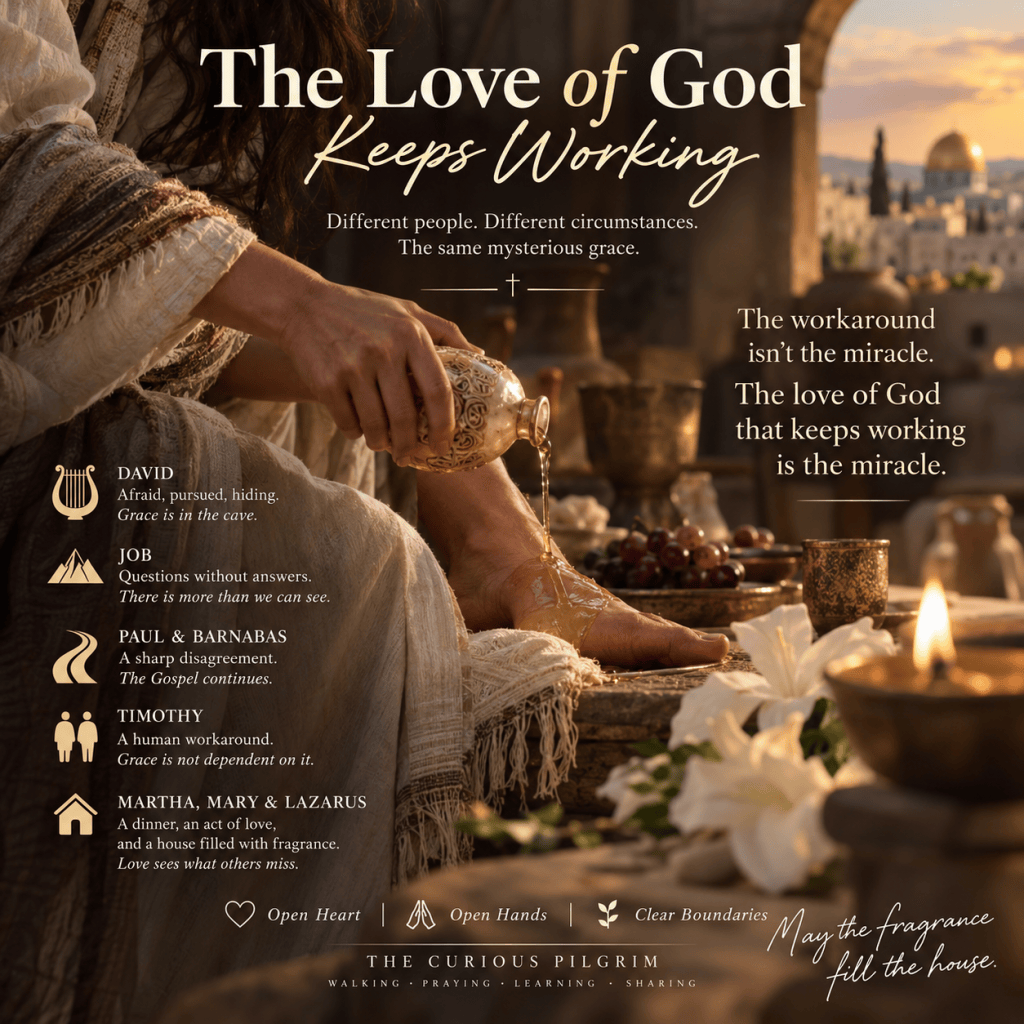
The workaround isn’t the miracle. The love of God that keeps working is the miracle.
God desires that none should perish.
God loves humanity.
Therefore, the Holy Spirit continues the work of grace.
That is why I can fellowship with people who don’t agree with me about everything. I don’t have to change them.
The Holy Spirit does the work of grace, not me.
I am simply called to bear witness.
Sometimes I am the mouthpiece.
Sometimes I need to listen.
Sometimes I need to learn.
Sometimes I need to set a boundary.
And sometimes I simply need to get out of the Holy Spirit’s way.
I have been seeing this repeatedly in The Way of a Pilgrim and The Pilgrim Continues His Way. The Pilgrim keeps walking and encountering people. Sometimes he gives something to them. Sometimes they give something to him. Sometimes the harvest from one encounter becomes seed planted in another person’s ground.
Grace moves in both directions.
Then John gives us one final picture.
It is almost Passover. People are arriving in Jerusalem, and everybody seems to be talking about Jesus.
Will he come?
The religious leaders are looking for him too. They have ordered people to report his whereabouts.
Meanwhile, Jesus is at a dinner given in his honor with Martha, Mary, and Lazarus.
Martha serves.
Lazarus, the man who had been dead, sits at the table.
And Mary takes expensive perfume and anoints Jesus’ feet.
Judas complains about the waste.
Everyone is looking at the same Jesus, but they aren’t seeing the same thing.
Mary sees someone worthy of extravagant love.
Judas sees wasted money.
The crowds see the man who raised Lazarus.
The religious authorities see a threat.
And eventually Lazarus himself becomes a target because his life testifies to what Jesus has done.
They want to kill the evidence of life.
Yet in the middle of all of this stands Mary.
She doesn’t argue.
She doesn’t try to control Judas.
She doesn’t confront the religious authorities.
She pours out what she has in love.
And John gives us one beautiful detail:
The house was filled with the fragrance of the perfume.
Maybe that is where today’s readings leave me.
I don’t have to control what God is doing.
I don’t have to understand everything God is doing.
I don’t have to make everybody agree with me.
I don’t have to manufacture grace.
The Holy Spirit does the work.
I am called to trust when I am afraid, praise God from the cave, remain humble when I cannot understand, love people through disagreements, bear witness to grace, and pour out whatever God has placed in my hands.
Sometimes I will only see through the tinted glass.
Sometimes I may take a detour.
Sometimes I may need a workaround.
But none of those things is the miracle.
The love of God that keeps working is the miracle.
So perhaps my prayer today is very simple:
Lord, let me be like Mary.
Let me pour out what you have given me in love,
and trust your Holy Spirit with what happens next.
May the fragrance fill the house.
Open Heart. Open Hands. Clear Boundaries.
 The Curious Pilgrim
Leave a comment