
The Curious Pilgrim — American Saints
September 14, 2026
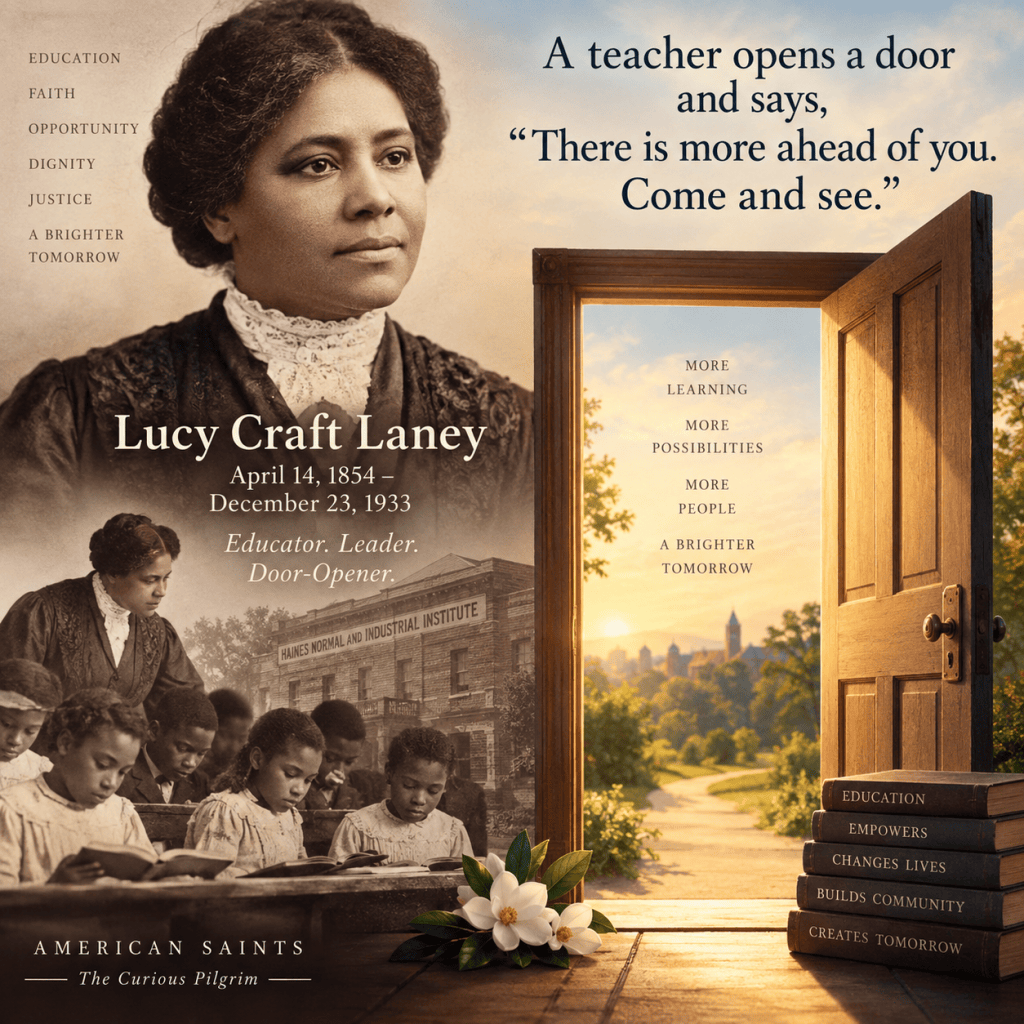
Lucy Craft Laney
April 14, 1854 – December 23, 1933
Source: A Year with American Saints, G. Scott Cady and Christopher L. Webber, Church Publishing, 2006
I will never forget something that happened when I was about five years old.
Minnie Wally patted me on the head and told me, “You are going to be a preacher just like your daddy.”
I quickly answered, “No way. I want to be a teacher.”
I hadn’t even started school yet. I don’t know where that desire came from. But all these years later, I smile when I remember it.
I did eventually become a preacher. But I also became a teacher.
Perhaps that little five-year-old boy understood something about his calling long before he had the words to explain it.
I thought about that memory as I read the story of Lucy Craft Laney.
Lucy was born in Macon, Georgia, in 1854, the seventh of ten children of David and Louisa Laney. Her parents had been enslaved, but her father saved enough money to purchase his own freedom and then the freedom of his wife years before Lucy was born.
So Lucy was born free.
Her parents were people of faith who believed strongly in education. Lucy learned to read before she was four years old. She eventually attended a high school established in Macon and became a member of the first graduating class of Atlanta University.
She spent ten years teaching in Georgia’s public schools, but she became dissatisfied with the limited education being offered to Black students.
Lucy believed they deserved more.
So in 1883, she opened a school of her own in Augusta, Georgia.
She began with six students.
By the end of the second year, she had 234.
The school eventually became the Haines Normal and Industrial Institute, and by 1928 its enrollment had grown to more than 800 students.
One of its early teachers was Mary McLeod Bethune, who would become another great educator and leader.
Lucy Laney also worked beyond the classroom. She helped establish a local chapter of the NAACP and was involved with the National Association of Colored Women. She understood that education was about more than books and classrooms. It was about dignity, opportunity, freedom, and opening possibilities that society had tried to close.
Her story speaks deeply to me.
I would never compare my journey with Lucy Laney’s. The discrimination and racial prejudice she confronted as a Black woman in the American South belonged to a history very different from mine.
But I understand something of her love for education and the influence of parents who believed their children should learn.
Neither of my parents finished high school. Yet they expected all five of their children to finish high school and go beyond it.
I became the first college graduate in my family.
When my father died and I later felt called to preach, I decided to attend Free Will Baptist Bible College in Nashville. Some people in the church told me:
“You don’t need to go to college. God will fill your head with everything you need to know.”
But something inside me knew better.
I didn’t know how I was going to pay for college. Somehow, I kept going, and I graduated without college debt.
And I kept learning.
Looking back now, I realize that I have had the extraordinary privilege of sitting in the classrooms of many ordinary people who devoted themselves to teaching.
They opened doors for me that I didn’t even know were there.
That may be one of the greatest gifts a teacher gives another human being.
A teacher opens a door and says, “There is more ahead of you. Come and see.”
Lucy Laney opened that door for thousands.
And those students opened doors for others.
That makes me think again about something I have been learning lately: the harvest becomes seed again.
Someone planted the seed of education in Lucy Laney.
Her parents planted.
Her teachers planted.
Others helped provide opportunities for her.
Lucy received that harvest, but she didn’t keep it for herself.
She planted it again.
Six students became 234.
Two hundred thirty-four became hundreds more.
And those students carried what they had received into families, churches, communities, classrooms, and another generation.
The same pattern can be seen in the lives of Mary McLeod Bethune, Sojourner Truth, Frederick Douglass, and so many others. Slavery, discrimination, and prejudice tried to tell them where the boundaries of their lives were supposed to be.
They refused to let those boundaries have the final word.
And they didn’t struggle merely to make their own lives better. They helped make life better for those who came after them.
We need more people like that.
We need teachers who open doors.
We need parents who tell their children, “You can go farther than I was able to go.”
We need people who receive an opportunity and then turn around and create an opportunity for somebody else.
And perhaps we need to remember the teachers who opened doors for us.
Some of their names may never appear in history books.
They may have considered themselves ordinary people simply doing their jobs.
But somewhere there is a student whose world became larger because a teacher looked at them and said:
“There is more ahead of you. Come and see.”
Lucy Craft Laney spent her life saying those words—not merely with her voice, but with her life.
May those of us who have walked through doors opened by others have the grace to hold a few of them open for those coming behind us.
The harvest becomes seed again.
The Curious Pilgrim
 The Curious Pilgrim
Leave a comment