
The Pilgrim Continues His Way
The Sixth Meeting
The Pilgrim and the Professor
Source: The Pilgrim Continues His Way, translated by Olga Savin, Shambhala, 2001
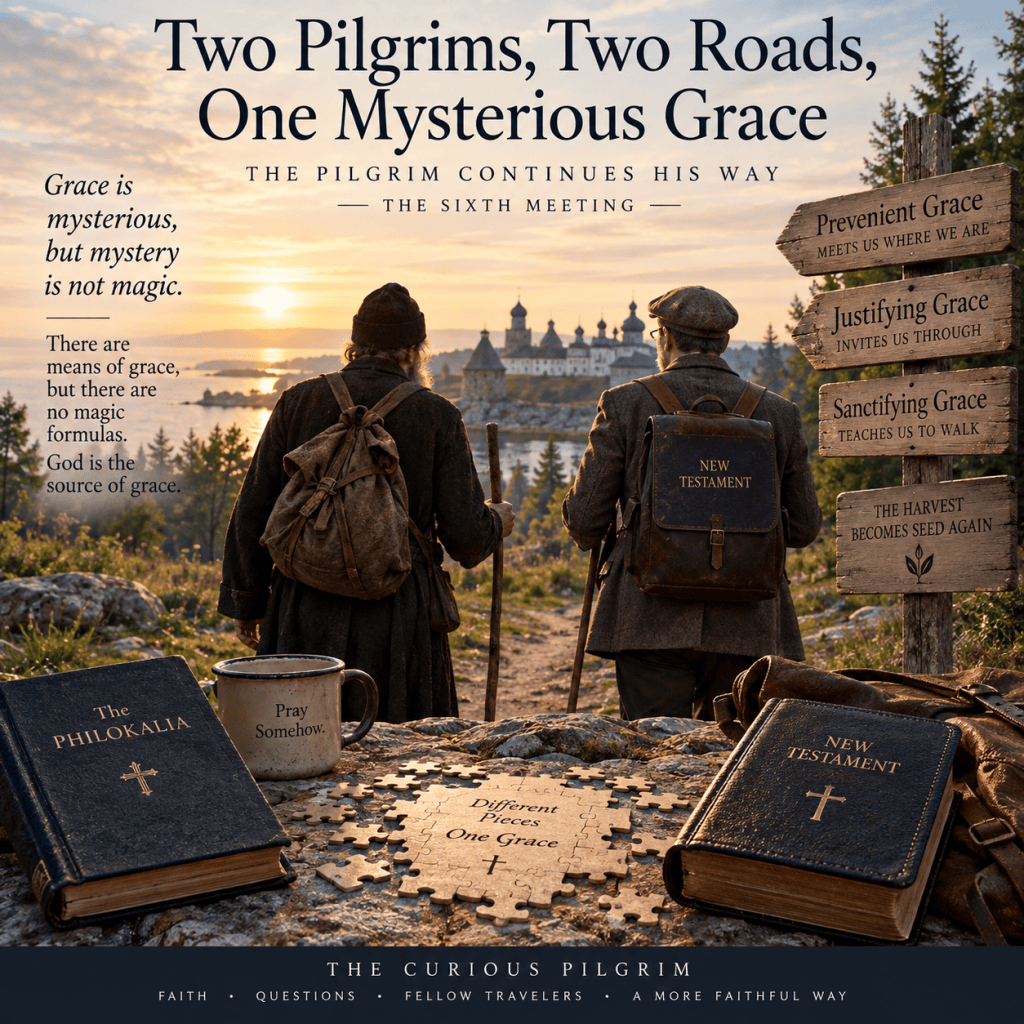
At the end of the Fifth Meeting, the Pilgrim is traveling with a man he calls the Barin, a gentleman. They are headed toward the Anzersky Skete associated with the Solovetsky Monastery on the White Sea.
The Barin is not accustomed to walking as the Pilgrim is, and eventually his feet hurt so badly that he hires a cart and a pair of horses. They stop for three days to rest before continuing their journey.
At the beginning of the Sixth Meeting, something changes.
The Barin becomes known to us as the Professor.
The Pilgrim has apparently already told a Starets—an elder monk—about his traveling companion. The Starets wants to meet him. When they gather the following day with a Skhimnik and a priest, the Starets asks the Professor how this great and devout mystery was revealed to him.
And then we discover that the Professor is a pilgrim too.
Two Very Different Roads
The Professor had taught at a Lyceum, or high school, and had become deeply involved in secular philosophy. His devout mother and sister lived with him.
One day, while taking a walk, he met a Frenchman from Paris who was looking for employment as a tutor. The Professor invited him into his home, and for about two months the two became almost constant companions.
Their companionship was not always wholesome.
Then something very strange happened.
One day the Frenchman was talking about visiting a place of questionable morality when he suddenly became uncomfortable. He said he could not continue the conversation in the presence of the New Testament sitting on the Professor’s bookshelf.
He asked the Professor to remove it.
When the Professor brought the New Testament near him, the Frenchman trembled and disappeared.
The Professor was so terrified that he fainted.
What are we to make of such a story?
I don’t know.
And I am comfortable saying that.
In fact, I want to be very careful here.
I do not believe the New Testament is a magic object. A Bible is not an amulet to ward off evil. Neither is a cross. Holy oil is not a magic potion. The Jesus Prayer is not an incantation.
Grace is mysterious, but mystery is not magic.
There are means of grace, but there are no magic formulas.
God is the source of grace.
A means of grace opens us to God. It does not give us control over God.
That distinction is important to me. I believe in anointing with oil. I believe in prayer, Scripture, Baptism, Eucharist, Christian fellowship, and other means through which God ministers grace to us. But the power does not reside magically in an object or in our ability to say the right words.
The power belongs to God.
And God remains greater than our ability to understand God.
What Happened Afterward Matters
The Professor became seriously ill after this strange experience. He was terrified and paralyzed and remained confined to bed for about a year.
During that time his mother died, his sister entered a monastery, and he resigned from his teaching position.
Yet there was one thing that brought him consolation:
the New Testament.
Then a hermit visited him and encouraged him to ask God for healing. The hermit told him that prayer was a powerful means of healing the illnesses of body and spirit.
The Professor objected that he didn’t even know how to pray. He could not even make the sign of the Cross.
The hermit’s counsel was wonderfully simple:
Pray somehow.
Now the Professor did what a professor knew how to do.
He studied.
He remembered learning as a student that Christian teaching about prayer was grounded in the New Testament. So he began searching the New Testament for passages concerning prayer. He marked them. He studied them carefully.
But he didn’t stop with studying them.
He practiced what he discovered.
Day after day, study became prayer, and prayer became practice.
Eventually he recovered.
Filled with gratitude to God, he now wanted to understand the contemplative life and salvation more deeply. That is why he was traveling toward the Solovetsky Monastery.
And that is where his road crossed the road of another pilgrim.
Two Pilgrims Carrying Different Pieces
The Pilgrim and the Professor could hardly be more different.
The Pilgrim has learned prayer largely through wandering, listening, practicing the Jesus Prayer, learning from his Starets, reading the Philokalia, and paying attention to what happens along the road.
The Professor approaches prayer as a scholar.
He searches the New Testament.
He identifies passages.
He studies them.
He reasons about them.
Then he puts what he learns into practice.
The Pilgrim carries the Philokalia.
The Professor carries the New Testament.
Neither carries the whole puzzle.
And perhaps that is exactly why they need each other.
They meet on the road, share what they have learned, and now they are going together to listen to the Starets, the Skhimnik, and the priest.
More pieces are about to be placed on the table.
Prevenient Grace Meets Us Where We Are
As I read their stories side by side, I see something beautiful about the prevenient grace of God.
God’s grace begins working before we understand what is happening.
The Holy Spirit woos us.
But God does not begin with everybody at the same place because we are not all the same.
Grace met the Pilgrim in his hunger to understand what it meant to “pray without ceasing.”
Grace met the Professor through a very different road of intellectual searching, crisis, suffering, Scripture, study, and prayer.
Grace starts where we are, not where somebody else thinks we ought to be.
And prevenient grace does something else.
It brings fellow travelers.
The Pilgrim needed his Starets.
The Professor needed the hermit who told him simply to pray.
Then the Professor needed the Pilgrim.
And perhaps the Pilgrim needed the Professor too.
Now both need something the Starets, Skhimnik, and priest may have to share.
Sometimes two pilgrims meet because each is carrying a piece of the puzzle the other needs.
I Know Something About That Road
I recognize this because I have experienced it.
I began reading the Bible when I was eight years old.
Along the way there were Sunday school teachers and pastors who taught me what they understood to be true.
Then I went to college.
Professors opened doors for me. Fellow students carried pieces I did not have. Later there would be still more teachers, experiences, questions, books, conversations, and fellow travelers.
Looking backward, I can see things I could not see while they were happening.
That is part of the mystery of grace.
I cannot see grace with my eyes.
I cannot hear it with my ears, smell it, taste it, or hold it in my hand.
And I certainly cannot explain completely how an infinite God works within the life of a finite human being.
I don’t think any of us can.
But when I look backward over the road I have traveled, I can see places where God was already at work before I knew to call it grace.
That does not mean I believe God caused everything that happened to me.
I don’t.
It means I believe God’s grace can meet us in whatever happens.
And grace invites a response.
The Door
I think of prevenient grace as bringing us toward a door.
God’s grace awakens us.
Grace woos us.
Grace gives us light for the road.
Grace brings fellow travelers.
Grace gives us Scripture, prayer, teachers, tradition, reason, experience, and other means of grace.
But grace does not force us through the door.
We must choose to respond.
When we respond in faith and walk through that door, we experience justifying grace—forgiveness, reconciliation, and restored relationship with God.
And even then the pilgrimage isn’t finished.
On the other side of the door waits sanctifying grace, continually transforming us in love.
Prevenient grace gets us on the road.
Justifying grace brings us through the door.
Sanctifying grace teaches us how to walk on the other side.
And all of it is gift.
The Harvest Becomes Seed Again
Perhaps that is what I love most about these two pilgrims.
Grace is never something we possess for ourselves.
It is gift.
And gifts are meant to be shared.
Someone helped the Pilgrim.
Someone helped the Professor.
Then the Pilgrim and Professor met one another.
Now they sit with other pilgrims who have still more to share.
Eventually something they receive may become something they give to somebody else.
The harvest becomes seed again.
That is how I increasingly understand my own pilgrimage.
I have pieces of the puzzle.
You have pieces.
The people who taught me had pieces.
The people I meet tomorrow may have pieces I need.
And perhaps, by the mysterious grace of God, I am carrying a piece somebody else needs.
So we keep walking.
We keep listening.
We keep learning.
We keep sharing.
Not because we possess God.
Not because we have discovered a magic formula.
But because somewhere along the road we have discovered that God’s mysterious grace was already there.
And when two pilgrims meet along the way, perhaps the best thing they can do is open their hands, place their pieces of the puzzle on the table, and say:
“This is what I have learned. What has grace taught you?”
The Curious Pilgrim
 The Curious Pilgrim
Leave a comment