
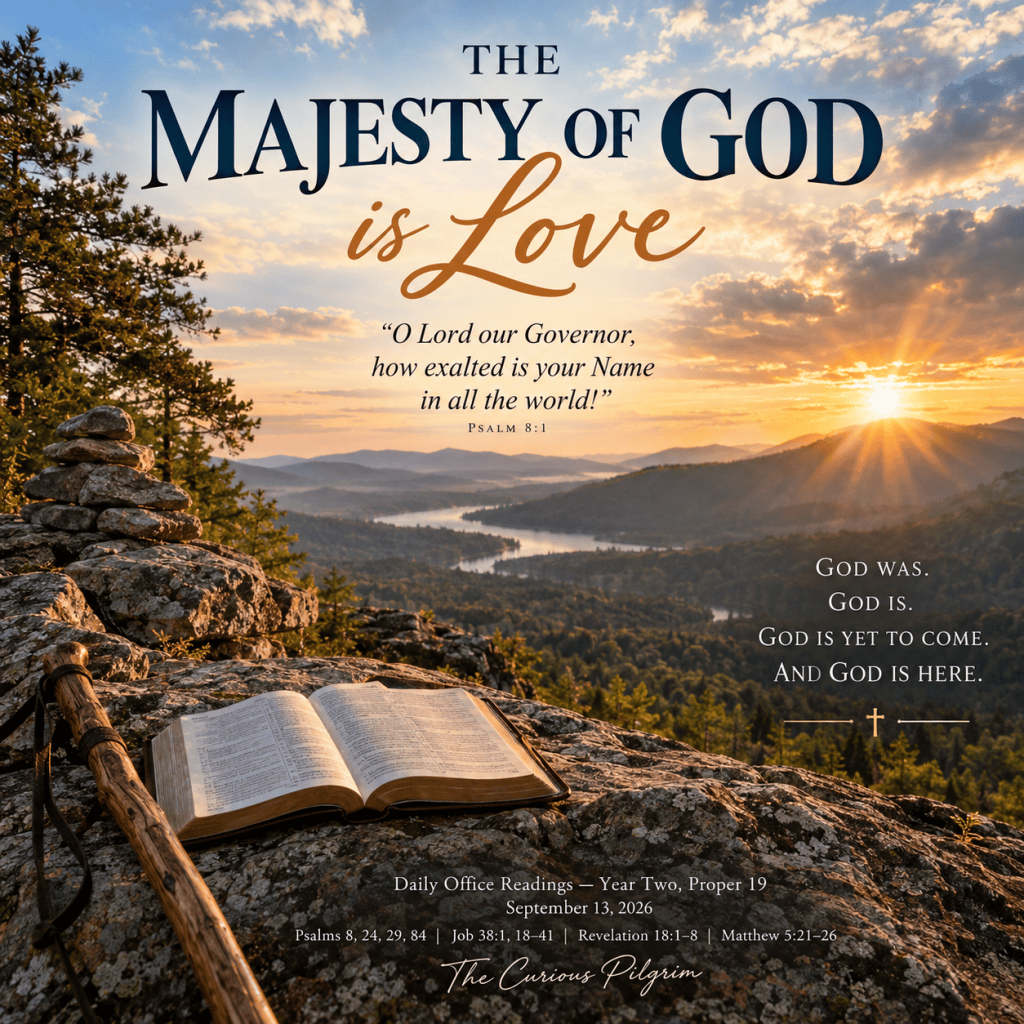
Daily Office Readings — Year Two, Proper 19
Sunday, September 13, 2026
Psalms 8, 24, 29, 84; Job 38:1, 18–41; Revelation 18:1–8; Matthew 5:21–26
Source: The Book of Common Prayer
I have been using the wrong week for my Daily Office readings. Today I discovered that I should be in Proper 19. Perhaps even that is part of being a pilgrim. Sometimes we discover that we have wandered onto the wrong path, correct our direction, and keep walking.
And what readings I found waiting for me!
When I read Psalm 8, I immediately thought about the majesty of God.
David looks at creation and cries out:
“O Lord our Governor, how exalted is your Name in all the world!”
God’s majesty fills the earth.
That reminded me of Michael W. Smith’s song Majesty. There is a line in that song about grace finding us exactly where we are and God’s love changing us forever. That moves me to tears because I know something about that kind of grace.
I also think about Sandi Patty singing about the majesty of Christ. There is coming a day when we will behold God’s majesty in ways that our eyes have not yet seen and our ears have not yet heard.
But Psalm 8 reminds me of something else:
God’s majesty is already here.
Look around.
Look at the heavens. Look at the earth. Look at humanity.
God created us with dignity and entrusted creation to our care. We are not the owners of creation. We are its stewards.
Psalm 24 makes that even clearer:
“The earth is the Lord’s and all that is in it, the world and all who dwell therein.”
Everything belongs to God.
And everyone belongs to God.
When I was a child, we sang that Jesus loved the children of the world regardless of the color of their skin. There was profound theology hidden in that little children’s song.
Indigenous peoples have also reminded us of something many of us have forgotten: the earth does not belong to us. We belong to the earth, and ultimately the earth belongs to the Creator. We are caretakers.
Psalm 24 then asks who may stand in God’s holy place.
Those with clean hands and pure hearts.
I understand clean hands as integrity—living what we profess to believe. A pure heart is a heart centered in loving relationship with God.
And we cannot separate loving God from loving others.
Jesus taught us to love God and to love our neighbors as ourselves. First John reminds us that we cannot claim to love God while refusing to love one another.
This is God’s plan:
Loving relationships with God, others, ourselves, and God’s creation.
And what should characterize those relationships?
Paul gives us a wonderful description in Galatians 5: love, joy, peace, patience, kindness, goodness, faithfulness, gentleness, and self-control.
Psalm 29 tells us:
“Worship the Lord in the beauty of holiness.”
What makes God holy?
We often describe holiness by saying God is perfect, pure, righteous, and incapable of evil. I believe that is true, but I think First John takes us even deeper:
God is love.
God is perfect love.
God’s justice flows from love. God’s mercy flows from love. God’s grace flows from love.
Creation itself flows from love.
God breathed into humanity the breath of life and gave us the freedom to choose whether we will live in love.
I remember the familiar story about the two wolves fighting within a person’s heart—one representing what destroys and the other what gives life. Which one becomes stronger?
The one we feed.
Every day we decide what we are going to feed within ourselves.
Psalm 84 takes us another step.
If we truly love God, we will long for God’s presence. Worship becomes more than an obligation. We desire communion with the One we love.
And here is something especially meaningful to me as a Curious Pilgrim:
God gives us strength for the journey.
Life is a pilgrimage.
Sometimes the road is beautiful. Sometimes it is confusing. Sometimes it hurts. Sometimes we don’t understand where God is leading us.
Job certainly didn’t.
Job wanted to know why he was suffering.
God answered him from the whirlwind:
Where were you when I established the world?
God does not really give Job the explanation Job wanted. Instead, God gives Job a vision of something much greater than Job’s immediate circumstances.
There are mysteries larger than our understanding.
We see through the glass darkly.
Sometimes the answer is simply:
I am God. I am that I am. Trust me.
Then Revelation 18 shows us Babylon falling.
Babylon represents the systems of this world that appear invincible. Governments, armies, weapons, wealth, commerce, institutions, and human power can convince us that they will last forever.
They won’t.
None of them gets the last word.
God does.
And after all this talk about majesty, creation, holiness, judgment, and the power of God, Jesus brings everything back to something very simple in Matthew 5.
Relationships.
If you come to worship God and remember that there is brokenness between you and another person, Jesus says to leave your gift at the altar and seek reconciliation.
Think about that.
Our relationship with God cannot be separated from the way we live in relationship with one another.
God’s great plan suddenly becomes remarkably simple.
Love God.
Love others.
Love yourself rightly.
Care for creation.
Live with integrity.
Seek reconciliation.
And keep walking.
That doesn’t mean the pilgrimage will always be easy. Job certainly teaches us otherwise.
But it does mean that we know the direction in which we are walking.
Perhaps that is what God’s majesty really looks like.
The majesty of God is not merely something we will behold someday.
We see glimpses of it right now whenever creation is cherished, people are loved, relationships are healed, grace is extended, mercy triumphs, and tired pilgrims receive enough strength to take another step.
God was.
God is.
God is yet to come.
And God is here.
O Lord, our Lord, how majestic is your name in all the earth.
Amen.
 The Curious Pilgrim
Leave a comment