
The Pilgrim Continues His Way
The Sixth Meeting — The Skhimnik Instructs
Scriptures: Matthew 13:1–23; Matthew 7:21; John 16:7–15; Romans 10:14–15; Ecclesiastes 3:1–8
Source: The Pilgrim Continues His Way, translated by Olga Savin, Shambhala, 2001
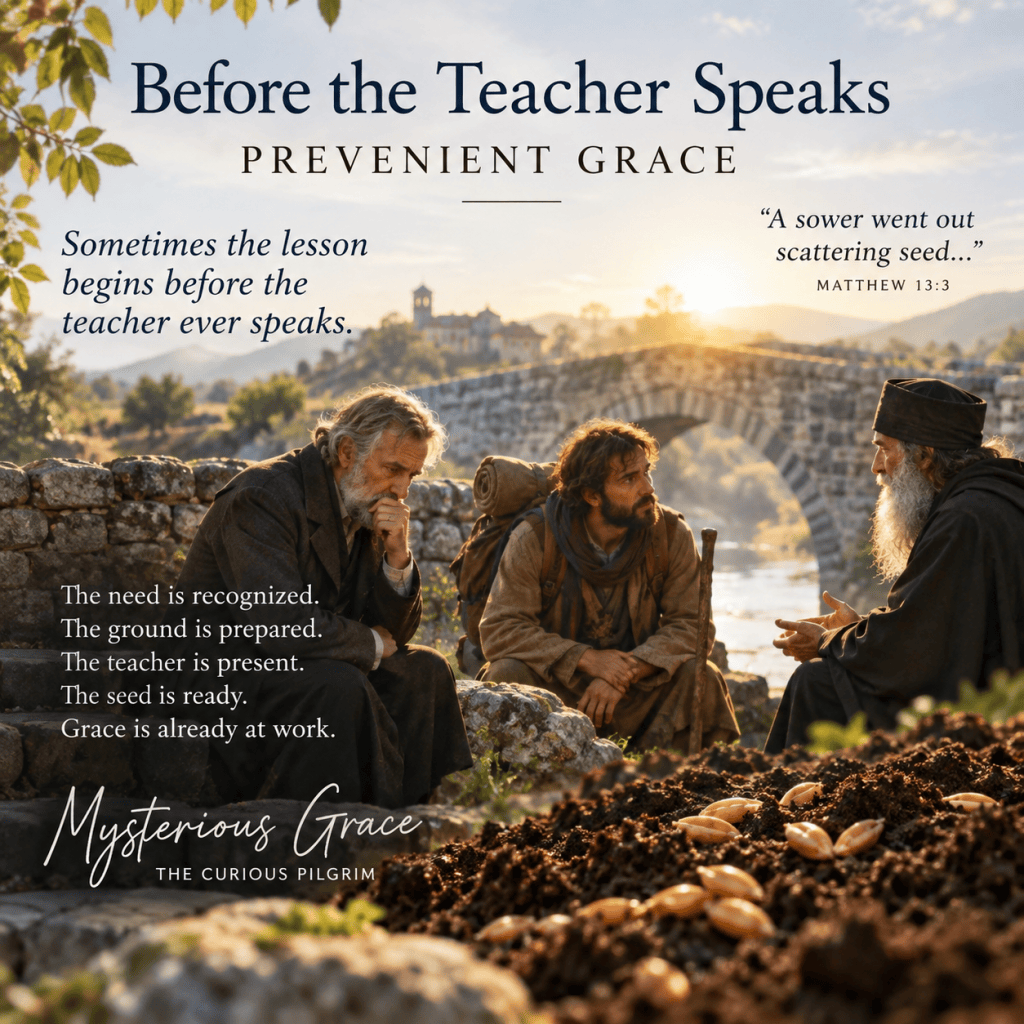
Sometimes a teacher begins teaching before saying a word.
That is what I see happening as we enter this part of the Sixth Meeting of The Pilgrim Continues His Way.
The Professor has been answering the Starets. He admits that he finds comfort in the New Testament, but he is frightened by the weakness and damaged condition of his own heart. When he considers everything that seems to be required for doing good and attaining salvation, he becomes overwhelmed.
He finds himself somewhere between despair and hope.
“I do not know what will become of me.”
There it is.
A teachable moment.
The Professor is an educated man. He is accustomed to knowing things and, presumably, to teaching others. His problem is not a lack of information. He has knowledge. He has studied. He has thought.
But his knowledge has brought him to the edge of a bridge.
On one side is what he knows. On the other is something unfamiliar that he has not yet learned how to understand or experience.
One of the basic principles of teaching is to connect the known with the unknown. A good teacher begins where the pupil is and helps the pupil cross the bridge toward something not yet understood.
But first the pupil must be willing to learn.
And suddenly the teacher has become the pupil.
There is a time and season for everything. There is a time to teach and a time to be taught. There is a time to speak and a time to listen. There comes a time when even the teacher must admit, “I don’t know.”
Then the Pilgrim joins the conversation.
Instead of sitting there thinking, “The Professor certainly needs this lesson,” the Pilgrim recognizes something in himself. He wants to hear the instruction too. He hopes that what he learns might help improve what he calls his lazy life, at least to some degree, for the glory of God and for his salvation.
Now there are two pupils.
And the Skhimnik has not even begun his instruction.
That is where I want to stop for a moment, because I think something important has already happened.
Jesus told the Parable of the Sower. A sower went out scattering seed. Some fell on the path. Some fell on rocky ground. Some fell among thorns. And some fell on good soil and produced a harvest.
Before we ask about the seed, we need to notice the soil.
The Professor’s struggle has broken open the ground. He knows something is missing. His knowledge alone has not carried him across the bridge. He recognizes his need.
The Pilgrim hears the Professor and recognizes his own need. He wants to learn. His ground is open too.
The soil is being prepared before the teacher ever plants the seed.
Then I hear Paul’s words in Romans:
How can people believe if they have not heard? And how can they hear without someone proclaiming?
Prepared soil still needs seed.
The Professor is ready to hear. The Pilgrim is ready to hear. And the Skhimnik is there to teach.
That does not mean either man will automatically receive what he hears. Jesus warned that simply crying, “Lord, Lord,” is not the same as living according to the will of God. Hearing is not the end of the process.
The seed must be received.
It must take root.
And eventually it must bear fruit.
This is where I see something even deeper happening.
This is prevenient grace.
Prevenient means “coming before.”
Before the Skhimnik teaches, grace is already at work.
Before the Professor receives an answer, he recognizes his need.
Before the Pilgrim hears the instruction, he realizes that he needs to hear it.
Before the seed is planted, the ground is being prepared.
Jesus said that the Holy Spirit would convict the world concerning sin, righteousness, and judgment and would guide people into truth.
That does not mean God forces anyone across the bridge.
Grace does not destroy free will.
The Holy Spirit awakens. The Holy Spirit illuminates. The Holy Spirit convicts. Grace enables us to respond.
But we must respond.
That is why I do not need to say that God caused the Professor and the Pilgrim to meet. We do not have to make every circumstance of life something God deliberately arranged.
They met.
And God was already there.
The Holy Spirit can work within an event without having caused the event.
That distinction has become increasingly important to me. God’s knowing does not mean God caused something to happen. God’s grace does not require God to manipulate human beings or circumstances.
Grace meets us where we are.
Perhaps that is what is happening here.
The Professor brings his knowledge, his questions, his fear, and his hope.
The Pilgrim brings his experience, his imperfections, and his desire to grow.
The Skhimnik brings what he has learned.
And somehow they find themselves together at precisely the kind of moment in which teaching can happen.
The writer may or may not have intended to give us a lesson in educational theory or Wesleyan theology. I cannot know that.
But he has written a remarkably good teachable moment.
The teacher has become the pupil.
The Pilgrim has joined him.
The ground has been opened.
The hearers are listening.
The teacher is present.
And the seed has not even been planted yet.
Sometimes we look for grace in the harvest.
Sometimes we recognize it when someone crosses the threshold.
But perhaps we should learn to look earlier.
Look at the ground being broken.
Look at the question being asked.
Look at the person finally willing to say, “I don’t know.”
Look at the moment when someone realizes, “I need help.”
Look at the teacher who happens to be there when the pupil is finally ready to listen.
There it is.
Prevenient grace.
God is already at work before we even know what the lesson will be.
The Curious Pilgrim
 The Curious Pilgrim
Leave a comment