
Godfrey Dickmann — April 7, 1908–February 22, 2002
Saint for September 15, 2026
Source: A Year With the American Saints, G. Scott Cady and Christopher L. Webber, Church Publishing, 2006
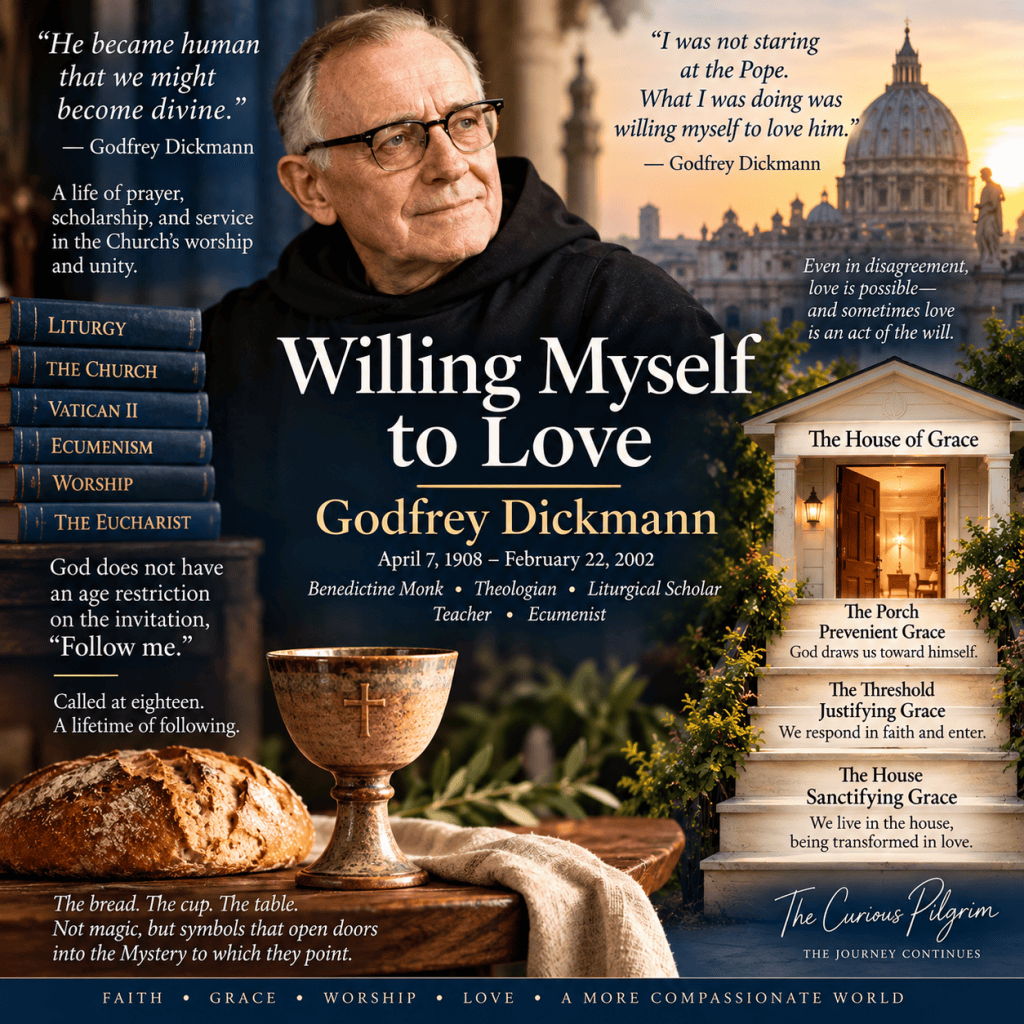
Godfrey Dickmann was born into a family of eight children, the son of German emigrés from Westphalia. He was baptized Leo. At eighteen, he entered the Benedictine Order at Collegeville, Minnesota.
Eighteen.
That caught my attention because I understand something about being called by God when you are young. I was fourteen when I experienced God’s call to preach.
God does not have an age restriction on the invitation, “Follow me.”
Samuel was young. Jeremiah protested that he was too young. Mary was young. Godfrey was eighteen. I was fourteen.
We may hear the call when we are young, but it can take a lifetime to discover everything that call means.
Something else happened to Godfrey when he was eighteen. He discovered Paul’s vision of the Church as the Bride of Christ. That image radically changed his understanding of faith.
I understand that, too.
Sometimes a theological explanation can give me information, but an image can open a door and take me somewhere deeper.
When I was in seminary, I encountered an illustration of God’s grace as a house. I had heard about grace for more than fifty years, but suddenly I could see it.
The porch is prevenient grace.
We are still out on the street, but God is already at work. The Holy Spirit draws us toward the house, up the steps, and onto the porch. Before we have done anything, grace is already calling us.
We hear the invitation to trust God and enter.
We open the door and cross the threshold.
That threshold is justifying grace.
But salvation does not end at the doorway.
We enter the house.
That is sanctifying grace.
We live in the house. We grow there. We learn there. We stumble there. We discover things about ourselves and about God that we did not know when we first crossed the threshold. Grace continues working in us, drawing us toward holiness, toward entire sanctification, toward becoming perfect in love.
We spend the rest of our earthly pilgrimage living in the House of Grace.
An image helped me understand something that theological definitions alone had never been able to communicate to me.
I think something similar happened to Godfrey Diekmann when he encountered Paul’s image of the Church as the Bride of Christ.
The Church was no longer simply an institution. The image spoke of relationship, covenant, intimacy, belonging, communion and love.
Perhaps it is not surprising, then, that Godfrey became one of the great liturgical scholars of his generation.
He became a leader in the liturgical movement and participated in the work surrounding the Second Vatican Council. He helped with the cultural adaptation of the liturgy and became involved in the development of English-language liturgy. He was also deeply involved in ecumenical work and spent decades teaching theology at Saint John’s University.
His life revolved around the mystery expressed through worship.
I understand why.
There is something mysterious about the table.
There is something mysterious about the bread.
There is something mysterious about the cup.
There is something mysterious about God’s people gathering around that table.
These are not magical objects. I do not believe that Christianity is about finding the correct formula, possessing the right object, or saying magical words.
But symbols matter.
Water is water, yet in Baptism it speaks of cleansing, death, resurrection, new life and belonging.
Oil is oil, yet in anointing it becomes a tangible sign of prayer, healing and God’s presence.
Bread is bread, and the cup is a cup, yet at the Eucharistic table they draw us into the mystery of Christ giving himself to us.
The table itself speaks of welcome, communion and the Kingdom of God.
A symbol is not the destination.
It opens a door into the Mystery to which it points.
Godfrey loved an ancient Christian statement:
“He became human that we might become divine.”
We do not become God. Rather, by grace we participate in the divine life. Grace transforms us increasingly into the likeness of the One we follow.
And what is the likeness of God?
Love.
That brings me to my favorite story about Godfrey Diekmann.
Following a service in the papal chapel, Godfrey was kneeling in prayer and appeared to be staring intensely at Pope Paul VI. Someone apparently thought his stare was almost rude.
Godfrey explained that he was not happy with much of the Pope’s leadership of the Church. He admitted plainly that he did not like him.
Then he explained what he had actually been doing.
He was willing himself to love him.
My, my.
There is a sermon in that.
Godfrey did not pretend to like someone he didn’t like. He did not pretend their disagreements didn’t exist. He did not say that love required him to approve of everything the other person did.
He chose love.
Jesus tells us to love our enemies and pray for those who persecute us. That does not mean manufacturing warm feelings toward everyone. Sometimes love becomes an act of the will.
I disagree with you.
I may not even like you.
But by the grace of God, I will myself to love you.
And suddenly I see Godfrey’s entire journey coming together.
At eighteen, God called him.
At eighteen, a sacred image opened his understanding of the Church.
He spent his life studying the liturgy and helping Christians encounter the mystery of God through worship.
He gathered around the table.
He received the bread.
He received the cup.
He studied grace.
He taught theology.
And after decades of following Christ, he was still learning how to love.
Godfrey had not graduated from grace.
Neither have I.
I am still living in the House.
I am still discovering rooms.
I am still coming to the Table.
I am still receiving the bread and the cup.
I am still learning what it means to love God with all my heart, soul, mind and strength and to love my neighbor as myself.
And sometimes that means praying for the grace to say:
I may not like you. I may disagree with you. But I will myself to love you.
Perhaps that is what sanctifying grace looks like.
The Holy Spirit keeps working within us, transforming us little by little, teaching us to love.
We hear the call at whatever age it comes.
We step onto the porch.
We cross the threshold.
We enter the House.
We gather around the Table.
And by mysterious grace, God keeps teaching us how to love.
I am the Curious Pilgrim. The journey continues.
 The Curious Pilgrim
Leave a comment