
Daily Office Lesson — Proper 19, Year Two
Wednesday, September 16, 2026
Readings: Psalm 72; Psalm 119:73–96; Job 42:1–17; Acts 16:16–24; John 12:20–26
Source: The Book of Common Prayer
Psalm 72 is attributed to Solomon. It can certainly be read as a prayer for Solomon and the kings who would follow him, but its vision seems to reach beyond any earthly king. Christians have long read this psalm as Messianic because it describes a kingdom extending beyond Israel, where the nations recognize the king and righteousness and peace flourish.
What interests me most is how the psalm describes the righteous king.
He defends the poor. He rescues the children of the needy. He crushes oppression. He delivers those who cry out for help.
That is quite a definition of power.
In the Kingdom of God, power is not measured by how many people serve the king. It is revealed in how the king serves and protects those who have the least power.
Psalm 119:73–96 moves us from the kingdom to the pilgrim traveling through a world where that vision has not yet been fully realized.
The psalmist knows suffering. There are people telling lies about him. There are people trying to destroy him. Yet he continues trusting God and seeking understanding.
Faith does not mean pretending that suffering does not hurt.
Faith means continuing the relationship with God even when we do not understand what is happening.
Then we come to Job.
Job 42 concludes one of the most difficult journeys in Scripture. Job has suffered terribly. His friends have tried to explain his suffering. They believed they understood how God worked, and their explanations became another burden Job had to carry.
But after encountering God, Job recognizes something much greater.
God cannot be contained within our explanations.
Job humbles himself before the mystery and majesty of God. Interestingly, God also rebukes Job’s friends. Their confident explanations about Job’s suffering had not represented God rightly.
Then Job does something remarkable.
He prays for his friends.
Restoration begins in relationship.
Job’s story ends with restoration and blessing, but I don’t think we should turn that ending into a formula: Remain faithful long enough and God will replace everything you have lost.
New children do not erase the children who died. Restoration does not make suffering unreal.
Instead, Job discovers that suffering does not have the final word.
Then Acts takes us into another kind of suffering.
Paul and Silas encounter an enslaved girl who has a spirit of divination. Her owners are making money from her condition.
She is being exploited spiritually and economically.
Paul commands the spirit to leave her in the name of Jesus Christ, and she is freed.
You might expect everyone to celebrate.
They don’t.
Her owners realize that their source of income has disappeared.
Suddenly liberation becomes a financial problem.
They seize Paul and Silas and drag them before the authorities. But notice what they do not say. They don’t complain that Paul has destroyed their profitable business. Instead, they turn an economic grievance into a cultural accusation. They emphasize that Paul and Silas are Jews and accuse them of teaching customs unacceptable to Romans.
Paul and Silas are stripped, beaten, flogged, thrown into prison, and placed in stocks.
There is something here that we need to hear.
We may say we want justice until justice costs us something.
And sometimes suffering does not come because someone has done something wrong. Sometimes suffering comes because someone has confronted something that is wrong.
That is where tomorrow’s reading leaves Paul and Silas.
We know the rest of the story. We know about the earthquake that is coming.
But they don’t—not yet.
For the moment, they are sitting in the darkness.
Sometimes we rush toward the next verse because we already know how the story ends. But the person presently suffering hasn’t reached the next verse yet.
Grace is still at work, even when we have not reached the next verse.
Finally, some Greeks come to Philip in John 12 and make a simple request:
“We wish to see Jesus.”
That is interesting after reading Psalm 72. The psalm envisioned the nations coming to the righteous king. Now people from outside Israel are seeking Jesus.
Jesus responds by talking about his death.
“The hour has come for the Son of Man to be glorified.”
Then Jesus gives us one of the most beautiful images of discipleship in Scripture.
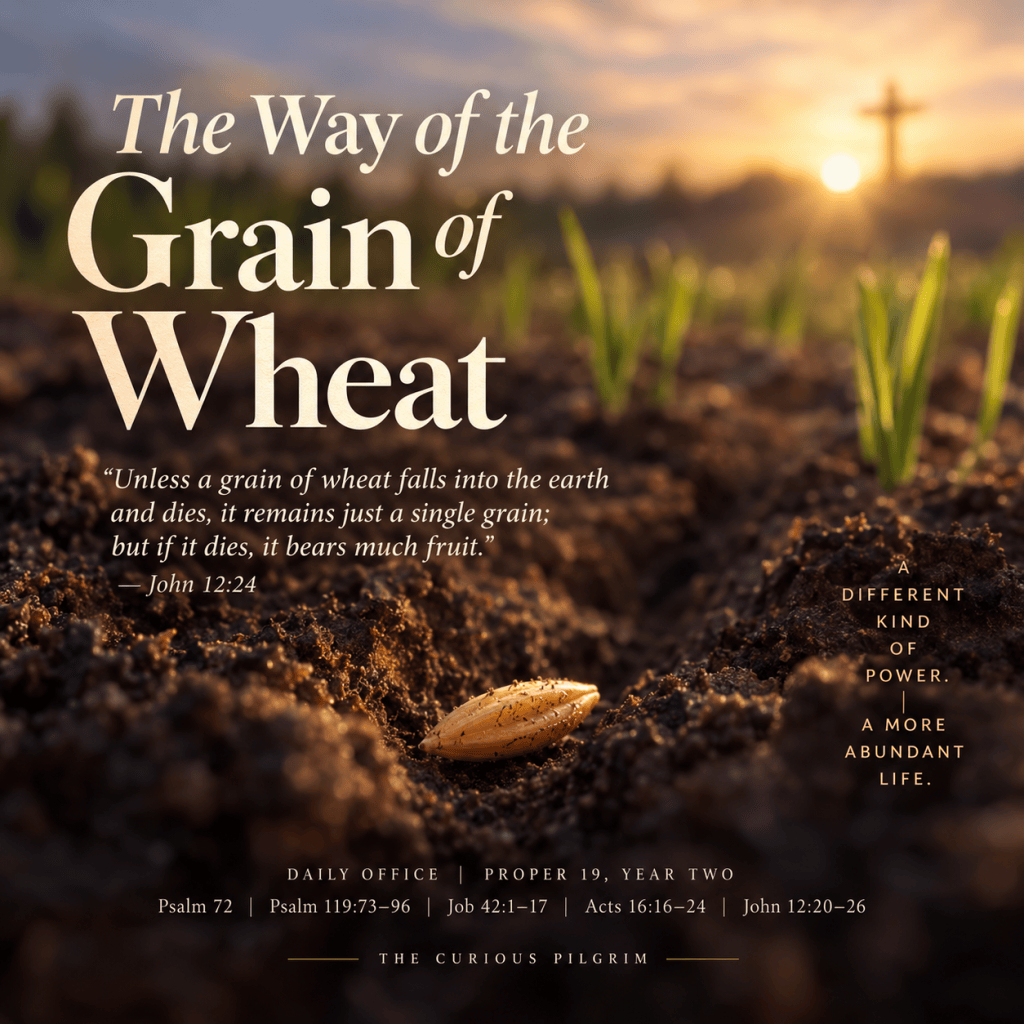
A grain of wheat.
Unless the grain falls into the earth and dies, it remains only a single grain. But when it dies, it produces abundant fruit.
This is the great paradox of Christian discipleship.
We find life by giving ourselves away.
But dying to self does not mean allowing ourselves to be exploited, abused, or controlled by someone else.
The enslaved girl in Acts is not told to accept her exploitation as an act of Christian sacrifice.
She is set free.
Paul and Silas willingly bear the consequences of participating in her liberation.
There is a difference.
Dying to self means surrendering the demand that everything revolve around me—my desires, my possessions, my reputation, my status, my need to control.
It is the way Jesus walks.
And suddenly all these readings begin to come together.
Psalm 72 shows us a kingdom where power protects the vulnerable.
Psalm 119 shows us a pilgrim remaining faithful while suffering.
Job reminds us that suffering cannot always be explained by simple religious formulas.
Acts shows us what happens when God’s liberating grace confronts human exploitation.
And John shows us Jesus walking toward the cross like a grain of wheat falling into the earth.
Perhaps that is why the Kingdom of God can be so difficult for us to recognize.
It does not look like the kingdoms we build.
Its King protects the vulnerable rather than exploiting them.
Its people can admit that they do not have every answer.
Its grace sets people free even when freedom carries a cost.
Its power is revealed through service.
Its glory is revealed through a cross.
Its abundant life begins with a grain of wheat disappearing into the earth.
We may sometimes find ourselves with Job in the ash heap.
We may sometimes find ourselves with the psalmist asking God for understanding.
We may sometimes find ourselves with Paul and Silas sitting in the darkness before the earthquake comes.
And sometimes we may simply be the Greeks standing before Philip saying,
“Sir, we wish to see Jesus.”
Jesus answers:
Follow me.
The road leads toward the grain of wheat.
The road leads toward self-giving love.
And somehow, through the mysterious grace of God, what looks like an ending becomes the beginning of abundant life.
The Kingdom of God does not look like the kingdoms we build.
Thanks be to God.
 The Curious Pilgrim
Leave a comment