
Terence Vincent Powderly, January 22, 1849–June 24, 1924
Labor Leader
Source: A Year with American Saints, G. Scott Cady and Christopher L. Webber, Church Publishing, 2006.
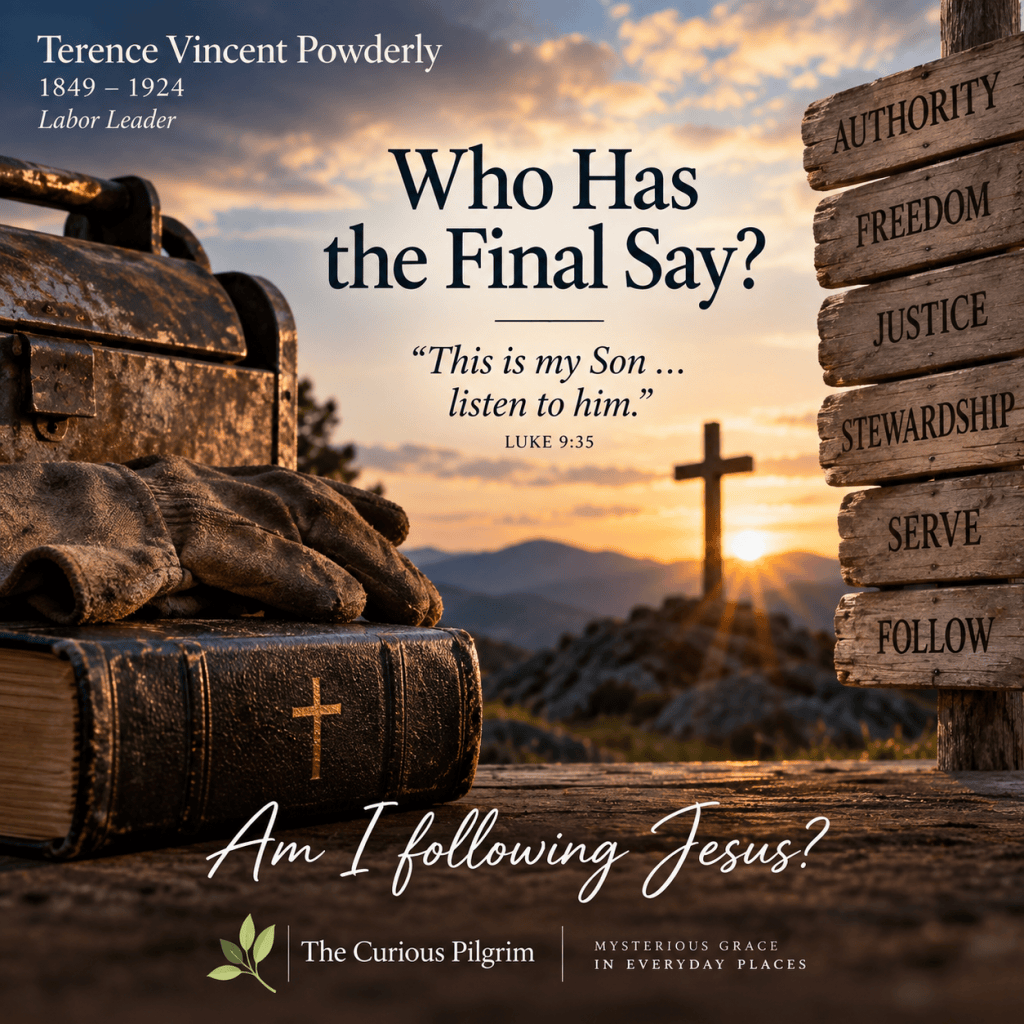
When I began reading about Terence Vincent Powderly, the opening sentence caught my attention. The authors wrote about European churches whose members came to America bringing Old World traditions of strong hierarchical authority.
I wondered, What does that have to do with this man? Why is that important to his story?
Then I kept reading.
Powderly was the son of Irish immigrants. He left school at thirteen, worked for the railroad, became a machinist, and eventually joined the Knights of Labor. He became a powerful labor leader and orator and served two terms as mayor of Scranton, Pennsylvania.
But Powderly saw something deeper than wages and working conditions in what was then called “the labor question.” He believed that the problems between labor and management involved relationships—including our relationship with God.
And that brought him into conflict with his church.
In 1884, Powderly traveled through Maine giving lectures on the labor question. Bishop James Augustine Healy of the Roman Catholic Diocese of Portland summoned him to his office.
The bishop asked whether Powderly was Catholic.
Powderly said that he was.
The bishop then told him that he had no right to lecture in Maine without the bishop’s permission. Because Powderly was Catholic and his lectures concerned matters that could touch faith and morals, the bishop believed Powderly was obligated to consult his ecclesiastical superiors.
Powderly saw things differently.
He told the bishop that he was speaking about labor, not teaching religion. He insisted that he was a freeborn American citizen and did not recognize the right of the bishop—or anyone else, regardless of religious or social position—to prevent him from doing what the laws of his country permitted him to do.
Powderly continued his lecture tour without the bishop’s approval.
At first, it is tempting to ask:
Who was right?
But the longer I have sat with this story, the less interested I have become in choosing a winner.
I can understand both men.
The bishop understood himself to have responsibility for what Catholics taught concerning faith and morals within his diocese.
Powderly understood himself to be a Catholic who was also a free American citizen with the right to speak publicly about labor and economics.
Here was Old World authority meeting New World religious and civil freedom.
Here was hierarchy meeting individual liberty.
Here was religion meeting economics.
Here was authority meeting conscience.
Here was control meeting freedom.
And these are not simply issues from 1884.
They are human issues.
We still wrestle with them.
The story reminded me of Paul and Barnabas. They had traveled together proclaiming the Gospel, but they had a sharp disagreement over whether John Mark should accompany them on another journey. Barnabas wanted to take him. Paul did not.
They separated.
Paul went one direction and Barnabas another.
Scripture does not clean up the story for us. It lets the disagreement remain.
This will happen.
Human beings will disagree. Christians will disagree. Churches will disagree. Sometimes those disagreements concern things about which people have deep and sincere convictions.
Christian history demonstrates this rather dramatically.
We have denominations, divisions, institutions, hierarchies, organizations, and magnificent church buildings. Some divisions arose from serious matters of conscience and doctrine. Others involved culture, personalities, money, property, authority, or power. Usually the history is more complicated than saying one side was completely right and the other completely wrong.
That brings me to another question I frequently ask.
When is enough, enough?
I once attended a United Methodist church that built a huge children’s wing. It was an architectural masterpiece. I understand why they built it. They wanted to minister to children and families.
But they also took on enormous debt.
Today that congregation is down to one worship service and is struggling to pay off that debt.
That doesn’t mean building the children’s wing was evil. It doesn’t mean the people who made the decision had bad motives.
But it makes me ask:
When is enough, enough?
I sometimes look at enormous and magnificent church buildings and wonder what some of that money might have accomplished elsewhere.
How many hungry people could have been fed?
How many families could have been helped?
How many people could have been housed?
How many medical bills could have been paid?
How many struggling neighbors could have received assistance?
Then I have to turn the question around.
What does the way I use my own money say about what I value?
It is easy to question someone else’s stewardship.
It is considerably more uncomfortable to examine my own.
And suddenly I find myself back with Terence Powderly and Bishop Healy.
The bishop says, in effect:
I have authority.
Powderly answers:
I have freedom.
But there is another question.
Who has the final say?
Psalm 50 tells us that God owns the cattle on a thousand hills.
Psalm 24 declares:
“The earth is the LORD’s and all that is in it.”
Then I remember Job.
Job wanted answers. God finally answered him, but not with the explanation Job expected.
Where were you when I laid the foundations of the earth?
Can you command the morning?
Can you control creation?
Can you master Leviathan?
Job finally recognizes something all of us need to remember.
I am not God.
The bishop isn’t God.
The labor leader isn’t God.
The employer isn’t God.
The worker isn’t God.
The pastor isn’t God.
The denomination isn’t God.
The government isn’t God.
And neither am I.
We are creatures living in a creation we did not make.
So perhaps the question isn’t simply whether authority or freedom should win.
Both authority and freedom exist under God.
Then where do we look for the answer?
Jesus.
That takes me to the Mount of Transfiguration.
Peter sees Jesus with Moses and Elijah and immediately wants to build three dwellings.
I understand Peter.
Something holy is happening.
Let’s build something!
But the voice from the cloud does not tell Peter to build.
The voice says:
“This is my Son…listen to him.”
Then they come down the mountain.
Jesus continues the journey.
He teaches.
He heals.
He welcomes.
He serves.
He touches people others will not touch.
He feeds people.
He washes feet.
And eventually he gives himself away.
Jesus says:
Follow me.
That brings me back one final time to Bishop Healy and Terence Powderly.
Perhaps the bishop needed to remember Matthew 25 and ask about the workers themselves—the hungry, the struggling, the poor, the immigrant, the family trying to survive.
Perhaps Powderly, in fighting passionately for workers and their freedom, needed to keep hearing the two Great Commandments:
Love God. Love your neighbor.
But I am not writing this to make Bishop Healy the villain or Terence Powderly the hero.
That would miss the lesson.
Their encounter is a mirror.
When I exercise authority, am I serving?
When I exercise freedom, am I loving my neighbor?
When I spend money, am I practicing stewardship?
When I build something, does it serve people—or will people eventually have to serve what I have built?
When I disagree with someone, am I trying to understand—or merely trying to win?
When I become absolutely certain that I am right, do I remember Job?
And when I start talking about what belongs to me, do I remember the cattle on a thousand hills?
Maybe we spend too much time asking:
Who has the right to decide?
The bishop?
The labor leader?
The employer?
The worker?
The pastor?
The congregation?
The denomination?
Me?
Perhaps we need to ask a different question:
Whose creation is this?
And once I remember the answer, I hear that voice from the mountain again:
Listen to Jesus.
Follow Jesus.
Love God.
Love your neighbor.
Serve the least of these.
Remember that everything belongs to God.
Sometimes a saint does not give us a life that we are supposed to imitate in every detail.
Sometimes a saint gives us a story complicated enough to make us examine our own lives.
Terence Vincent Powderly has done that for this Curious Pilgrim.
And perhaps the most important question his story leaves me with is not:
Was Powderly right or was Bishop Healy right?
It is:
Am I following Jesus?
 The Curious Pilgrim
Leave a comment