
A Year with American Saints — Thursday, September 17, 2026
Daniel Coker, African Methodist, 1780–1846
Source: A Year with American Saints, G. Scott Cady and Christopher L. Webber, Church Publishing, 2006
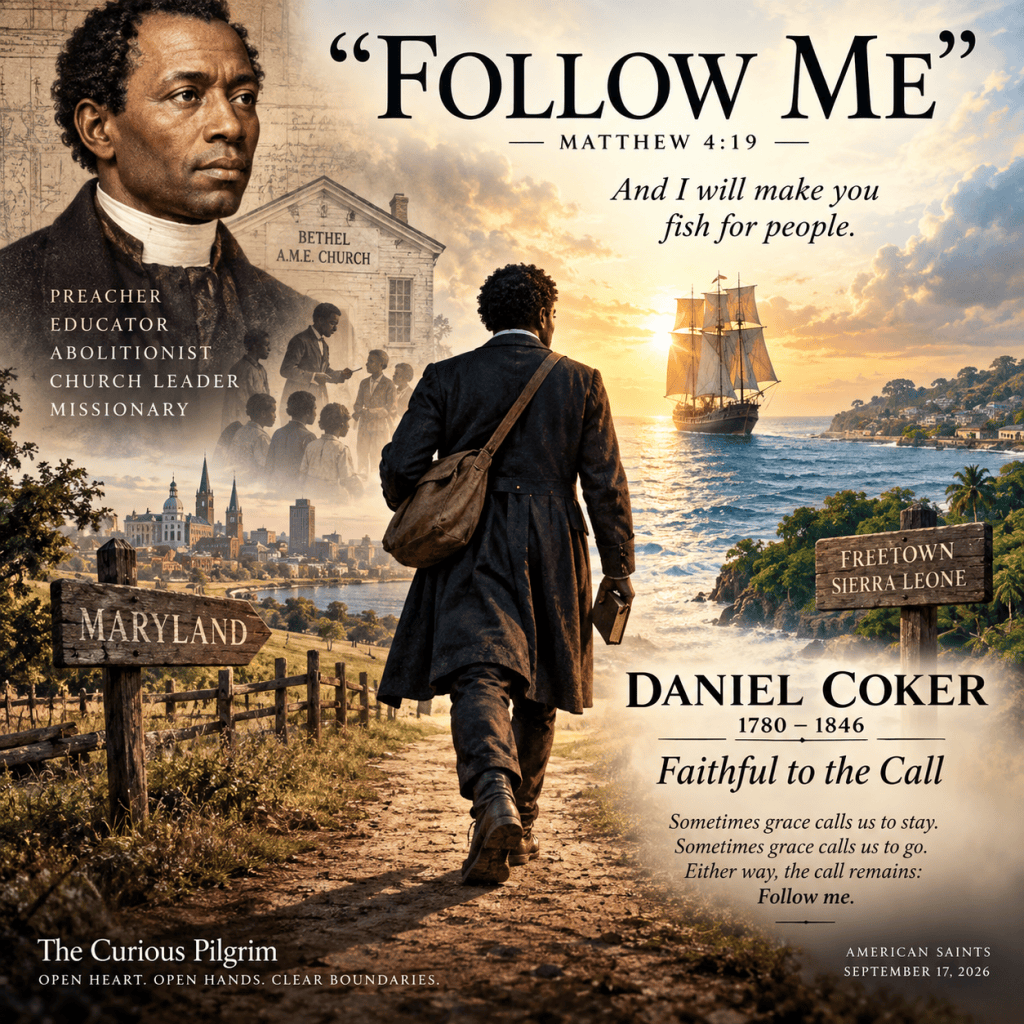
Daniel Coker did not look like an obvious candidate for ministry.
Born around 1780 in Maryland, he was the son of Susan Coker, a white woman, and Edward Wright, an enslaved African American. He was born Isaac Wright, and despite his mixed-race parentage, he lived under the bondage and racial divisions of his time.
As a young man, he escaped slavery and fled to New York. Because he was now considered a fugitive, he changed his name to Daniel Coker to avoid discovery.
Think about that beginning.
Enslaved. Mixed-race in a society obsessed with racial classification. A runaway. A fugitive using another name.
Traditionalists looking only at his background might have found plenty of reasons to reject him.
But God called him.
Coker joined the Methodist Episcopal Church and encountered Bishop Francis Asbury, who ordained him a deacon in 1802. Coker became a preacher, educator, writer, abolitionist, and advocate for Black Methodists.
In 1807, he founded a school for Black children in Baltimore. In 1810, he published Dialogue between a Virginian and an African Minister, challenging slavery from within the slaveholding South.
He also became convinced that Black Methodists needed freedom from white control within the church. He helped establish an independent Black congregation in Baltimore and, in 1816, joined Richard Allen and others in Philadelphia in organizing the African Methodist Episcopal Church.
At that organizing meeting, Coker was selected to serve as bishop, but he declined. Richard Allen was subsequently chosen and became the first consecrated bishop of the new denomination.
Coker’s story reminds me of something God told Samuel:
“The LORD does not see as mortals see; they look on the outward appearance, but the LORD looks on the heart.” — 1 Samuel 16:7
We human beings have always had our ideas about who looks qualified to serve God.
Jesus apparently wasn’t very interested in our qualifications.
He walked beside the Sea of Galilee and called fishermen.
“Follow me, and I will make you fish for people.” — Matthew 4:19
Notice the order.
Jesus did not say, “Become qualified, and then follow me.”
He said, “Follow me, and I will make you.”
The calling came first. Formation followed.
Later Jesus called Saul, a man who had persecuted the followers of Jesus and approved of their imprisonment. Saul certainly did not look like apostle material.
But God looked beyond what everyone else could see.
And God called him.
I see something similar in Daniel Coker.
Coker remained faithful to his calling even when circumstances changed. His racial status did not stop him. His past did not stop him. His location did not stop him. Even discipline and restrictions from the church did not finally stop him.
That distinction is important to me.
The church can recognize a calling, but the church does not create the calling.
A church can ordain someone. It can appoint someone. It can give someone a position. It can also remove a position or restrict someone’s ministry.
But a position and a calling are not the same thing.
The question remains:
Am I still following Jesus?
Then Coker’s journey took another unexpected turn.
In 1820, he left the United States with his family and traveled to Africa as a missionary.
Coker had not been born in Africa. Maryland was his birthplace. Africa was across an ocean from everything familiar to him.
Yet his calling took him there.
Eventually he established a church in Freetown, Sierra Leone, where he continued serving until his death in 1846.
That reminds me of Abraham.
God said:
“Go from your country and your kindred and your father’s house to the land that I will show you.” — Genesis 12:1
God did not give Abraham the entire itinerary.
He simply told him to go.
There is something about calling that we sometimes forget.
We can begin thinking that because God called us in one place, we must remain in that place forever. We can confuse our calling with our position, our denomination, our congregation, our occupation, or even our geography.
But Jesus never promised that following him would allow us to stay home and serve him on our terms.
He simply said:
“Follow me.”
Peter left his nets.
Matthew left his tax booth.
Paul traveled throughout the Roman world.
Abraham left home without knowing exactly where the journey would end.
And Daniel Coker crossed an ocean.
The place changed.
The people changed.
The institution changed.
The circumstances changed.
But the calling remained.
That speaks deeply to this Curious Pilgrim.
A pilgrim cannot demand that the road always remain familiar. If I am truly following Jesus, I cannot know beforehand everywhere that following him may take me.
Sometimes grace calls us to stay.
Sometimes grace calls us to go.
Sometimes grace closes a chapter we thought would last forever and opens another we never imagined.
Our task is not to control the road.
Our task is to listen for the voice that still says:
“Follow me.”
Daniel Coker listened.
And he kept walking.
Open Heart. Open Hands. Clear Boundaries.
— The Curious Pilgrim
 The Curious Pilgrim
Leave a comment