
A Year with American Saints — September 12, 2026
William Leroy Stidger | March 15, 1885–August 7, 1949 | Methodist
Source: A Year with American Saints, G. Scott Cady and Christopher L. Webber, Church Publishing, 2006.
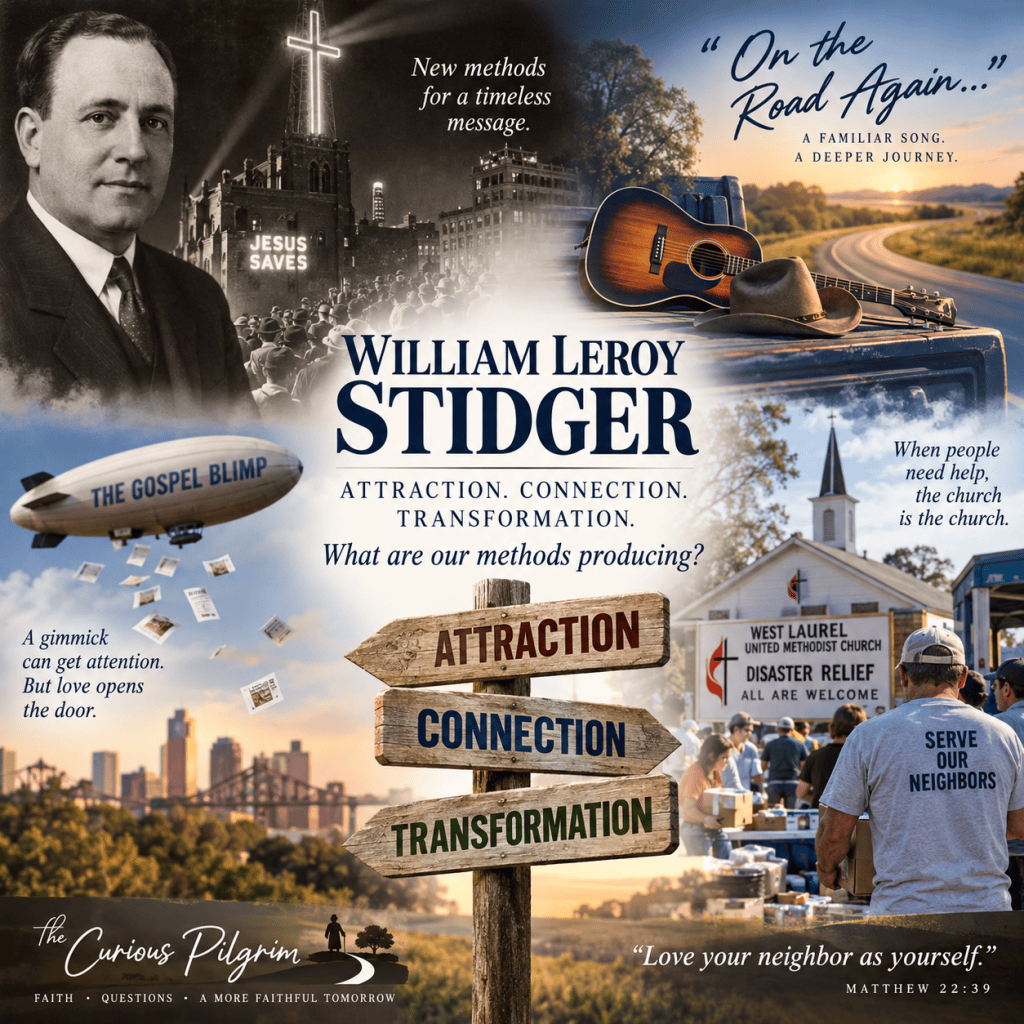
William Leroy Stidger has been called evangelism’s first modern media star.
Born in Moundsville, West Virginia, Stidger was ordained in the Methodist Episcopal Church in 1914. He served churches in several cities, including Detroit, Kansas City, San Francisco, and San Jose.
What caught my attention was his willingness to use the communication tools of his day—advertising, publicity, electric lights, and radio—to proclaim the Gospel.
When Stidger became pastor of a church in San Francisco, he tried some of the usual ways of increasing attendance. Pamphlets were distributed, and church members were encouraged to bring friends.
It didn’t accomplish much.
So Stidger tried something different.
He had an electrically illuminated revolving cross installed high on the church where it could be seen from much of the city. He publicized its dedication, and a large crowd came. Combined with good music, innovative preaching, advertising, and follow-up, attendance increased.
Some people criticized him. They thought he was using gimmicks and bringing business methods into the church.
I understand that criticism because I have heard some of it myself.
I Tried a Few Gimmicks Too
During my years as a pastor, I tried a few things to increase attendance.
Once I promised to sing a solo if we reached a certain attendance. Another time, I promised to climb onto the church roof and preach if we reached our attendance goal.
And it worked!
At least for a Sunday.
We attracted a crowd.
But looking back, I learned an important lesson:
Attracting a crowd and transforming lives are not the same thing.
That is the fine line pastors and church leaders walk.
Churches expect pastors to make the church grow and blossom. We want new people. We want young families. We want children. We want people who have never attended church before.
But sometimes we want all those new people without changing anything that might appeal to them.
In other words:
“Make the church grow, Pastor—but don’t change anything.”
Building a Bridge
I learned something in my Christian education courses that has stayed with me. If we want someone to learn something new, it helps to connect the new idea with something the person already knows.
Jesus did that constantly.
Seeds. Soil. Sheep. Bread. Fishing. Vineyards. Weddings. Money. Families.
Jesus began with the world people knew and used it to help them understand something they did not yet know.
I tried that in preaching.
One Sunday I used Willie Nelson’s “On the Road Again” to begin a sermon.
I was preaching to people who liked country music. They knew the song. When it began playing, people started singing along.
I had their attention.
But more importantly, we had made a connection.
From Willie Nelson being “on the road again,” I moved into a sermon about the journey of life and our journey with God.
And I followed another lesson I learned from my father, who was also a preacher.
He believed a sermon should not last more than twenty minutes.
So mine didn’t.
There is a difference between attracting attention and making a connection.
A gimmick says, “Look at me!”
A bridge says, “Come with me. I want to show you something.”
Stidger Didn’t Stop at the Revolving Cross
That is one reason I find Stidger interesting.
The revolving cross attracted attention, but he didn’t stop with the revolving cross.
He began a radio ministry called Goodwill Radio, which eventually expanded to five days a week. Radio gave him a way to teach people and proclaim Jesus beyond the walls of his church.
And his ministry went beyond preaching.
When restaurant workers fought for an eight-hour workday, Stidger sided with the workers even though the Chamber of Commerce opposed their cause.
That reminds me of Matthew 25:
“I was hungry and you gave me food, I was thirsty and you gave me something to drink, I was a stranger and you welcomed me.”
The Gospel must eventually become something more than words.
The Gospel Blimp
Years ago I held a retreat at a church where we explored how to grow the church.
We watched a movie called The Gospel Blimp.
The movie was almost a parable about evangelism.
Some church members decided they could evangelize their community by buying a blimp and dropping Gospel tracts from the sky.
It sounded like a great idea.
Until the tracts started falling everywhere.
People complained.
So they developed another idea. They attached weights to the tracts so they could supposedly control where they landed.
That didn’t work very well either.
Now their evangelistic efforts were damaging cars, breaking windshields, and hitting people on the head!
They were certainly getting people’s attention.
But it wasn’t the kind of attention they wanted.
Meanwhile, something completely different was happening quietly on the ground.
One of the men who had been involved with the church committee began spending time with his neighbor. The neighbor’s wife was sick in the hospital, and the church member reached out and helped him.
Someone involved with the blimp project saw the church member with his neighbor, who was drinking beer.
Instead of seeing a man caring for his hurting neighbor, he saw a church member associating with someone who was “sinning.” He wanted the man removed from the committee.
But while the blimp was dropping Gospel tracts from the sky, this man was doing something much simpler.
He was loving his neighbor.
The neighbor couldn’t understand why this man was being so kind to him while his wife was sick. Eventually he wanted to know what motivated him.
And that relationship brought the neighbor to church.
I have never forgotten that movie.
The blimp distributed religious information.
The neighbor demonstrated love.
Maybe sometimes we make evangelism much more complicated than Jesus did.
Jesus said:
“Love your neighbor as yourself.”
Then Katrina Came
I experienced something similar in a much more serious situation when Hurricane Katrina struck while I was serving West Laurel United Methodist Church in Laurel, Mississippi.
Our church became a relief center.
Suddenly ministry wasn’t about attendance goals.
It wasn’t about getting somebody to sing a solo.
It wasn’t about putting the preacher on the roof.
It wasn’t about finding the latest church-growth program.
People were hurting.
People needed help.
And the church was there.
We ministered to our community because our neighbors needed ministry.
And we saw people changed as a result.
We weren’t serving people so they would attend our church.
We served them because they were our neighbors.
Whatever results followed came afterward.
That taught me something no church-growth seminar could have taught me quite the same way:
The ministry came first. The results followed.
What Are Our Methods Producing?
Stidger once explained that his goals in preaching were education, inspiration, helping people recognize the best within themselves, bringing peace to their souls, and ultimately bringing people to God through Jesus Christ our Savior.
Those goals give us a way of evaluating our methods.
A revolving cross can attract a crowd.
A rooftop preacher can attract a crowd.
A solo can attract a crowd.
Radio can reach thousands.
PowerPoint can illustrate a sermon.
A familiar country song can build a bridge.
Today we can use Facebook, Instagram, blogs, podcasts, livestreaming, Substack, and even artificial intelligence.
None of those things is the Gospel.
They are tools.
And that is where we must be careful.
Some preachers have taken the kinds of methods Stidger pioneered and used them to build enormous ministries that eventually became something resembling personal empires.
When attendance, money, buildings, influence, followers, or the personality of the preacher becomes our measure of success, we have crossed a line.
There is a fine line between using the tools of the culture to proclaim the Gospel and using the Gospel to build something for ourselves.
External Worship or Internal Transformation?
There is another side to this.
I have attended worship services where everything was so perfectly scripted that I wondered whether we had confused performing worship correctly with experiencing the transforming presence of God.
But spontaneity doesn’t guarantee transformation either.
Traditional does not automatically mean faithful.
Modern does not automatically mean effective.
Large does not automatically mean successful.
Small does not automatically mean unsuccessful.
So perhaps we are asking the wrong question when we ask:
“How do we get more people into church?”
Maybe the better question is:
“What is happening to the people?”
Are we learning to love God?
Are we learning to love our neighbors?
Are hungry people being fed?
Are strangers being welcomed?
Are hurting people finding someone willing to walk beside them?
Are minds being renewed?
Are lives being transformed?
Are we becoming more like Jesus?
Attraction. Connection. Transformation.
Maybe that is what William Leroy Stidger leaves this Curious Pilgrim thinking about.
The church sometimes needs to change its methods because the world around us changes. We need to speak in ways people can understand. We need to build bridges from the world people already know toward truths they have not yet discovered.
But our methods must never become our mission.
Attraction can bring people through the door.
Connection can help them hear.
Love made visible can show them why the message matters.
And transformation is ultimately the work of grace.
The illuminated cross may catch someone’s eye.
The blimp may fill the sky with tracts.
The radio may carry a preacher’s voice for miles.
But none of them can replace one human being loving another human being.
Maybe the greatest evangelistic program Jesus ever gave the church wasn’t a program at all:
Love God.
Love your neighbor.
And when someone asks why we love them—
we can point toward Jesus.
The methods will continue to change.
The tools will continue to change.
The world will continue to change.
And this Curious Pilgrim hopes he will continue changing too.
But through all those changes, the invitation remains remarkably simple:
“Follow me.”
 The Curious Pilgrim
Leave a comment