
Psalm 75; Psalm 76; Psalm 23; Psalm 27; Esther 2:5–8, 15–23; Acts 17:16–34; John 12:44–50
Sometimes I wonder where God is.
I don’t see God. I don’t hear a voice from heaven. I look at what is happening around me and wonder why God doesn’t do something. Why doesn’t God stop the injustice? Why doesn’t God answer the prayer now? Why doesn’t God make things clear?
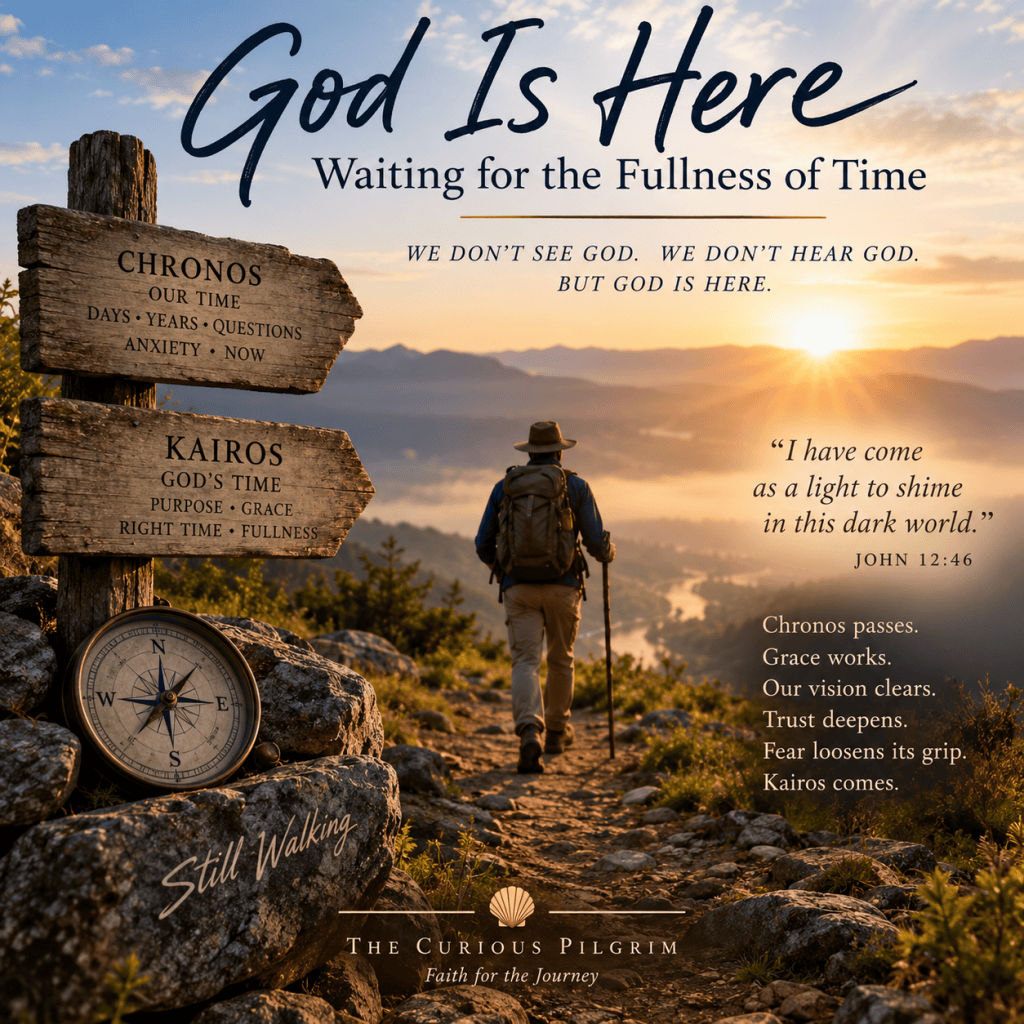
Perhaps part of the problem is that I live in Chronos, while God is working toward Kairos.
Chronos is clock time. It is Saturday, September 12, 2026. It is yesterday, today, and tomorrow. It is birthdays, appointments, deadlines, years, decades, beginnings, and endings.
My life is measured by Chronos.
And because my life is short, I become impatient.
God is eternal.
Psalm 75 begins with an assurance I need to remember:
God is near.
The Psalm goes on to remind us that God will judge with justice when the proper time comes. Human beings don’t get the final word. Governments don’t. Kings don’t. Religious leaders don’t. I don’t.
God does.
But when?
There’s the question.
I want God to operate according to my clock.
Scripture keeps reminding me that God doesn’t.
Peter wrote that God is not slow concerning the promise as some people understand slowness. God is patient because God does not want people to perish but wants them to come to repentance.
What I sometimes interpret as God’s delay may actually be God’s mercy.
God waits.
God gives grace.
God gives another opportunity.
God gives us time to turn around.
That’s Kairos—the right time, the appointed time, the fullness of time.
Psalm 76 reminds us to stand in awe of God’s justice and to keep the commitments we make to God. But then Psalm 23 gives us another picture of this sovereign God.
God is my Shepherd.
The Judge is also the Shepherd.
God provides for me, guides me, restores me, comforts me, and walks beside me through the darkest valleys.
The Shepherd doesn’t promise there won’t be valleys.
The promise is:
You are with me.
Then Psalm 27 declares:
“The LORD is my light and my salvation; whom shall I fear?”
That becomes especially meaningful when we reach today’s Gospel reading.
Jesus says:
“I have come as a light to shine in this dark world.”
I don’t need enough light to see the entire road.
I need enough light to take the next step.
Perhaps that is one of the lessons I have been learning along this pilgrimage.
Paul said that now we see through a glass darkly. We see only part of the picture.
When something happens, I want to understand it immediately.
Why did this happen?
Where is God?
What is God doing?
Where is this leading?
But I cannot see the whole picture from where I am standing.
Time passes.
Grace works.
I learn.
I change.
I look backward.
And sometimes I begin to understand things I couldn’t understand when I was living through them.
That is part of sanctifying grace.
Sanctifying grace isn’t merely making me behave better. Grace is transforming me. It changes how I see God, myself, other people, and the world around me.
I may begin by crying:
“God, why aren’t you doing something?”
Then grace teaches me to say:
“God is here, even though I don’t understand what God is doing.”
And eventually I may be able to say:
“I don’t have to understand everything in order to trust God.”
That doesn’t mean I stop asking questions.
Job asked questions.
David asked questions.
The Psalms are filled with questions.
Faith isn’t pretending that I understand.
Faith is learning to trust while I don’t understand.
Esther may be one of the best examples of this.
The Book of Esther never mentions God.
There is no burning bush. No voice from heaven. No prophet appears announcing, “Thus says the LORD.”
Esther simply lives her life within the circumstances surrounding her.
She is a Jewish woman living among a people who have been conquered. She is taken into the king’s harem. She goes through an elaborate preparation process. She gains the favor of those around her. Eventually she becomes queen.
At this point in the story, Esther cannot possibly see everything that is coming.
But Chronos keeps moving.
Later, when her people face annihilation, Esther will find herself in exactly the position where she can intervene.
Mordecai will ask:
Who knows whether you have come to the kingdom for such a time as this?
There is Kairos.
Not necessarily because God caused every event that brought Esther there. Human beings made choices. Political systems operated. Evil people did evil things.
Yet somehow, within all of that, grace was still at work.
God was there even when nobody could see God.
Then Paul walks into Athens.
He finds a city filled with people discussing ideas and searching for answers. They have even erected an altar to an unknown god, apparently making sure they haven’t overlooked some deity.
Paul tells them about the God for whom they are searching.
The God who created the world and everything in it.
The God who gives everyone life and breath.
The God who made humanity.
And then Paul says something extraordinary:
God is not far from each one of us.
There it is again.
Psalm 75: God is near.
Psalm 23: You are with me.
Psalm 27: The LORD is my light.
Acts 17: God is not far from each one of us.
John 12: The Light has come into the world.
We don’t see God.
We don’t hear God.
But God is here.
And because God created everything, everything ultimately belongs to God.
I don’t own creation. I am its steward.
I don’t own other people.
I don’t decide who is worthy of God’s grace.
I don’t decide who is beyond redemption.
And I certainly don’t get to pronounce God’s final judgment upon another human being.
God alone is Judge.
But the Judge is also the Shepherd.
The Judge is the One who is patient.
The Judge is the One who gives grace.
The Judge is the One who desires repentance.
The Judge is the One who sent the Light into the darkness.
Paul tells the Athenians that the time has come to repent—to turn toward God.
Some laugh at him.
Some say they want to hear more.
Some believe.
The same grace is offered.
Different people respond differently.
God’s sovereignty doesn’t make us puppets.
Grace invites.
We respond.
And sometimes God waits.
I think I understand that better today than I did earlier in my pilgrimage.
I still see through the glass darkly.
But as Chronos passes, sanctifying grace continues its work.
I understand a little more.
I trust a little more.
And I become a little less anxious about knowing how everything is going to turn out.
I don’t have to see the entire road.
The Shepherd does.
I don’t have to know when justice will finally come.
The Judge does.
I don’t have to understand everything God is doing.
I only need to recognize that God is near and continue walking toward the Light.
Chronos passes.
Grace works.
Our vision clears.
Trust deepens.
Fear loosens its grip.
And when the fullness of time comes—
Kairos.
God will have the final word.
Until then, I keep walking.
After all, I’m still a Curious Pilgrim.
 The Curious Pilgrim
Leave a comment