
Albert Benjamin Simpson
December 15, 1843 – October 29, 1919
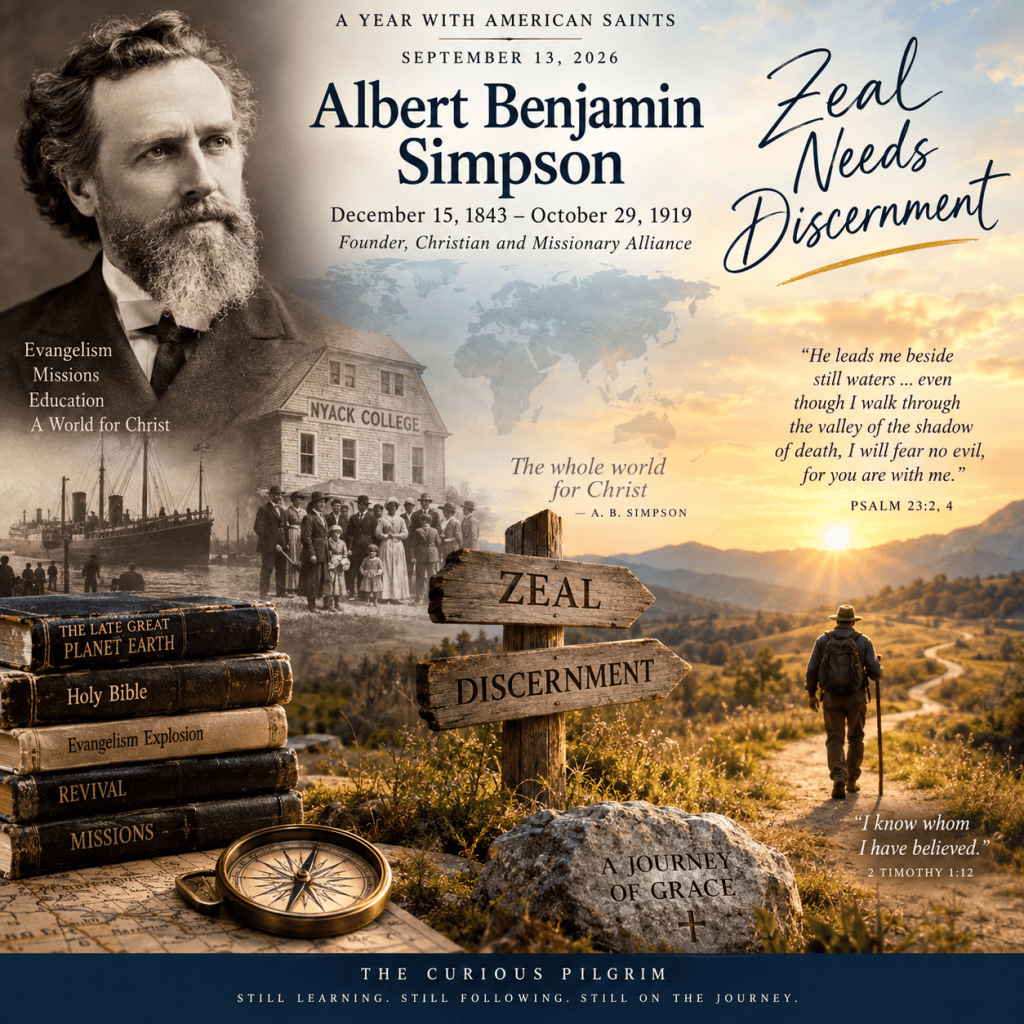
Albert Benjamin Simpson was a man of tremendous zeal.
Born on a barren farm in western Ontario, Canada, Simpson worked as a teacher to earn money for his education and graduated from college with honors. Feeling called to ministry, at only twenty-two he became pastor of a large Presbyterian church in Hamilton, Ontario.
He was energetic and innovative. He began a midweek service, helped pay off the church mortgage, and started new programs. When the congregation outgrew its building, Simpson wanted something simple and functional. The elders wanted something more elaborate.
Eventually Simpson left and moved to New York, where he became deeply concerned about European immigrants who were often being overlooked by established churches.
While there, Simpson experienced what he described as the Baptism of the Holy Spirit, an experience he believed spiritually transformed him. His understanding of baptism also changed, and eventually he left Presbyterian ministry and concentrated on evangelism and missions.
His work contributed to what became Nyack College, and Simpson became one of the founders of the Christian and Missionary Alliance.
Simpson wanted a simple, flexible organization focused on spreading the Gospel. He believed strongly that God would provide what was needed.
But zeal sometimes got ahead of preparation.
Early missionaries were sent overseas with inadequate preparation, with tragic results. Simpson initially believed extensive language training was unnecessary because the first Christians had received the gift of tongues. Experience taught him otherwise, and he changed his approach.
That part of Simpson’s story speaks to me.
I don’t want to criticize him for his zeal because I understand his zeal.
I began preaching when I was fourteen years old. I, too, was influenced by the religious movements surrounding me.
Billy Graham filled stadiums, and thousands came forward while Just As I Am was sung. There were Kathryn Kuhlman, Rex Humbard, Jerry Falwell, Carl McIntire, D. James Kennedy and others telling us what Christianity should look like and how Christians should live.
While attending Free Will Baptist Bible College, I jumped aboard the Evangelism Explosion wagon. We were convinced that getting people saved—getting them converted—was the answer.
Some students preached on street corners. Tracts were distributed. Evangelism was urgent because people needed to be saved.
There was another urgency as well.
Jesus was coming soon.
As a child, I remember hearing Rev. M. L. Hollis preach about the Second Coming in a way that frightened us. Jesus might come tomorrow.
Then Hal Lindsey’s The Late Great Planet Earth came along.
I taught it in my church. I taught Revelation from a premillennial, pre-tribulation viewpoint. I thought I understood what was coming and what Christians needed to do about it.
I had zeal.
What I didn’t yet understand was the journey.
More bluntly, I had little understanding of what Paul meant when he wrote about presenting our bodies as living sacrifices and being transformed by the renewing of our minds.
The glass was very dark, and I could not see clearly.
Then life happened.
Our daughter Amanda Joy died.
Suddenly, the theological message I carried inside me had to confront something very different from an evangelistic campaign or a prophecy chart.
Grief.
The message that could tell someone how to get saved did not know how to minister adequately to the grief in my soul or the grief in my wife’s soul.
Life was asking questions my theological system could not answer.
Looking back now, I don’t simply say that everything I believed was wrong.
I say that what I could see was incomplete.
I was looking through the glass darkly.
And God wasn’t finished with me.
Over the years, life, Sacred Writings, tradition, reason, experience, other people, education, grief, mistakes and grace have continued clearing that glass.
I have changed.
I expect to keep changing.
That brings me back to A. B. Simpson.
Simpson discovered that some of his assumptions about missionary preparation were wrong. He learned. He changed. His zeal remained, but experience required greater discernment.
Perhaps that is one of the lessons his life offers us.
We need A. B. Simpsons.
We need people who dare to trust God.
We need people who notice needs that established institutions have stopped noticing.
We need people willing to take risks, cross boundaries and follow where they believe God is leading.
But zeal alone is not enough.
We need discernment.
How do we know whether something is truly a movement of God’s Spirit or simply our own religious enthusiasm?
I’ve lived long enough to watch movements come and go. I watched the winding down of the old revivalist movement. I watched the growth of charismatic Christianity, nondenominational churches and megachurches. Each generation seems to discover another method that promises to renew the Church.
Some movements bear good fruit.
Some disappear.
Some become institutions themselves.
And sometimes sincere people simply get things wrong.
Jesus said we would know them by their fruits.
That gives me a better test than excitement, crowds, charismatic personalities or claims that God is doing something new.
Does it produce love?
Joy?
Peace?
Patience?
Kindness?
Goodness?
Faithfulness?
Gentleness?
Self-control?
And are we humble enough to admit that we may have misunderstood God?
I needed that humility and discernment when I began preaching at fourteen.
I need it today.
And I expect to need it until the day I die.
Transformation isn’t something that happened to me once. Sanctifying grace continues its work. My mind is still being renewed.
That is why an old Happy Goodman Family gospel song means much more to me now than it once did:
I wouldn’t take nothing for my journey now.
Looking backward, I can see the grace of God running through the journey.
Grace when I was certain.
Grace when I was wrong.
Grace when I was grieving.
Grace when I questioned.
Grace when I changed.
Grace when I couldn’t see through the darkened glass.
The Shepherd has led me beside still waters.
The Shepherd has walked with me through the valley of the shadow of death.
And after all these years, I don’t need to say that I know everything about God.
I can say something much simpler:
I know whom I have believed.
I believe He is able to keep me until that day.
The Good Shepherd gave His life for the sheep.
And the Shepherd is still leading this Curious Pilgrim.
The journey isn’t finished.
The glass is becoming clearer.
The mind is still being renewed.
And grace is still leading me home.
Source: G. Scott Cady and Christopher L. Webber, A Year with American Saints (Church Publishing, 2006).
 The Curious Pilgrim
Leave a comment