
Source: The Pilgrim Continues His Way, Author Unknown
Chapter: “The Pilgrim’s Account of the Fifth Meeting”
Scripture: Luke 9:23; Matthew 11:28–30; Romans 12:2
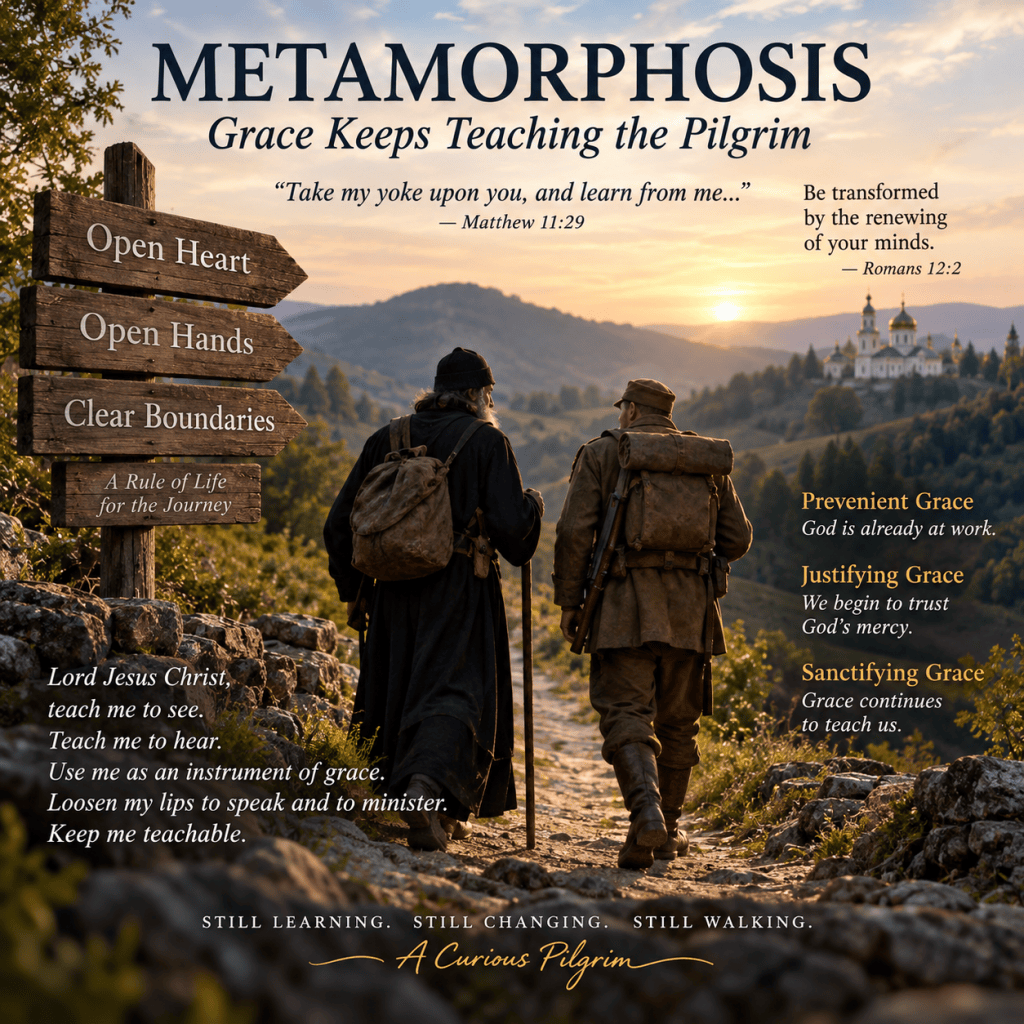
Come sit with me on the porch for a while. I have been reading The Pilgrim Continues His Way, and something happened while I was reading the account of the Pilgrim’s Fifth Meeting.
I saw something I had not seen before.
Maybe that is one of the purposes of being a pilgrim.
The Pilgrim was traveling toward Pochaev when a soldier caught up with him. They walked together for several miles in silence. The Pilgrim could tell the soldier was troubled, so eventually he asked him what was wrong.
What came out was quite a story.
The soldier had deserted the army fifteen years earlier. He had become a thief and a drunkard. He had been arrested and escaped. He had taken the papers and money of a dead soldier and assumed his identity. He married, settled down for a while, started drinking again, and returned to stealing.
Then he had a terrifying dream.
His grandfather appeared to him and condemned him. The soldier awakened overwhelmed with fear, sorrow, and despair. For six months he had been tormented by what he had done. He had considered returning to his regiment and confessing everything. He had even considered hanging himself.
So he asked the Pilgrim what he should do.
The Pilgrim told him to pray.
The soldier was horrified.
He believed that if someone as sinful as he was tried to pray, God would strike him dead on the spot.
The Pilgrim basically told him that was nonsense. God is merciful and compassionate toward sinners and quick to forgive those who repent.
Then the Pilgrim shared something he himself had learned: the Jesus Prayer.
Lord Jesus Christ, Son of God, have mercy on me, a sinner.
Notice what the Pilgrim did not do.
He did not try to solve the soldier’s problems.
He did not take responsibility for changing him.
He did not offer some formula guaranteeing that everything would work out.
He shared what he had experienced. He pointed the soldier toward Jesus.
They continued walking.
Eventually they reached Pochaev. The Pilgrim read to him from the Philokalia and encouraged him to pray without ceasing, go to confession, and receive Communion.
Then something changed.
The soldier awakened after another dream with tears in his eyes, but these were different tears. He was filled with joy.
He said that now he believed God did not torment sinners but was merciful toward them.
The man who had been afraid to pray because he thought God would destroy him had discovered mercy.
I see prevenient grace in that soldier’s story.
Before the soldier understood what was happening, grace was already awakening him. Something within him was telling him that the road he was traveling could not continue.
Then I see justifying grace as he turned toward God’s mercy rather than running from God in fear.
But there is another grace operating in this story that I almost missed.
Sanctifying grace was working in the Pilgrim.
The Pilgrim did not always know how to do what he did for this soldier.
He had to learn.
A monk taught him. An ascetic taught him. The Philokalia taught him. Prayer taught him. The people he met along the road taught him.
The Pilgrim had first been a student before he could become a teacher.
That opened my eyes.
I have spent much of my life trying to help people. I was a pastor. I have worked with people who were hurting. I have met many people who felt something like this soldier felt.
Looking backward, I can see occasions when I tried too hard to solve people’s problems. Sometimes my own needs became mixed with my desire to help. Sometimes I thought carrying another person’s burden was what God expected me to do.
But Jesus said something I am hearing differently now:
“Take my yoke upon you, and learn from me.”
Learn from me.
Jesus also told his followers to take up their cross daily and follow him.
Daily.
Following Jesus isn’t something I finished learning years ago. It isn’t something I mastered when I became a minister, went to seminary, preached sermons, taught classes, or reached a certain age.
I am still learning.
I have seen the same principle at work through SCSEP. I sometimes encounter older adults who resist computers, cellphones, new technology, and now artificial intelligence because things aren’t the way they used to be.
I understand that feeling.
Yesterday can be comfortable.
We already know how to live there.
But pilgrims cannot live in yesterday because the road keeps moving forward.
Paul writes:
“Be transformed by the renewing of your minds.”
Transformation requires change.
There is a word for the kind of transformation in which one form becomes another:
Metamorphosis.
I think I am experiencing metamorphosis.
Not because I have finally figured everything out. Quite the opposite.
I am discovering how much there still is to learn.
And that, too, is grace.
Sanctifying grace doesn’t merely make me “better.” Grace continues teaching me. Grace allows me to see something today that I couldn’t see yesterday. Grace renews my mind. Grace changes the way I understand experiences from my past. Grace teaches me another way to walk.
That is why a prayer has become increasingly important to me:
Lord Jesus Christ, teach me to see.
Lord Jesus Christ, teach me to hear.
Lord Jesus Christ, use me as an instrument of grace. Loosen my lips to speak and to minister.
And now I would add:
Lord Jesus Christ, keep me teachable.
The Fifth Meeting has also helped me understand something about my Rule of Life:
Open Heart. Open Hands. Clear Boundaries.
I can love another person with an open heart.
I can offer what I have learned with open hands.
And I can maintain clear boundaries because the other person’s response does not belong to me.
Prevenient grace means God was working in that person before I ever arrived.
I don’t bring God to another person.
God is already there.
Perhaps my calling is simply to recognize what God is doing, walk beside another traveler for whatever distance our roads run together, share what grace has taught me, and point toward Jesus.
Then I can trust the Holy Spirit with the rest.
The Pilgrim eventually parted company with the soldier. The soldier headed toward Zhytomyr. The Pilgrim continued on his own journey.
He didn’t follow the soldier to make sure everything turned out correctly.
He let him go.
Both men continued their journeys.
Maybe that is why Jesus can say:
“My yoke is easy, and my burden is light.”
I don’t have to be the Holy Spirit.
I don’t have to change another person.
I don’t have to guarantee the outcome.
I am responsible for following Jesus and responding faithfully to the grace given to me. The person walking beside me is responsible for responding to the grace given to him.
That makes the burden lighter.
And it makes my prayer simpler:
Lord Jesus Christ, teach me.
I am still a student.
I am still changing.
I am still being transformed.
I am still walking.
After all, I am a Curious Pilgrim.
 The Curious Pilgrim
Leave a comment