
I continued reading The Pilgrim Continues His Way today.
After saying goodbye to the military officer, the Merchant, and his hosts, the Pilgrim continued toward Kyiv.
He walked for five days.
Then something happened that I understand.
He became tired.
Not merely physically tired. He became weak and gloomy and found it difficult to pray.
This is the same Pilgrim who has spent so much of his journey learning to pray without ceasing.
And now he is having difficulty praying.
I appreciate that honesty.
Sometimes even pilgrims get tired.
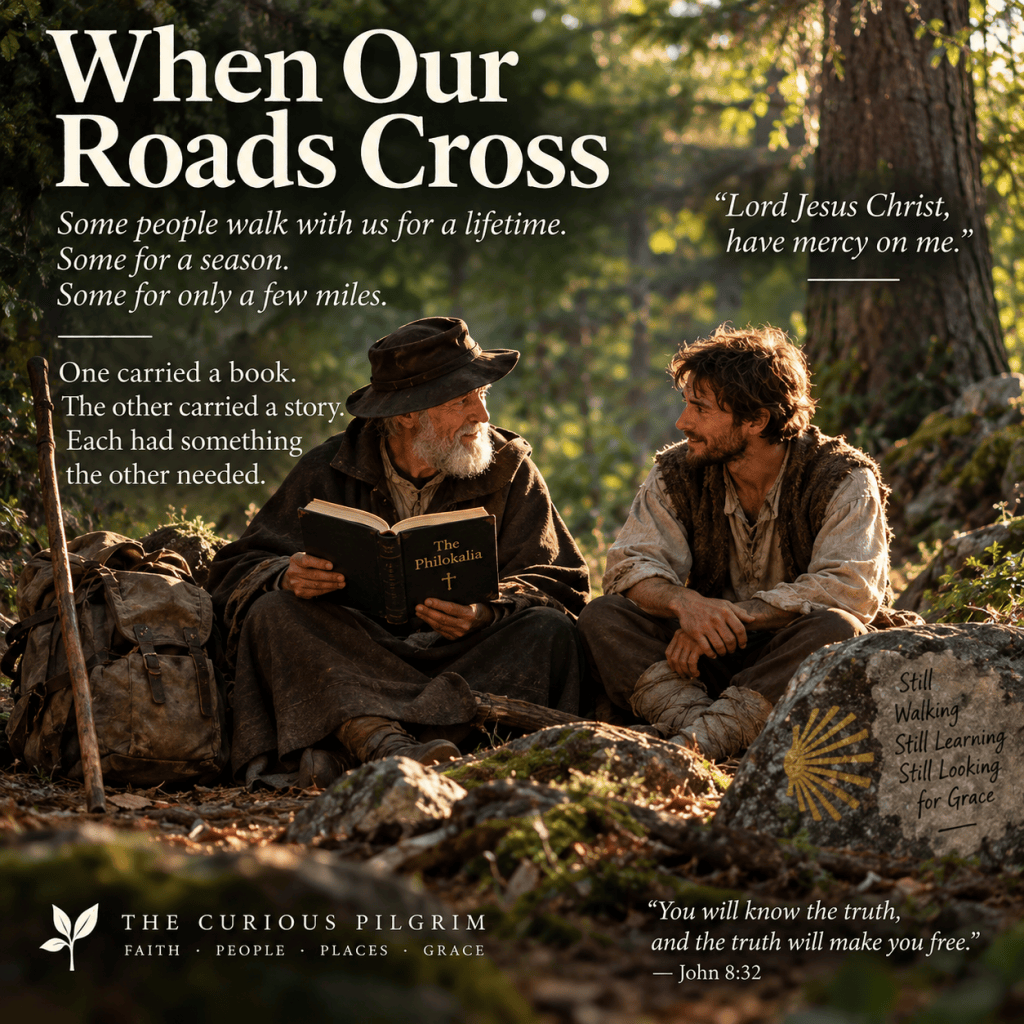
So he left the road, found a secluded place among the trees, settled behind a bush, and opened his Philokalia.
After reading for about half an hour, he noticed someone farther into the woods.
A young man was kneeling.
The sight encouraged the Pilgrim, and he returned to his reading.
About an hour later he looked again.
The young man was still kneeling.
Then suddenly he collapsed.
The Pilgrim went to investigate and discovered that the young man wasn’t injured.
He was asleep.
Another Traveler
The young man was about twenty-five years old and dressed like a poor peasant.
He didn’t have a knapsack.
He didn’t even have a walking stick.
The Pilgrim learned that he had come from Kyiv.
“Where are you going?” the Pilgrim asked.
The young man didn’t know.
He was simply going wherever God led him.
He had already been traveling for about five years, visiting churches, monasteries, and holy places.
Then he told the Pilgrim his story.
The Lost Sheep
The young man had grown up poor and had worked as a shepherd since childhood.
One evening he brought the sheep home and discovered that one belonging to the village elder was missing.
The village elder was cruel.
He threatened the young shepherd:
Find my sheep or I will beat you to death. I will break your hands and feet.
Terrified, the young man returned to the woods looking for the lost sheep.
He searched the places where the sheep had grazed.
Then darkness came.
A storm arose.
The trees swayed and moaned.
Wolves howled in the distance.
The frightened young shepherd fell to his knees.
And he prayed:
“Lord Jesus Christ, have mercy on me.”
He made the sign of the cross.
And something happened.
The storm didn’t disappear.
The wolves didn’t disappear.
The missing sheep didn’t suddenly walk out of the woods.
But his fear did.
He became peaceful.
He remained there through the night, kneeling and praying.
When daylight came, he calmly returned home.
Without the sheep.
Prayer Didn’t Prevent His Suffering
When he arrived home, the village elder carried out his threat.
He beat the young man and twisted his leg so badly that he couldn’t walk for six weeks.
Yet during those six weeks, the young shepherd continued praying:
“Lord Jesus Christ, have mercy on me.”
When he recovered, he left home and began the pilgrimage he was still making five years later.
That caught my attention because of what I had just been reading in the previous part of the book.
There, prayer sometimes sounded almost transactional.
Pray and God protects you.
Perform some small religious act and God rewards you.
But that’s not what happens here.
This young man prayed.
He still didn’t find the sheep.
He prayed.
He still got beaten.
He prayed.
His leg was still injured.
He prayed.
And he still suffered.
So why did he continue?
His answer was simple.
He couldn’t live without the prayer.
Maybe that’s the difference between prayer as a transaction and prayer as a relationship.
He wasn’t praying because prayer guaranteed that nothing bad would happen.
He prayed because somewhere in that dark forest, surrounded by a storm and the howling of wolves, he discovered the presence of God.
The circumstances didn’t change.
He did.
Each Had Something the Other Needed
The Pilgrim was delighted by the young man’s story.
He asked whether he still prayed the Jesus Prayer.
Of course he did.
Then the Pilgrim opened the Philokalia and read to him what he had discovered about the prayer.
The young man was overjoyed.
Here was confirmation that what he had discovered alone in the woods was part of something much larger.
And that’s where this story became especially beautiful to me.
At first, it seems that the Pilgrim is helping the young shepherd.
But remember how the story began.
The Pilgrim was tired.
He was gloomy.
He was having difficulty praying.
And who did he encounter?
A young man who told him:
I cannot live without prayer.
Maybe the young man needed the Pilgrim.
But perhaps the Pilgrim needed the young man too.
One had the Philokalia.
The other had a story.
Each had something the other needed.
The Good Samaritan
This reminded me of Jesus’ story about the Good Samaritan.
Two travelers meet along the road because one has something the other needs.
The Samaritan doesn’t explain the wounded man’s suffering.
He doesn’t ask what the man did to deserve being attacked.
He doesn’t offer a theological explanation.
He sees him.
He stops.
He gives what he has.
Then he continues his journey.
Maybe that is what traveling companions do.
People Along My Road
This story also caused me to think about the people I’ve encountered during my own pilgrimage.
Some walked beside me for many years.
Some stayed for a season.
Some appeared briefly and disappeared again.
For years, I sometimes thought that if a relationship ended, something had gone wrong.
I’m not so sure anymore.
Maybe some people are only meant to walk beside us for part of the road.
They bring something we need.
Perhaps we bring something they need.
We listen to each other’s stories.
We share what we’ve learned.
We encourage one another.
Then the road divides.
And we continue our separate journeys.
That doesn’t mean the relationship failed.
It means our roads crossed.
What Grace Did We Exchange?
Maybe I have been asking the wrong question about some of the people who have passed through my life.
Instead of asking:
“Why didn’t they stay?”
perhaps I should ask:
“What grace did we exchange while our roads crossed?”
Somebody encouraged me.
Somebody challenged me.
Somebody listened.
Somebody taught me something.
Somebody helped me see myself differently.
Somebody simply sat beside me when I needed someone there.
And perhaps, without even realizing it, I gave something to them too.
That’s pilgrimage.
Then They Prayed
I love how this encounter ends.
The two travelers don’t establish an organization.
They don’t exchange addresses.
They don’t promise lifelong friendship.
They don’t make plans for another meeting.
They pray.
And then they continue their journeys.
That’s enough.
Two pilgrims met in the woods.
One was tired and struggling to pray.
The other couldn’t imagine living without prayer.
One carried a book.
The other carried a story.
Each had something the other needed.
They shared it.
They prayed.
And they continued on their way.
Perhaps today I need to give thanks for the people whose roads have crossed mine.
Those who stayed.
Those who left.
Those I still love.
Those I barely remember.
Those who taught me.
Those who challenged me.
Those who helped me when I was lying beside the road.
And even those brief companions who walked only a few miles beside me.
Maybe the measure of a relationship isn’t always how long it lasted.
Maybe sometimes the better question is:
What grace did we exchange while our roads crossed?
Lord Jesus Christ, have mercy on me, a pilgrim.
And thank You for the pilgrims You have allowed me to meet along the way.
Amen.
 The Curious Pilgrim
Leave a comment