
The Daily Office Readings for Sunday, September 6, 2026: Psalm 63:1-11, 98, 103; Job 25:1-6, 27:1-6; Revelation 14:1-7, 13; and Matthew 5:13-20.
I grew up hearing a lot about sin.
Some of the preaching I heard as a child—not from my dad, but from others—left me with the impression that human beings were dirty, rotten sinners headed for Hell. We were completely depraved, incapable of anything good.
Of course, there was sometimes an interesting exception. The preacher and those of us sitting in church seemed to be on the right side of the line. It wasn’t always said explicitly, but we knew who was in and who was out.
Reading today’s Daily Office brought some of those memories back.
Bildad sounds a little like some of those preachers I heard as a boy.
In Job 25, he describes God as powerful and dreadful and asks:
“How can a mortal be innocent before God?”
Then he goes even further. Compared with God, a human being is a maggot, a worm.
Now there is certainly truth in recognizing the holiness and greatness of God. Paul reminds us that none of us is righteous on our own and that all of us have sinned.
But does that mean there is absolutely nothing good left in humanity?
I don’t think so.
Maybe We Have a Corrupted Hard Drive
Since computers came along, I have found another way of thinking about sin.
Maybe humanity is something like a computer with a corrupted hard drive.
The computer itself isn’t worthless. Someone designed it for a purpose. The basic machinery is still there. But something has become corrupted, and because of that corruption, it can no longer function exactly as its creator intended.
That’s how I have come to understand sin.
We are still created in the image of God.
There is still goodness within humanity.
There is still something of the fingerprints of our Creator upon us.
But something has become corrupted. Our relationships with God, ourselves, one another, and creation have become distorted.
What we need isn’t to be thrown onto God’s trash heap.
We need restoration.
And that is where grace enters the story.
Job Refuses to Lie About Himself
Job doesn’t accept Bildad’s explanation.
He says:
“As long as I live, while I have breath from God, my lips will speak no evil, and my tongue will speak no lies.”
And then Job says something remarkable:
“I will never concede that you are right… I will maintain my innocence without wavering.”
Job isn’t claiming that he has never sinned.
He is saying that Bildad’s explanation for his suffering is wrong.
Job refuses to confess to something he hasn’t done just to make someone else’s theology work.
There is a lesson there.
Humility before God does not require us to lie about ourselves.
Purchased by the Lamb
Then Revelation 14 gives us another picture.
John sees the Lamb and 144,000 people singing a song that no one else could sing.
Some have taken that number to mean that only 144,000 people will be in heaven. I think that misses the larger picture Revelation gives us. Earlier, John sees a multitude so large that nobody could count them, coming from every nation, tribe, people, and language.
I am more interested in the song.
It is a song of redemption.
These people have been purchased.
And what was the purchase price?
Jesus.
His birth.
His life.
His death.
His shed blood.
His burial.
His resurrection.
He defeated death so that death does not have the final word.
It reminds me of that old hymn I heard growing up:
“Are You Washed in the Blood?”
What a strange image when you stop and think about it.
Blood ordinarily stains.
But the blood of the Lamb cleanses.
We are made righteous not because we somehow managed to clean up the hard drive ourselves.
We are righteous because Jesus is righteous.
Grace does what we could never accomplish for ourselves.
From Worms to Light
And then we arrive at Jesus’ words in Matthew 5.
After hearing Bildad call humanity worms, listen to what Jesus calls us:
“You are the salt of the earth.”
And:
“You are the light of the world.”
What a contrast.
Bildad looks at humanity and sees worms.
Jesus looks at humanity and sees salt and light.
Jesus also says that he did not come to abolish the Law but to fulfill it.
The Law showed us what righteousness looked like, but rules alone could not repair what had become corrupted within us.
Jesus fulfilled the Law.
He became the sacrifice.
Grace and mercy now accomplish what the Law alone could never accomplish.
Grace restores us.
The Breath Returns
There is another image that I find beautiful.
In Genesis, God breathes into humanity the breath of life.
Sin separated and distorted that relationship with the Source of our life.
But after his resurrection, Jesus meets his disciples and does something remarkable.
He breathes on them and says:
“Receive the Holy Spirit.”
The breath returns.
God’s presence lives within us.
The corrupted hard drive begins to be restored.
And something begins growing that could not grow properly before.
Paul calls it the fruit of the Spirit:
Love.
Joy.
Peace.
Patience.
Kindness.
Goodness.
Faithfulness.
Gentleness.
Self-control.
We don’t manufacture those things by following enough rules.
They are fruit.
They grow because the Spirit of God is alive within us.
Why Salt and Light?
Salt isn’t salt for its own benefit.
Light doesn’t shine so that it can admire itself.
Fruit isn’t produced merely for the tree.
God’s grace restores us so that God’s love can flow through us.
We become salt in a world that needs healing.
We become light in places where darkness seems overwhelming.
We bear fruit in relationships desperately needing love, patience, kindness, gentleness, and peace.
That takes me back to the Psalms we read today.
David said:
“Your unfailing love is better than life itself.”
He remembered that God forgives, heals, redeems, fills our lives with good things, and removes our sins as far as the east is from the west.
And perhaps Psalm 103 gives us the best description of the God who does all of this:
“The Lord is compassionate and merciful, slow to get angry and filled with unfailing love.”
That is the God I see in these Scriptures.
Not a God looking at humanity with disgust and wondering how quickly He can throw us away.
A God who looks upon His creation with compassion.
A God who redeems.
A God who restores.
A God who breathes life into us again.
We are sinners.
We need grace.
But we are also God’s beloved creation, still bearing the image of our Creator.
And through Jesus Christ, what sin has corrupted can be restored.
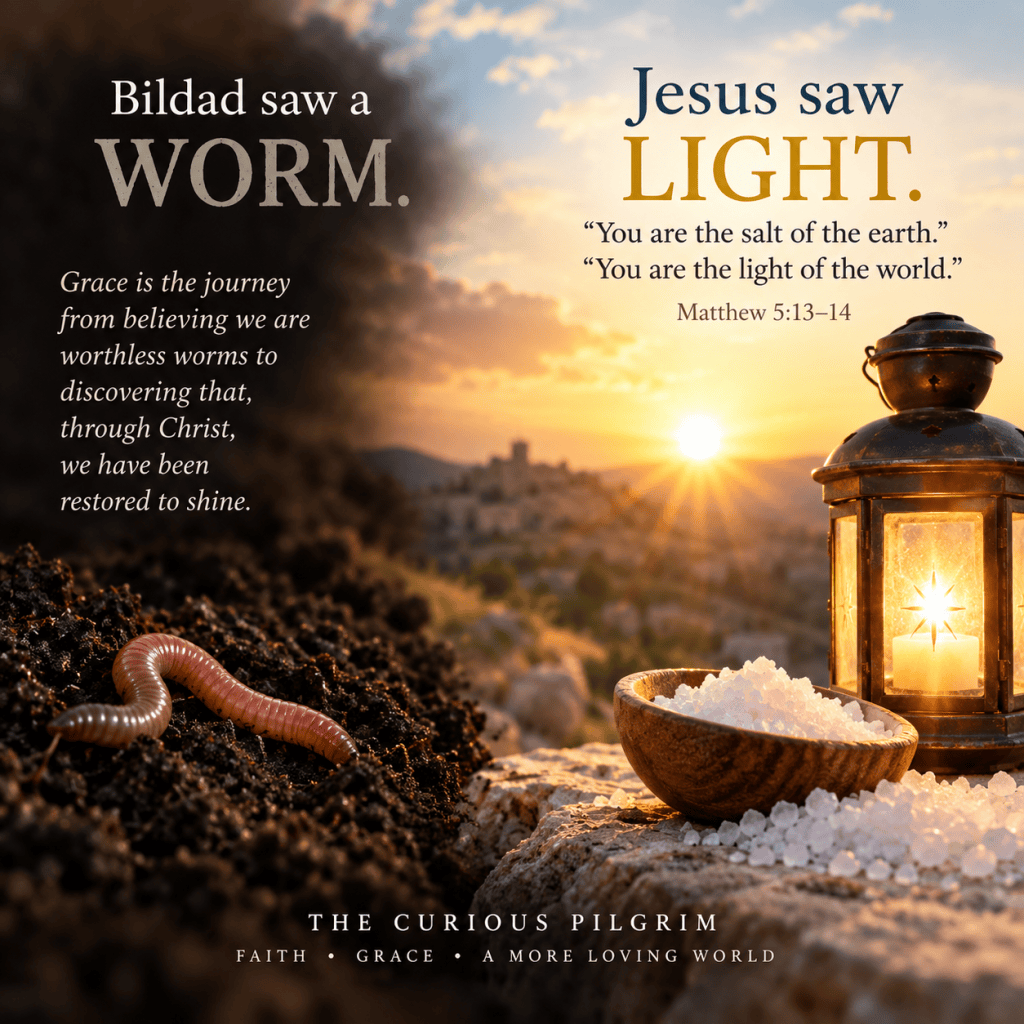
Bildad saw a worm.
Jesus saw something else.
“You are the light of the world.”
Maybe grace is the journey from believing we are worthless worms to discovering that, through Christ, we have been restored to shine.
A Prayer
Lord Jesus Christ,
Have mercy on me.
Where sin has corrupted me, restore me.
Where my light has grown dim, breathe your Spirit into me again.
Teach me to remember that I bear the image of my Creator.
Let your Spirit produce in me love, joy, peace, patience, kindness, goodness, faithfulness, gentleness, and self-control.
And then send me into your world—
to be salt,
to be light,
and to love as I have been loved.
Amen.
“You are the light of the world.” — Matthew 5:14
The Curious Pilgrim


Leave a Reply