
Tradition, Judgment, and a Curious Pilgrim
For the past couple of days, I have been reading The Pilgrim Continues His Way, and one conversation in “The Pilgrim’s Account of the Fifth Meeting” has stayed with me.
It has also troubled me.
Maybe that isn’t a bad thing.
Sometimes a sacred or spiritual book teaches us by giving us an answer.
Sometimes it teaches us by making us ask a question.
And the question I kept asking while reading this story was:
Are you sure about that?
Three Travelers Meet
The Pilgrim arrives in Bila Tserkva and meets another traveler, a merchant. Eventually a non-commissioned officer in the army joins them.
The next morning the church bells ring. The Pilgrim and the Merchant decide to attend worship.
The officer declines.
He asks what good it does God for us to attend church and pray.
Later the officer realizes that he has lost his passport. He hurries back looking for it, eventually finds it among the hay and rubbish, and injures his foot during his frantic search.
The Pilgrim and Merchant connect his misfortune with his refusal to attend church.
That’s where I stopped.
Are you sure about that?
Did God cause this man to lose his passport and injure his foot because he didn’t attend church?
Or did a man lose his passport, panic, run too fast, and hurt his foot?
A Mite and a Gold Coin
The Merchant continues explaining the importance of prayer.
There is much in what he says that I find beautiful.
God desires us to abide in Him and Him to abide in us.
The Holy Spirit awakens prayer within us.
Even the smallest movement of the human heart toward God matters.
The Merchant says that if we merely begin turning toward the Father, God comes toward us. If we can barely utter, “Accept me! Have mercy on me!” the Father is already embracing and kissing us.
I immediately thought about Jesus’ story of the Prodigal Son.
The son starts home with a prepared speech. But while he is still far away, his father sees him and runs toward him.
That is grace.
The Merchant also speaks about giving God a worthless mite and receiving a gold coin in return.
That reminded me of the widow Jesus watched place her mite into the offering.
But this time I stopped again.
Are you sure about that?
The widow didn’t give her mite because Jesus promised her a gold coin.
She gave what she had.
If I give because I expect God to give me something greater in return, there is a very fine line between generosity and greed.
Grace isn’t a business transaction.
I don’t put something into God’s vending machine and wait for a larger blessing to fall out.
Then Came the Monk and His Dried Fish
The Merchant tells another story.
A monk developed a strong desire for dried fish. Because he had taken a vow of self-denial, he struggled with whether he should satisfy that desire.
Eventually he left the monastery to buy the fish.
Along the way, he remembered his rosary and returned to retrieve it. He resumed his journey, put the rosary over his hand, made the sign of the cross, and continued toward the marketplace.
Then a frightened horse pulling a loaded cart came charging toward him.
The horse struck the monk and knocked him down, bruising his shoulder. A few steps away, the cart overturned and was smashed.
The monk survived.
That night he received an explanation.
His desire for the fish had supposedly given the enemy an opportunity to attack him. His guardian angel had inspired him to remember his rosary. His obedience in returning for it and praying had resulted in God’s protection.
Once again I found myself asking:
Are you sure about that?
I can understand the monk saying:
“Thanks be to God! I’m alive!”
I can understand him believing that remembering his rosary brought him back to prayer and awareness of God’s presence.
But how does he know that his desire for dried fish gave the enemy permission to frighten a horse?
And here’s something else:
The monk still went to the market and bought the fish!
That little detail made me smile.
Then I Thought About Job
I’ve also been reading Job.
Job’s friends come to comfort him.
At first, they do something beautiful.
They sit with him.
They remain silent.
Then they start talking.
And that’s when the trouble begins.
They have a theological explanation for Job’s suffering.
God rewards righteousness and punishes wickedness. Job is suffering terribly. Therefore, Job must have done something terribly wrong.
Their theology makes sense to them.
There is only one problem.
They are wrong.
They have taken their understanding of God and used it to explain another person’s suffering.
The more I thought about that, the more these stories from The Pilgrim Continues His Way reminded me of Job’s friends.
Jesus Encountered This Too
The disciples encountered a man who had been blind from birth and asked Jesus:
Who sinned?
Was it this man or his parents?
Somebody must be responsible.
Jesus refused their explanation.
Jesus also spoke about people killed when the tower of Siloam fell.
Were they worse sinners than everyone else?
No.
Jesus repeatedly confronted religious people who had become so certain of their interpretation of Scripture and tradition that they sometimes missed the human being standing in front of them.
That troubles me.
Because I can do it too.
Tradition Can Be a Wonderful Teacher
I am not rejecting tradition.
Quite the opposite.
Tradition has given me treasures.
One of them came from these very books: the Jesus Prayer.
Lord Jesus Christ, have mercy on me.
That prayer has become important on my pilgrimage.
Tradition carries the wisdom, prayers, worship, struggles, discoveries, and experiences of generations who walked this road before us.
But tradition can become dangerous when we stop allowing it to be questioned.
There is a difference between saying:
“This tradition helps me encounter God.”
and saying:
“This tradition tells me exactly what God is doing.”
The first can produce humility.
The second can produce certainty about things we may not actually know.
The Merchant Has One More Story
After telling these stories, the Merchant reads about a man named Agaphonik.
Agaphonik had been taught as a child to pray to the Virgin Theotokos. As an adult, the cares and worries of life overwhelmed him, and he stopped praying.
Later he said he had stopped because he saw no benefit from the prayer.
He was reminded of several occasions when he had escaped danger.
He had nearly drowned but survived.
An epidemic killed neighbors while he remained unharmed.
He fell from a carriage with a friend. His friend broke his leg.
Agaphonik was unharmed.
These events were presented as evidence of the benefit of his prayer.
And immediately another question came to me.
What about his friend with the broken leg?
What about the neighbors who died in the epidemic?
What about the person who prayed faithfully and still drowned?
If my survival proves my faithfulness, what does another person’s suffering prove?
That is where this kind of thinking can become cruel.
Who Am I to Explain?
Yesterday I was reflecting upon another question:
Who am I to judge?
Today I think I need to add another:
Who am I to explain?
Sometimes somebody tells us about something painful that has happened and we immediately start explaining it.
“God is trying to teach you something.”
“Everything happens for a reason.”
“You must not have had enough faith.”
“God closed that door.”
“Maybe you weren’t praying enough.”
Perhaps we should listen first.
Job’s friends might have helped Job more if they had continued doing what they did when they first arrived.
They sat beside him in the ashes.
Maybe sometimes that’s enough.
And I Need to Do This With Myself
This isn’t merely about how I treat other people.
I can become one of Job’s friends to myself.
Something goes wrong and immediately I start asking:
What did I do wrong?
Is God punishing me?
Did I misunderstand God?
Didn’t I pray enough?
Maybe I need to stop.
Listen.
Pray.
Discern.
And sometimes admit:
I don’t know.
There have been many things along my pilgrimage that I cannot explain.
Some happened because of choices I made.
Some happened because of choices other people made.
Some happened because we live in a world where things happen that nobody controls.
Yet through all of them I can look backward and see something.
Grace.
That doesn’t mean God caused everything that happened.
It means God met me there.
There is a tremendous difference between saying:
“God did this to you.”
and saying:
“God can meet you in this.”
Then the Travelers Part Company
After the Merchant finishes his story, the travelers are called to eat.
Then they go their separate ways.
I find something beautiful about that ending.
They traveled together for a while.
They exchanged stories.
They talked about God.
They talked about prayer.
They talked about suffering.
They talked about temptation, angels, providence, obedience, and grace.
Then they parted company.
And the Pilgrim continued his way.
Maybe that is what I am doing with tradition.
I walk alongside those who came before me.
I listen to their stories.
I receive their wisdom.
I treasure what leads me closer to God.
I question what I don’t understand.
Sometimes I even turn toward those ancient travelers and ask:
“Are you sure about that?”
Then I continue my way.
Not because I have all the answers.
But because I am still a pilgrim.
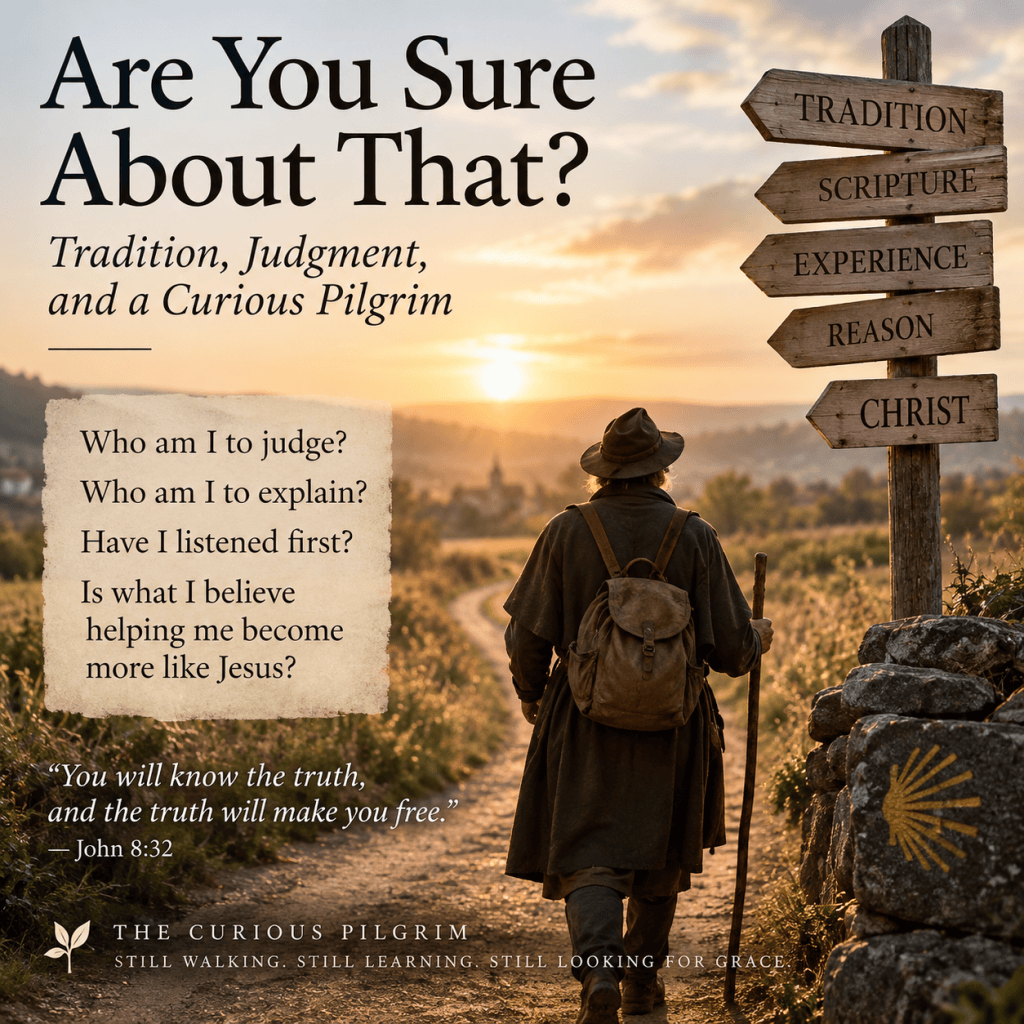
Maybe there are four questions I need to carry with me:
Who am I to judge?
Who am I to explain?
Have I listened first?
Is what I believe helping me become more like Jesus?
Jesus said:
“You will know the truth, and the truth will make you free.”
— John 8:32
I don’t want tradition to imprison me.
I don’t want my interpretation of Scripture to imprison me.
I don’t want my own experiences or explanations to imprison me.
I want all of them to lead me toward Truth.
And for me, Truth ultimately leads me to Jesus.
So I will keep reading.
I will keep listening.
I will keep questioning.
I will keep praying.
And when I don’t understand why something happened, perhaps I don’t need to explain it.
Maybe I can simply sit beside another traveler for a while.
And together we can keep looking for grace.
Prayer
Lord Jesus Christ,
Teach me to listen before I speak.
Give me humility when I think I understand another person’s journey.
Keep me from turning tradition into judgment or my explanations into Your voice.
Help me receive the wisdom of those who walked before me without becoming afraid to ask questions.
When another traveler suffers, teach me compassion before explanation.
When I suffer, keep me from becoming my own accuser.
And when I cannot understand what is happening, help me trust that I don’t have to understand everything to know that You are near.
Lead me into the truth that makes us free.
Lord Jesus Christ, have mercy on me, a pilgrim.
Amen.


Leave a Reply