
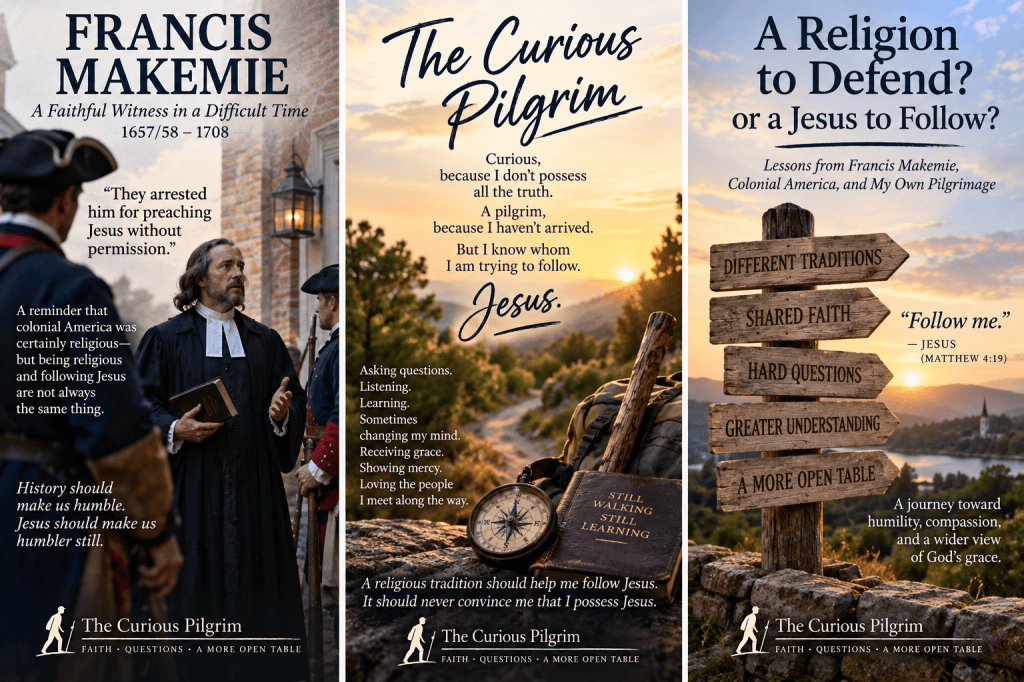
Today I read about Francis Makemie in A Year with American Saints.
Makemie was a Presbyterian minister who came to America from Northern Ireland in the seventeenth century. He became an important leader among early American Presbyterians and is often called the Father of American Presbyterianism.
But something about his story caught my attention.
Makemie lived at a time when particular Christian traditions could have the power of government behind them. When Maryland established the Church of England, dissenters such as Makemie faced restrictions. He needed permission to preach and was required to help support the established church.
He was even arrested for preaching without government permission.
Think about that for a moment.
A Christian was arrested by a government representing another expression of Christianity because he preached Christianity without its permission.
Later, Makemie would again be arrested and imprisoned because he preached without the required authorization.
His story reminded me of something we sometimes forget when talking about early America.
Religious Doesn’t Necessarily Mean Following Jesus
Colonial America was certainly religious.
Christianity profoundly shaped its culture.
There were churches, ministers, sermons, prayers, religious laws, and religious institutions everywhere.
But Christians were also divided into sects.
Anglicans.
Congregationalists.
Presbyterians.
Baptists.
Quakers.
Catholics.
And others.
They didn’t always get along.
Sometimes the group possessing political power restricted the religious freedom of the others.
That makes me uncomfortable when I hear people describe early America simply as a “Christian nation.”
Perhaps we need to distinguish between being religious and following Jesus.
A nation can have churches everywhere and still fail to love its neighbor.
A society can quote Scripture and still mistreat people.
A government can invoke God while denying another person’s freedom.
Religion can become something we defend rather than something that transforms us.
We Have Seen Where That Can Lead
This attitude wasn’t limited to disagreements among Christian denominations.
European settlers encountered Native peoples whose cultures, spirituality, relationship with the land, and ways of organizing society were very different from their own.
Too often they were called “savages.”
Enslaved Africans were also treated as inferior human beings, while Christians sometimes found ways of interpreting Scripture that allowed slavery to continue.
There were enormous economic, political, racial, and territorial forces involved in both slavery and the treatment of Native peoples. Religion wasn’t the sole cause.
But religion was sometimes used to justify what people already wanted to do.
That should trouble every one of us who claims to follow Jesus.
Because Jesus said:
Love your neighbor as yourself.
And in Matthew 25, Jesus went even further.
He identified himself with the hungry, the thirsty, the stranger, the poorly clothed, the sick, and the prisoner.
“I was a stranger and you welcomed me.”
So perhaps the question isn’t simply:
Were our ancestors Christian?
Perhaps we should ask:
How did they treat the stranger?
The Laws Changed. Did We?
Eventually America took important steps toward religious liberty. The Constitution prohibited religious tests for federal office, and the First Amendment prohibited Congress from establishing religion or preventing its free exercise.
We no longer require a Presbyterian preacher to obtain permission from an Anglican governor.
But I wonder whether the attitude underneath those old laws completely disappeared.
Maybe it simply became less explicit.
I have traveled through several Christian traditions during my pilgrimage.
Free Will Baptist.
Nazarene.
Methodist.
Episcopal.
I have encountered wonderful people in all of them. I have learned something from every stop along the journey.
But I have also encountered the temptation within every religious group—including my own—to believe:
We are right. They are wrong.
Our interpretation is biblical.
Our worship is correct.
Our theology is sound.
Our people understand God.
Those people don’t.
That attitude concerns me far more than denominational differences themselves.
Because I see something very similar in the Gospels.
Jesus Didn’t Fit the Profile
Some religious leaders couldn’t accept Jesus because he didn’t fit their profile of what the Messiah was supposed to look like.
He ate with the wrong people.
He touched the wrong people.
He healed on the wrong day.
He challenged their interpretation of religious traditions.
He welcomed people they believed should be excluded.
They were so certain they understood God that when God was working right in front of them, they couldn’t recognize it.
Woe to us when we do the same.
And this isn’t only a problem for Baptists, Catholics, Methodists, Presbyterians, Anglicans, or Episcopalians.
We can become so attached to any label—even agnostic, progressive, conservative, liberal, traditionalist, or something else—that our identity becomes something we must defend against everybody outside it.
Eventually the label becomes more important than the person standing in front of us.
This Is Why I Am a Curious Pilgrim
Maybe this explains why I have become uncomfortable calling myself a denominational person.
I worship within the Episcopal tradition, and I have found much there that helps me in my journey.
But Episcopalian isn’t my ultimate identity.
Neither was Methodist.
Neither was Nazarene.
Neither was Free Will Baptist.
They have all been places along my pilgrimage.
I increasingly prefer simply:
Follower of Jesus.
And perhaps that is also why I call myself The Curious Pilgrim.
I am curious because I don’t believe I possess all the truth there is to know.
I am a pilgrim because I haven’t arrived.
But I am not wandering without direction.
I have someone I am trying to follow.
Jesus.
Jesus didn’t say, “Become a Baptist.”
He didn’t say, “Become an Anglican.”
He didn’t say, “Become a Methodist.”
He said:
“Follow me.”
Following requires movement.
Sometimes Jesus leads us into silence and solitude.
Sometimes into community.
Sometimes toward the stranger.
Sometimes toward someone hurting.
Sometimes toward someone whose life makes us uncomfortable.
And sometimes following Jesus requires admitting:
Maybe I was wrong.
Four Questions Along the Road
As I continue this pilgrimage, I increasingly find myself returning to four relationships:
How am I relating to God?
How am I relating to others?
How am I relating to myself?
How am I relating to creation and the universe of which I am a part?
Morality matters because our choices affect those relationships.
Scripture matters.
Tradition matters.
Reason matters.
Experience matters.
Church matters.
But none of them should become an idol.
A religious tradition should help me follow Jesus.
It should never convince me that I possess Jesus.
Maybe that’s the difference.
I can say:
“This tradition helps me follow Jesus.”
without saying:
“Therefore Jesus belongs to people like me.”
Francis Makemie reminds me what can happen when Christians become convinced that their particular expression of Christianity should determine what everyone else is permitted to believe and practice.
History should make us humble.
And Jesus should make us even more humble.
So I will continue walking.
Asking questions.
Listening.
Learning.
Sometimes changing my mind.
Receiving grace.
Trying to show mercy.
Trying to love the people I meet along the road.
I don’t need a religious identity to defend.
I have Jesus to follow.
And this Curious Pilgrim still has a long way to walk.
A Prayer
Lord Jesus Christ,
Keep me from becoming so attached to my religion,
my tradition,
my theology,
or my opinions
that I stop following You.
When I become certain that I am right
and everyone else is wrong,
teach me humility.
When I encounter someone
who does not fit my expectations,
help me see a neighbor rather than an enemy.
Teach me to love You,
to love others,
to receive myself with grace,
and to walk gently upon Your creation.
Keep me curious.
Keep me humble.
Keep me walking.
And above all,
keep me following You.
Lord Jesus Christ, Son of God,
have mercy on me.
Amen.
 The Curious Pilgrim
Leave a comment