
The saint for September 7 in A Year with American Saints is Timothy Lull. He was a theologian, pastor, professor, seminary president, gifted writer, and speaker. He was also instrumental in the establishment of the Evangelical Lutheran Church in America.
Something about his story caught this Curious Pilgrim’s attention.
The ELCA sought greater unity among Christians and eventually entered into full communion relationships with Christians from other traditions.
Imagine that.
Instead of asking, How can we establish another group that separates us from everyone else? the question became something closer to, How can we recognize our brothers and sisters in Christ across the boundaries that divide us?
That took me back many years.
When I was a student at Free Will Baptist Bible College, someone asked Dr. Leroy Forlines why there were so many different Christian denominations and sects.
His answer, as I remember it, was that God used these different groups to help keep the Word of God pure.
I respected Dr. Forlines tremendously, but even then something about that answer seemed strange to me.
The Psalmist wrote:
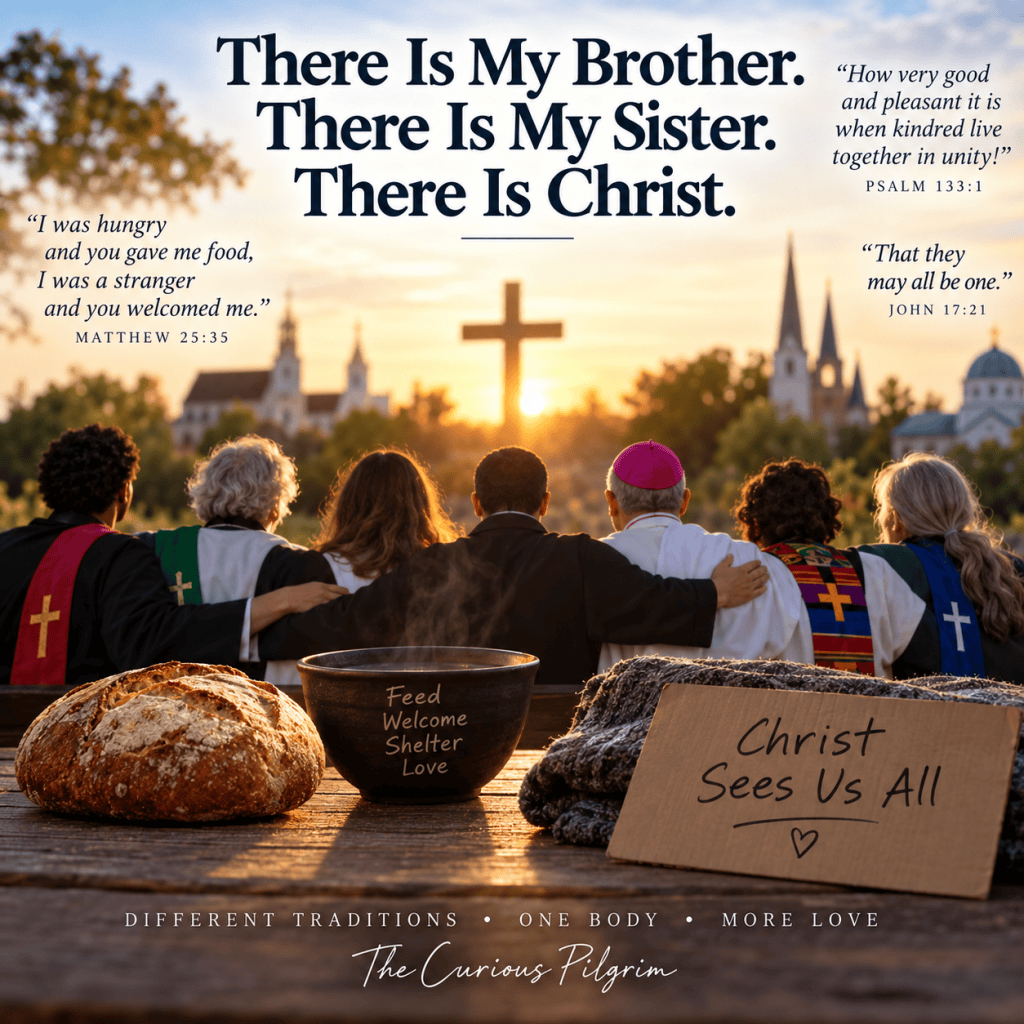
“How very good and pleasant it is when kindred live together in unity!”
— Psalm 133:1
And Jesus prayed for his followers:
“That they may all be one.”
— John 17:21
So how did we get from that they may all be one to thousands of groups, each one sometimes believing that it possesses something the others do not?
Growing up Protestant, I heard another explanation for our divisions.
We were taught that the Catholic Church had become so entangled in traditions that it had lost sight of the truth. Sometimes Catholics were compared to the Pharisees and Sadducees of Jesus’ day—people so concerned about religious traditions that they could miss what God was doing right in front of them.
For a long time, I accepted much of that.
Then I actually met Catholics.
And one of the Catholics who changed my thinking was my own brother Ted.
At one point in his life, Ted was homeless. He eventually became Catholic, and I remember asking him about it.
His explanation wasn’t theological.
He told me that when he was homeless, Catholics gave him food and helped him find shelter.
Then he said something I have never forgotten:
“You Baptists turned me away.”
There isn’t much you can say after that.
You can argue about doctrine.
You can argue about tradition.
You can argue about church government, baptism, Communion, bishops, priests, saints, liturgy, predestination, free will, and a thousand other things Christians have found to argue about.
But there stood my brother.
He had been hungry.
Someone fed him.
He needed shelter.
Someone helped him find it.
And suddenly I hear Jesus:
“I was hungry and you gave me food, I was thirsty and you gave me something to drink, I was a stranger and you welcomed me.”
— Matthew 25:35
Maybe Christian unity doesn’t require us to agree about everything.
Maybe unity isn’t the same thing as uniformity.
Paul described the Church as a body. A body isn’t made entirely of hands or feet or eyes. Its members are different, but they belong to one body.
Perhaps our traditions can be like that.
I have traveled through several of them myself. I was raised Free Will Baptist. I became Nazarene. Later I became United Methodist. Today I worship in the Episcopal Church.
And this Curious Pilgrim has discovered something along the road:
There is something to learn from people at every stop.
Perhaps instead of asking which denomination has everything right, we could occasionally ask what gift another tradition has received that we need.
Perhaps the Catholics can teach the Baptists something.
Perhaps the Baptists can teach the Episcopalians something.
Perhaps the Episcopalians can teach the Lutherans something.
And perhaps all of us could sit down together long enough to listen.
That may be one reason Timothy Lull’s life speaks to me.
He worked toward Christian unity rather than simply defending another wall.
I once thought Christian division protected the purity of our faith.
As I have traveled farther along this pilgrimage, I have begun to wonder whether loving one another across those divisions might demonstrate its purity far better.
Jesus never said the world would recognize his disciples because we had perfectly defined denominational boundaries.
He said:
“By this everyone will know that you are my disciples, if you have love for one another.”
— John 13:35
My brother Ted taught me something about that.
When he needed help, somebody crossed a boundary.
They didn’t begin by asking whether he belonged to the right denomination.
They fed him.
They helped him find shelter.
They loved him.
Maybe that’s where Christian unity begins.
Not by pretending our differences don’t matter.
Not by requiring everyone to become alike.
But by looking across the boundaries we have constructed and recognizing:
There is my brother.
There is my sister.
There is Christ.
“How good and pleasant it is when God’s people live together in unity.”
Amen.
—The Curious Pilgrim


Leave a Reply