
Daily Office Reflections
Friday, August 21, 2026
Readings: Psalms 140–144; Job 2:1–13; Acts 9:1–9; John 6:41–51
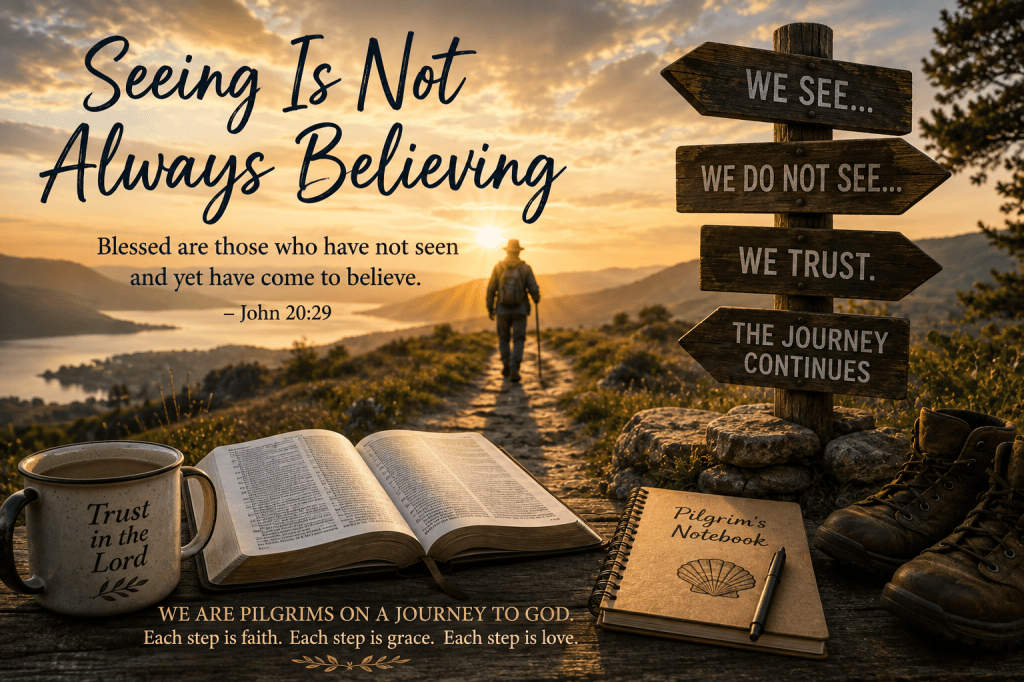
We have all heard the expression:
“Seeing is believing.”
It means that we sometimes need evidence before we are willing to accept something as true.
But today’s Daily Office readings make me wonder:
Is seeing always believing?
Apparently not.
Some people see and still do not believe.
Others cannot see at all—and yet they trust.
Job Cannot See the Whole Picture
Yesterday we met Job, a man who had lost almost everything.
His possessions were gone.
His children were dead.
Yet Job continued to worship God.
Today things get worse.
Satan challenges Job’s faithfulness again, and God permits Job’s health to be affected but does not allow Satan to take his life.
Job finds himself sitting among the ashes, scraping his sores with broken pottery.
His wife finally tells him:
“Curse God, and die.”
But Job refuses.
Job cannot see what is happening behind the scenes.
He does not know why this has happened.
He does not know what tomorrow holds.
He cannot see an explanation.
Yet he refuses to abandon God.
Then three friends arrive.
When they see Job, they hardly recognize him.
They sit down beside him.
For seven days and seven nights, they say nothing.
Sometimes perhaps the most faithful thing we can do for someone who is suffering is simply sit beside them.
No explanations.
No easy answers.
Just presence.
Saul Sees—and Then Cannot See
Then we meet Saul.
Saul believes he knows exactly what he is doing.
He is so convinced that the followers of Jesus are wrong that he is actively persecuting them.
He is traveling toward Damascus with authority to arrest followers of the Way.
Then suddenly a light flashes around him.
Saul falls to the ground.
And he hears:
“Saul, Saul, why do you persecute me?”
Saul asks:
“Who are you, Lord?”
The answer changes everything.
“I am Jesus, whom you are persecuting.”
Then Saul gets up.
And he cannot see.
There is something almost poetic about that.
Saul thought he could see clearly.
Then God made him physically blind so that he could begin learning to see differently.
The man who was certain he understood God had to discover that he had been fighting against what God was doing.
And yet God did not abandon Saul.
God loved Saul enough to stop him.
Grace interrupted his journey.
And eventually the man who persecuted followers of Jesus would become a follower of Jesus himself.
They Saw Jesus and Still Did Not Understand
Then we return to the people following Jesus.
They have seen him.
They have heard him.
They have witnessed what he has done.
Some were among the thousands who ate when Jesus multiplied the loaves and fish.
They have seen.
But seeing has not necessarily produced understanding.
They struggle with Jesus’ claims about who he is.
They know his family.
They know where he came from—or at least they think they do.
How can this man make these claims?
They have seen Jesus.
Yet they cannot see who Jesus is.
Perhaps seeing isn’t always believing after all.
David Thirsts for God
Then I hear David crying out through the Psalms.
He is surrounded by enemies.
He is troubled.
He needs help.
Yet he prays:
“You are faithful and righteous.”
And then comes this beautiful image:
“I stretch out my hands to you; my soul thirsts for you like a parched land.”
David hungers and thirsts for God.
David’s life was certainly not perfect.
He made terrible choices.
His adultery with Bathsheba and his role in the death of Uriah brought devastating consequences.
God did not simply erase those consequences.
But God continued dealing with David.
God confronted him.
God called him to repentance.
God continued loving him.
Grace does not always protect us from the consequences of our choices.
Sometimes grace loves us enough to show us that we are wrong.
Pilgrims on a Journey to God
I am currently reading The Way of a Pilgrim and The Pilgrim Continues His Way.
In the introduction, Father Thomas Hopko describes these books as reminding us that we are pilgrims on a journey to God.
That sentence has stayed with me.
Life is a journey.
Each day we travel another step.
And every step requires some measure of faith.
The pilgrim cannot see everything that lies beyond the next bend in the road.
If I refuse to move until I can see the entire journey, I will never leave where I am standing.
Faith allows me to take the next step.
Not because I know everything.
Not because I understand everything.
Not because I can see everything.
But because I trust the One with whom I am traveling.
Seeing Is Not Always Believing
Job couldn’t see an explanation for his suffering.
Yet he continued trusting God.
David couldn’t always see how his troubles would end.
Yet his soul thirsted for God.
Saul thought he could see clearly, but he had to become blind before he could begin seeing differently.
The crowd saw Jesus and still struggled to understand who stood before them.
So perhaps the old saying needs some reconsideration.
Seeing is not always believing.
Sometimes we see and still don’t understand.
Sometimes we don’t see and still believe.
And sometimes God has to change the way we see before we can understand what has been in front of us all along.
A Question for the Journey
Yesterday I asked:
What are we seeking?
Today I find myself asking:
Can I trust God when I cannot see what lies ahead?
That is the question of a pilgrim.
I don’t know everything waiting farther down the road.
I don’t understand everything that has happened behind me.
I certainly cannot see around every bend.
But I can take another step.
Faith gives me hope.
Hope allows me to keep walking.
And both rest in the love of God.
The God who loved Job in the ashes.
The God who continued loving David despite his failures.
The God who loved Saul enough to stop him on the road.
The God who continued teaching a crowd that saw but did not yet understand.
That same God walks with us.
So I will take another step.
Not because I can see the entire road.
But because I trust the One who travels with me.
Blessed are those who have not seen and yet have come to believe.
The pilgrim keeps walking.
And the journey continues.
The Curious Pilgrim — Reflections on faith, family, and mysterious grace.
 The Curious Pilgrim
Leave a comment