
Series: Family & Legacy Stories
Every family has stories.
Some are documented. Some are memories. Some are family lore passed from one generation to another. And some are rumors repeated so many times that eventually nobody remembers what was fact, what was assumption, and what was simply somebody’s judgment.
My family has those stories too.
My paternal grandfather, William Nathan Pearson, was born in 1861. His father, Nathan Lafayette Pearson, served in the 23rd Alabama Infantry during the Civil War. We have a name for my grandfather’s mother, but we know very little about her, and we have found no record of a marriage between her and my great-grandfather.
Then there is the family lore.
The story passed down through the family says that my great-grandfather was captured at Vicksburg and escaped. According to the story, he eventually found himself in Jones County, Mississippi, where a woman helped conceal him by hiding him beneath her skirt. He later married her, had seven children with her, and became a successful businessman in Laurel.
I cannot tell you how much of that story is fact and how much has been embellished through generations of retelling.
But I do know something about the story of my grandfather.
He was not treated like the other children.
Why?
I don’t know.
And that may be one of the most important things I can say:
I don’t know.
Yet families have a way of filling in what they don’t know.
We hear a story. We make an assumption. Someone adds another detail. Before long, an assumption becomes a rumor, a rumor becomes family lore, and family lore gets repeated as fact.
And somebody gets labeled the black sheep.
My grandfather married a woman who also carried the stigma of being born outside of marriage. The family story was that her mother had an affair with a Baptist preacher.
My maternal grandmother carried a similar stigma. Family history says her mother operated a brothel.
Whatever the complete truth behind these stories, one thing troubles me.
Why should a child carry the shame of circumstances the child did not create?
Yet that is what families and society have often done.
We still do it.
Sometimes people are rejected because of circumstances beyond their control. Sometimes people make choices that genuinely hurt themselves or others. Sometimes we reject people simply because they are different from us.
My own brother was gay. He also spent time in prison. Those are two very different things and should not be confused with each other. But both became parts of his story that affected how people saw him.
Today, there are still Christian parents who will reject a son or daughter who tells them they are attracted to someone of the same sex.
I struggle with that.
Whatever our convictions or disagreements may be, when did disagreement give us permission to stop loving someone?
Jesus said:
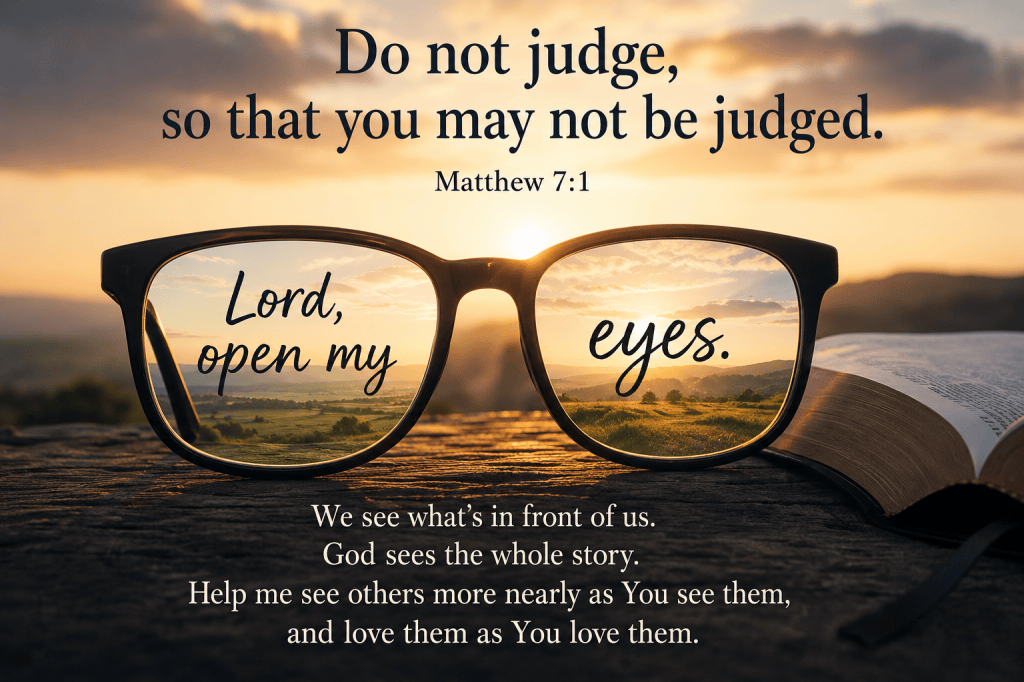
“Do not judge, so that you may not be judged.” — Matthew 7:1
I don’t read those words as saying that we should never exercise discernment. We have to make decisions. Sometimes we need boundaries. Actions have consequences.
But I hear Jesus warning me to be very careful about putting myself in God’s place.
Because I don’t know everything.
I don’t know another person’s whole story.
I don’t always know what is true and what is rumor.
I don’t know every wound they carry.
And I certainly don’t know another person’s heart the way God does.
I have my own prejudices. I make rash judgments too.
God taught me that lesson rather dramatically when I was in seminary.
For one semester, I served as a chaplain’s assistant. One day I was sent to the ICU to visit a man.
When I walked into his room, I immediately formed an opinion.
He had tattoos everywhere, long hair, and a beard. To my eyes, he looked like a member of the Hell’s Angels.
I judged him before he ever opened his mouth.
I almost turned around and walked out.
Then he welcomed me.
After visiting him, I went to see another patient. I learned that this man was a member of a sister church.
Now I made the opposite judgment.
This is going to be different.
I was ready to go into his room, be very spiritual, talk about God, and pray with him.
Instead, he cussed me out.
He told me to leave and not come back.
I had been wrong about both men.
I have never forgotten that lesson.
There is a story in 2 Kings 6 that has come to mean something special to me. Elisha and his servant were surrounded by an enemy army. The servant could see the danger and became frightened.
Elisha prayed:
“O LORD, please open his eyes that he may see.”
God opened the servant’s eyes, and suddenly he could see what had been there all along but what he had been unable to see.
That has become my prayer too.
Lord, open my eyes.
When I look at my family tree, open my eyes.
When I hear an old family story, open my eyes.
When I meet someone who looks different from me, open my eyes.
When someone’s life or choices trouble me, open my eyes.
When my prejudices start talking before the other person has even had a chance to speak, open my eyes.
When I am tempted to believe a rumor, open my eyes.
When I am tempted to decide who the black sheep is, open my eyes.
Because maybe the black sheep isn’t always the person we were told they were.
Maybe sometimes the family simply decided they were.
I cannot change the judgments made by generations before me. I cannot untangle every family rumor or discover the truth behind every story.
But I can decide what I will pass to the next generation.
I don’t want to pass down prejudice.
I don’t want to pass down rumors as though they were facts.
I don’t want to pass down shame that never belonged to the person carrying it.
I want to pass down something better.
Love.
Compassion.
Grace.
Mercy.
And humility enough to admit:
I don’t know the whole story.
Lord, open my eyes. Help me see beyond appearances, rumors, labels, my own prejudices, and my own rash judgments.
Teach me to see others more nearly as you see them.
And teach me to love them as you love them.
Amen.
—The Curious Pilgrim


Leave a Reply