Friday, August 21, 2026
Series: Traveling Companions
Recently, I found myself in a conversation with two of the people I work with through AARP Foundation SCSEP in Springfield, Missouri. All three of us are over 55, which means we have accumulated more than a few stories along the way.
There was Deborah, a Black woman; Marla, a Native American woman; and me, Will, a white man from Mississippi.
We were talking about Denver.
I lived in Denver for six years after my Hurricane Katrina relief work in Mississippi, and our conversation reminded me just how important those years were in shaping the person I am today.
Denver was unlike the world in which I grew up. It was a place where cultures met. I encountered Native American, Latino, Black, Asian, and many other communities. They didn’t all think alike, worship alike, eat alike, or understand the world alike.
And that was precisely what made the experience so valuable.
Frank, a Lakota Sioux friend, introduced me to Native American food and helped me encounter Native American ways of thinking about life, spirituality, and our relationship with creation.
My friend Darlene introduced me more deeply to Black history and culture—the stories, struggles, ideas, food, and experiences that had shaped her world.
Terry helped me better understand women’s experiences, rights, and struggles.
David and Glen, a gay couple who owned the Gallop Cafe, welcomed all of us with open arms—and fed us some wonderful meals along the way.
Each of these people allowed me to see something beyond the boundaries of my own experience.
I have been curious for as long as I can remember. I ask questions. Sometimes too many questions. When I encounter something I don’t understand, I want to know more.
But Denver helped me understand something else.
I am a pilgrim.
A pilgrim doesn’t travel alone.
Along the journey, we encounter fellow travelers whose roads have been very different from our own. They may see things we cannot see because of where they have traveled. They may ask questions we have never thought to ask. They may challenge things we have always assumed were true.
And if we are willing to listen, they may help us see a much larger world.
This week, as I sat in the office talking with Marla and Deborah, I began thinking again about Denver and all those traveling companions I had encountered there.
Then I realized something about The Curious Pilgrim.
My writing has told many stories about my journey, but it has not fully reflected the breadth of what I have discovered along the way—or the curiosity that continues to lead me forward.
So today I am making a change.
I will still tell stories. I will still write from the front porch. I will still talk about faith, family, people, places, movies, music, mistakes, discoveries, and ordinary moments.
But I want The Curious Pilgrim to become a better reflection of the journey I am actually traveling.
There are four sources of truth that have helped guide me along the way: Sacred Writings, Tradition, Experience, and Reason.
There are also four relationships through which I experience life: God, others, self, and the universe.
I want to explore all of them.
That means listening to sacred writings, including voices beyond my own Christian tradition. It means crossing cultural and religious boundaries and learning why other people believe and live as they do. It means learning from experience. It means using reason and discernment to ask questions rather than simply accepting easy answers.
It also means exploring my relationship with God, learning how to care for and understand myself, listening to the people traveling beside me, and considering my relationship with this remarkable creation of which we are all a part.
Father Thomas Hopko expresses the heart of this beautifully in his introduction to The Way of a Pilgrim and The Pilgrim Continues His Way:
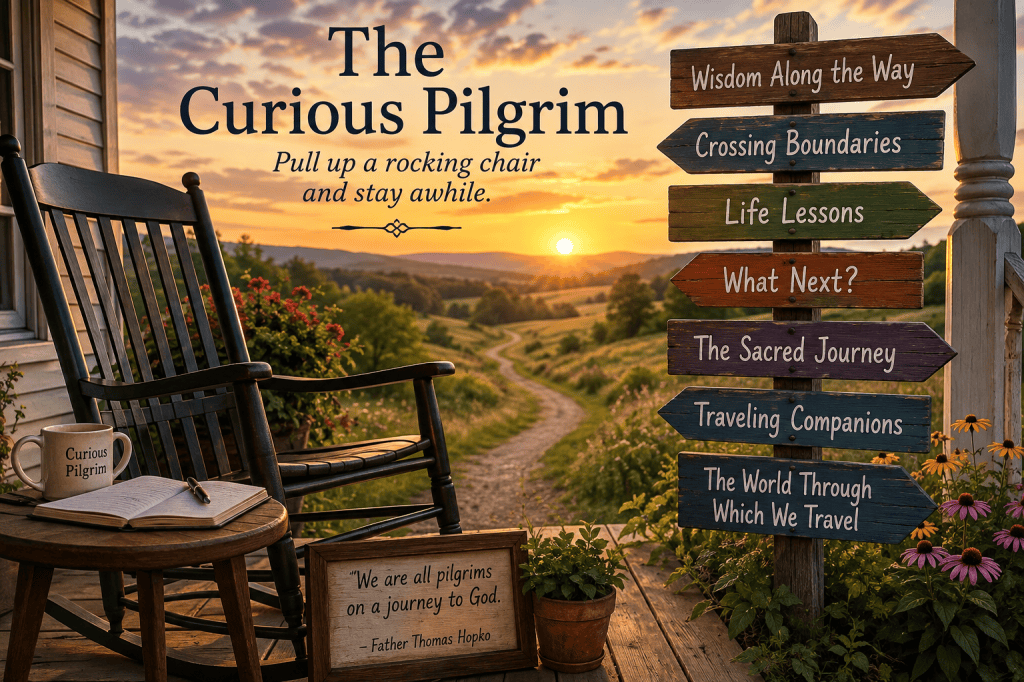
“We are all pilgrims on a journey to God.”
That is The Curious Pilgrim.
I haven’t arrived. I don’t have all the answers. I am still traveling, still asking questions, still encountering people whose experiences differ from mine, and still discovering things I didn’t know.
So beginning now, these are the paths we will explore together:
Wisdom Along the Way — encountering wisdom in Sacred Writings.
Crossing Boundaries — encountering traditions, cultures, beliefs, and ways of life beyond what is familiar.
Life Lessons — reflecting on experience and what living teaches us.
What Next? — exploring questions, different perspectives, reason, and discernment as we consider where the road leads next.
The Sacred Journey — exploring our relationship with God.
Traveling Companions — exploring our relationships with ourselves and the people who share the journey.
The World Through Which We Travel — exploring our relationship with creation, the earth, and the larger universe.
I don’t know exactly where all these roads will lead.
That’s the point.
I’m a Curious Pilgrim.
Pull up a rocking chair and travel with me for a while.


Leave a Reply