
Interruptions, Surprises, and Grace
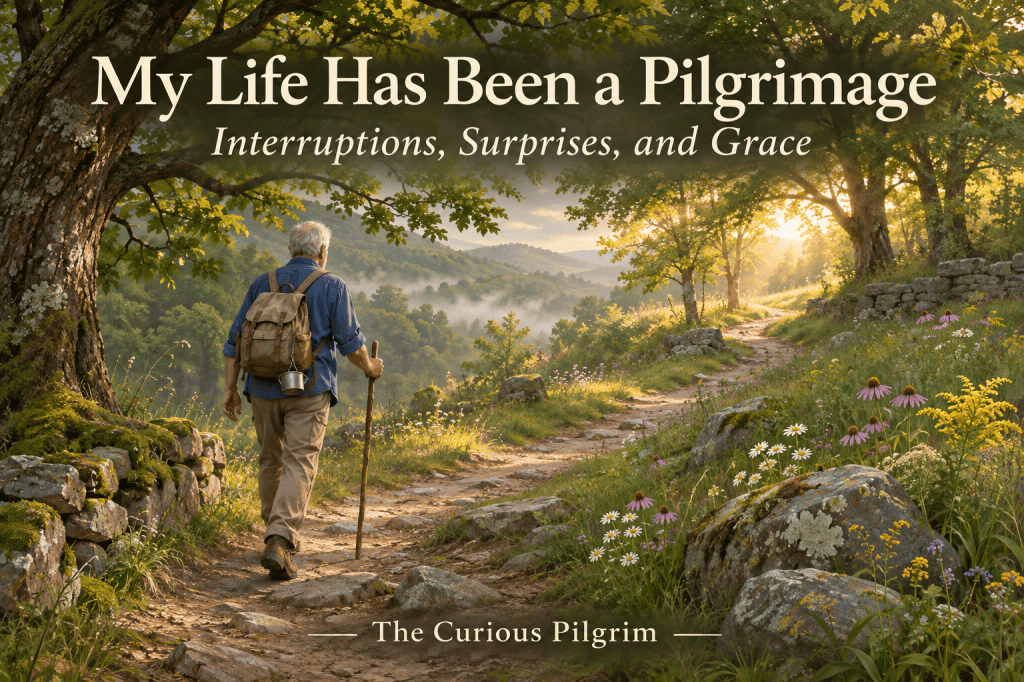
I have been reading Jim Forest’s The Road to Emmaus: Pilgrimage as a Way of Life. His chapter “Interruptions and Surprises” has given me reason to pause and look back over my own journey.
Forest begins by describing pilgrimage as a religious journey on foot along an unfamiliar path. I understand that definition. There is something meaningful about leaving familiar surroundings and walking with intention toward a sacred place.
But as I read, I kept thinking: my whole life has been a pilgrimage.
There have been plans, responsibilities, hopes, and destinations. There have also been interruptions I never wanted and surprises I could never have imagined. I am still learning what it means to walk with God through all of it.
Two quotations at the beginning of the chapter helped me find words for this.
Thomas Merton writes:
“Let us embrace reality and thus find ourselves immersed in the life-giving will and wisdom of God which surrounds us everywhere.”
Flannery O’Connor observes:
“Some kind of loss is usually necessary to turn the mind toward faith.”
I hear Merton inviting me to inhabit the life before me: the ordinary day, the responsibilities, the people, the unfinished work. This is where I can practice being present to God.
O’Connor’s words touch a more painful place. Loss can shake what we thought we understood. Questions rise that familiar answers cannot settle. Faith itself may become a struggle.
I know something about that.
When our daughter Amanda Joy was stillborn, the future we had imagined with her was gone. We had loved her and anticipated her arrival. Then we faced the anguish of losing her.
Her death became part of my grief and my questioning of God. I cannot tie that experience into a neat explanation. Amanda Joy was our daughter. She remains part of my life and part of my pilgrimage.
Reading Forest’s account of his family’s love for their unborn son Oscar, and their grief after a miscarriage, touched that place in me. Our stories differ, but I recognized the love for a child whose place in the family endures.
I believe God can meet us within sorrow. Sometimes we recognize that presence through someone willing to sit beside us without trying to explain everything. Sometimes we look back much later and realize how we were sustained.
As the chapter unfolds, Forest widens his understanding of pilgrimage to include the whole course of ordinary life. That is the journey I recognize: learning, losing, questioning, receiving, and beginning again.
He also brings us to the Good Samaritan. A wounded man beside the road becomes someone to notice, approach, and care for. The Samaritan allows another person’s need to change his day.
That challenges me. How often am I so occupied with what I intended to do that I miss the person before me? Can I pause long enough to listen? Can I make room for compassion when it costs me time?
Much of this pilgrimage happens in small choices. Paperwork. Answering the phone. Cleaning the house. Keeping patience. Offering a kind word. These ordinary moments give us opportunities to practice the love we pray about.
I find myself returning to my own prayer: teach me to see with compassion, listen with wisdom, speak with love, and discern what is true and loving.
That discernment matters. We have limits and responsibilities. An open heart needs clear boundaries, too. We learn, with God’s help, when to stop, when to act, when to rest, and when to ask someone else to walk beside us.
The chapter ends with a pilgrim disappointed by a meal she had expected to be a celebration. As she breaks bread, she recognizes Christ’s presence and understands that he had accompanied her through the encounters along the way.
That brings me back to Emmaus: the companionship was there before the recognition.
I wonder how often that has been true in my own life. How many ordinary kindnesses have carried grace? How many conversations have helped me take another step? How often have I understood only afterward that I had been accompanied?
My life has been a pilgrimage. I have not always understood the road. I have stumbled, questioned, grieved, and started again. I have also received love and kindness in unexpected places.
And I am still walking, learning to recognize the grace that accompanies me.
God of the journey, be present with us in the life before us. Heal what is wounded. Give us eyes to notice, wisdom to discern, and hearts willing to love. When the road changes, help us take the next faithful step. Amen.
Reading companion: Jim Forest, The Road to Emmaus: Pilgrimage as a Way of Life (Orbis Books, 2007), “Interruptions and Surprises.” The Merton and O’Connor quotations appear at the chapter’s opening; Merton’s is drawn from Thoughts in Solitude.


Leave a Reply