
Daily Office Reflection · Wednesday, October 28, 2026
Psalm 72; Psalm 119:73–96; Sirach 43:23–33; Revelation 16:1–11; Luke 13:10–17
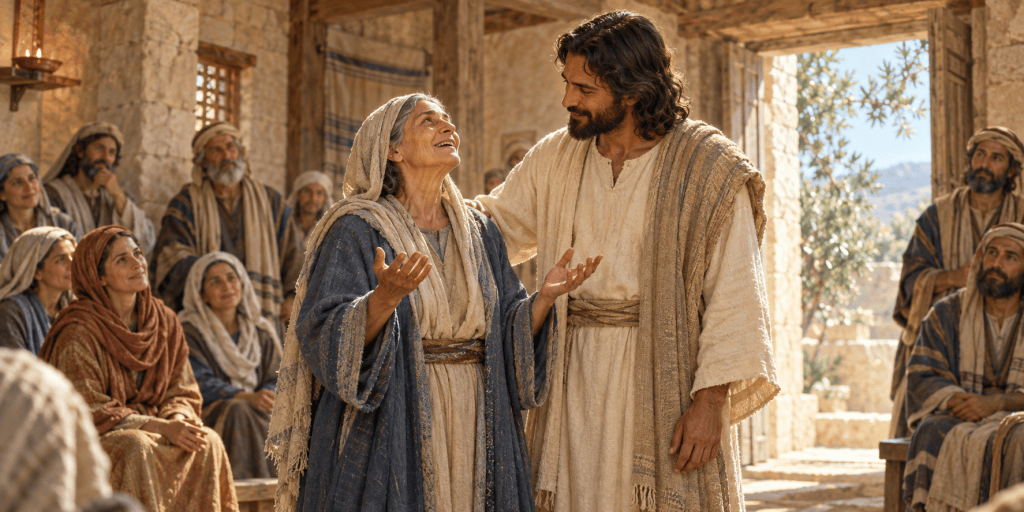
A woman stands upright after eighteen years of being bent over, and a religious leader objects.
That is where today’s readings began to trouble me.
Jesus sees her in the synagogue. He calls her forward, speaks her freedom, and lays his hands upon her. She straightens up and praises God. But the synagogue leader sees something else: a healing performed on the Sabbath. He tells the crowd there are six other days when they can come to be healed.
I wonder how Jesus and the leaders of churches and religions around the world would respond to one another in an encounter like this. There are so many voices claiming to speak for God. What happens when God’s compassion challenges the convictions we are certain came from God?
I cannot ask that question honestly without questioning myself. Would I rejoice with the woman? Or would I become so occupied with defending my understanding of faith that I failed to recognize the freedom unfolding before me?
The God I See in Judgment
Revelation is harder to read. The bowls are poured out, the waters become blood, people suffer, and still they refuse to repent.
I remember teaching passages like this during my Baptist years, when I was a strong follower of M. R. DeHaan and premillennial teaching. I knew the framework through which I understood these visions. Today, I find myself returning to the character of the God whose judgment they describe.
I read them in the light of Peter’s assurance that God is patient, desiring repentance rather than destruction (2 Peter 3:9).
That patience matters to how I understand Revelation. I see humanity becoming so committed to evil that its own choices become the means of its destruction. I hear the terrible grief of God allowing people to pursue what they will not relinquish.
God works through individuals and peoples throughout Scripture: Abraham, Moses, Israel, the disciples. Can God also accomplish judgment through those whose intentions are evil? Can destructive powers turn upon themselves?
Revelation itself pictures such a turning when the beast and its allies destroy Babylon, even as God’s purpose is accomplished (Revelation 17:16–17).
I do not pretend that this explains every disturbing image. But I cannot separate judgment from the God who patiently calls humanity toward life. I understand the tragedy as a refusal of the mercy that could deliver us. There comes a point when we experience the devastation of what we persist in choosing.
Power Beyond Our Understanding
Sirach brings me to the sea, to the wonders of creation, and to the limits of what we know. Verse 32 reminds us that much remains hidden, that we have seen only a small part of God’s works.
Creation is full of relationships. What happens in one place affects another. Our actions have consequences that extend beyond what we intend or understand.
We have learned to release atomic power. We are developing artificial intelligence. Yet our ability to create powerful things does not establish our wisdom in using them.
What could happen when such power serves hatred, greed, domination, or indifference? What might we destroy before we understand what we have set in motion?
Sirach calls me to humility. We know something of God’s creation. We do not know enough to assume we can control every consequence of our actions.
Perhaps humanity’s danger is sharpened by the distance between what we can do and the wisdom with which we do it.
What Power Is For
Psalm 72 gives power a purpose.
The king is to defend the poor, deliver the needy, confront oppression, and bring peace. The lives of vulnerable people are precious to him. His authority carries responsibility for those who have no helper.
This gives me something concrete to pray for in our leaders. May they have wisdom to recognize whose lives are being diminished. May they protect people who cannot purchase influence or command attention. May their exercise of power make room for others to flourish.
In Luke, Jesus makes that prayer visible. He uses his authority to lift a woman who has been bowed down for eighteen years. He calls her a daughter of Abraham. Her suffering has not erased her belonging or her worth.
Here is power accomplishing the work of God: a person stands upright and praises.
Give Me Understanding
Psalm 119 makes all of this personal. The psalmist begins this portion by acknowledging God as the one who made and formed him, then asks for understanding.
That is a prayer I need.
I have held convictions with confidence. I have taught others. I am still learning to recognize where my understanding is limited and where God may be calling me beyond it.
The psalmist also knows exhaustion, affliction, and the difficulty of waiting. Faith can bring all of that into prayer. We can ask for life, comfort, and understanding while admitting how little we see.
By verse 96, the psalmist recognizes limits in everything he has observed, while God’s commandment remains exceedingly broad. My understanding cannot contain the fullness of God’s wisdom.
Today’s readings leave me with a question I cannot direct only toward someone else:
Will our growing power be guided by humility, compassion, and wisdom—or will we refuse the grace that could keep us from destroying ourselves?
I ask it of nations, religious communities, and leaders. I must also ask it of myself.
Creator God, you made us and continue to call us toward life. Give us understanding. Open our eyes to the suffering before us. Teach us to use our power with compassion, and make us willing to receive your correction. Where we resist your healing grace, turn our hearts toward you. Amen.


Leave a Reply