
Daily Office Reflection — Tuesday, October 27, 2026
Psalms 61, 62, and 68; Sirach 43:1–22; Revelation 14:14–15:8; Luke 13:1–9
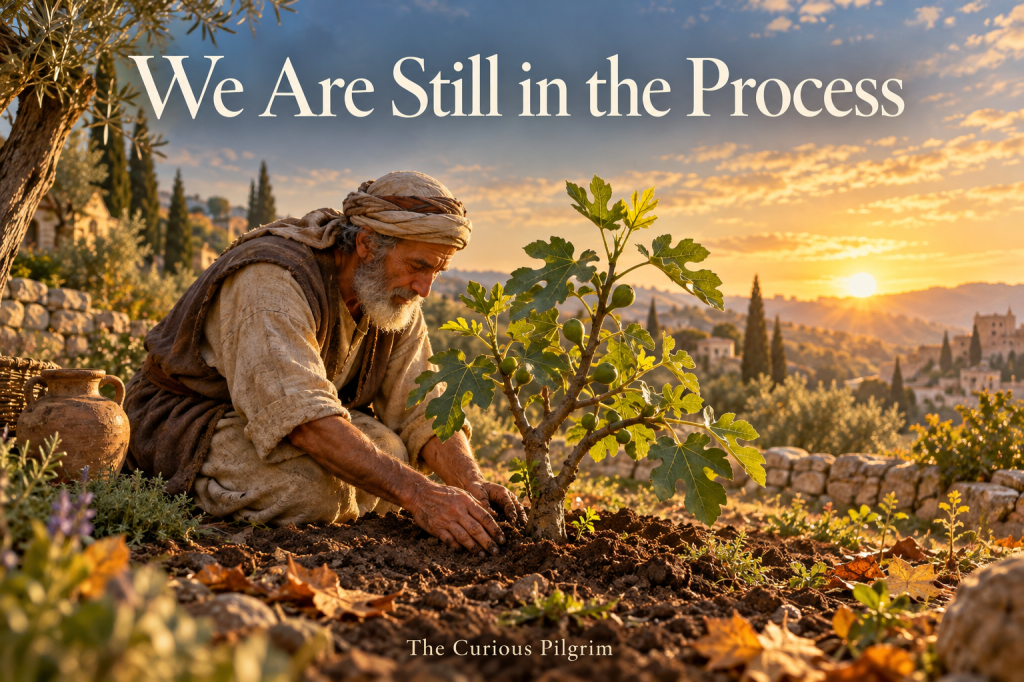
There is something hopeful about a gardener who looks at a struggling tree and asks for more time.
In Luke 13, Jesus tells of a fig tree that has produced no fruit. The owner is ready to cut it down. But the gardener asks for another year. He will dig around it, nourish the soil, and give it the care it needs.
As I sit with this passage, I find myself thinking about repentance—and about how much growing I still have to do.
I have repented many times in my life. I have also discovered that turning toward God once does not mean every part of me immediately knows how to follow. Old habits remain. Wounds influence my reactions. Fear slips into my decisions. Sometimes I recognize my failures quickly. Sometimes it takes years to see what I was carrying and how it affected other people.
We are in the process.
That does not excuse the harm we do. It reminds us that we need both mercy and transformation.
Before telling the story of the fig tree, Jesus addresses two tragedies: people killed by Pilate and people crushed beneath a falling tower. He asks whether those who died were worse sinners than everyone else.
His answer is no.
That should make us careful whenever we are tempted to explain another person’s suffering as something they deserved. Safety does not prove righteousness. Tragedy does not prove guilt. We cannot measure someone’s relationship with God by how comfortable or difficult their life appears.
Jesus turns our attention toward our own need for repentance.
Where do I need to change? Whom have I hurt? What have I accepted because it benefits me, even though it harms my neighbor? Where has my fear become suspicion, my certainty become arrogance, or my anger become cruelty?
Repentance begins to reach deeper when we allow those questions to become personal.
The Greek word often associated with repentance, metanoia, points toward a change of mind, a reorientation of life. It involves learning to see differently and allowing that new understanding to change how we live. Sorrow may open the door. Confession acknowledges what is true. Making amends and practicing love carry that turning into our relationships.
And we may need to turn again tomorrow.
Peter reminds us that God’s apparent delay expresses patience, a desire that people come to repentance (2 Peter 3:9). I believe there is hope until the final breath. The man beside Jesus on the cross had almost no time remaining. Yet he turned toward Jesus and received a promise of welcome.
He had no years left to build a record of good deeds. He entrusted himself to mercy.
For those of us who have more days, that same mercy gives us time to grow. Sanctification is the continuing work of grace within us: healing, correcting, awakening, and teaching us to love God and our neighbors with our whole selves.
The gardener’s work helps me picture that. He gets close to the roots. He disturbs the soil. He adds nourishment. Growth involves care, and some of that care may unsettle us.
The reading from Revelation brings harder images: harvest, judgment, and the winepress of God’s wrath. I cannot pretend those images are easy to reconcile with the God I know as love. I have to sit with them honestly.
Yet love takes seriously what happens to people. The lives broken by violence, exploitation, deceit, and corrupted power matter to God. Judgment declares that evil cannot claim the earth forever.
Still, these visions give me no permission to delight in anyone’s destruction. They call me to examine my own loyalties and trust God with the judgment that belongs to God.
Revelation also reminds us that faithful people suffer. Some lose their lives. Following Christ does not guarantee physical safety. Their suffering does not mean God has abandoned them, any more than the deaths Jesus discusses in Luke prove that the victims were worse sinners.
Our lives remain precious to God, even when they are vulnerable.
Then Sirach invites us to look up: the sun, moon, stars, clouds, snow, and refreshing dew. Creation draws us into wonder. Paul makes a related observation in Romans 1: what God has made bears witness to its Maker. He also asks whether we respond with honor and gratitude.
I think about the elm tree outside my apartment. Its changing leaves invite me to pause. There is life unfolding beyond my worries, and I am part of a creation I did not make and cannot sustain by myself.
Gratitude helps loosen my grip. I can receive this day as a gift. I can ask how to care for the people and the world entrusted to me.
Perhaps this is where today’s readings meet: God takes our lives seriously enough to call us to change, and loves us patiently enough to keep cultivating us.
There should be no delay in answering that love. An apology can begin today. A harmful habit can be acknowledged today. Someone who needs compassion can receive it today.
And when we stumble, we can turn toward God again.
We are still in the process. There is work to do, grace to receive, and fruit yet to grow.
Lord Jesus Christ, Son of God, have mercy on us. Tend the places in us that have grown hard. Give us courage to acknowledge the harm we do and humility to make amends. Teach us to see with compassion, listen with wisdom, and speak with love. Keep turning our hearts toward you, and let your grace bear fruit in our lives, for as long as we have breath. Amen.


Leave a Reply