
Saint for Friday, September 25, 2026
Melville Beveridge Cox, Methodist
November 9, 1799–July 21, 1833
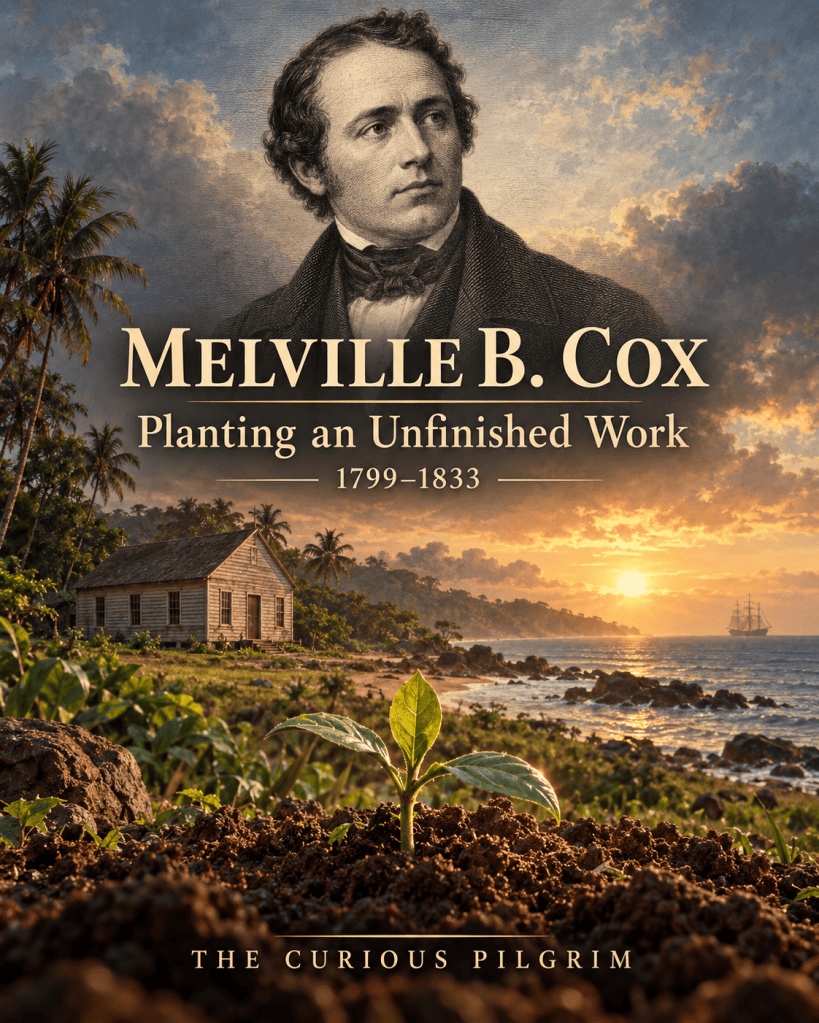
Melville B. Cox knew grief, illness, and interrupted plans.
Born near Hallowell, Maine, in 1799, he entered the New England Methodist Conference as an itinerant preacher in 1822. Tuberculosis forced him to stop preaching in 1825. He moved to Baltimore, worked in a bookstore, and edited a weekly newspaper.
He married Ellen Cromwell, but within two years both Ellen and their young daughter died during a cholera epidemic. Cox returned to pastoral ministry, serving for a time at Edenton Street Methodist Church in Raleigh, North Carolina. Once again, illness forced him to resign.
Cox could have decided that grief and physical weakness had taken away everything he had to offer. Instead, he volunteered to become a missionary. He originally offered to go to South America, but Bishop Elijah Hedding asked him to go to Liberia.
Before sailing, Cox was warned about the danger. He reportedly replied:
“Let a thousand fall before Africa be given up.”
Cox arrived in Monrovia on March 8, 1833. Some of the formerly enslaved and free Black Americans who had settled there were already Christians and had been holding Methodist meetings. Cox did not carry God into a land where God was absent. He joined work that had already begun.
During his brief time in Liberia, Cox helped organize a Methodist Episcopal congregation, established regular worship and a Sunday school, held a camp meeting, and developed plans for missions and education. He also began recording his experiences in Sketches of West Africa.
Within weeks of his arrival, Cox became ill with malaria. He declined an opportunity to return to the United States and died on July 21, 1833. He had been in Liberia for only a little more than four months.
His ministry was brief, but it was not meaningless. When news of his death reached the United States, others volunteered to continue the work. Cox planted seeds whose harvest he would never see.
Yet I cannot remember Melville Cox without also acknowledging the complicated history surrounding his mission.
Liberia grew from the American colonization movement. Some formerly enslaved and free Black Americans viewed settlement in Africa as an opportunity to create a free and self-governing society. But many white supporters of colonization did not want free Black citizens living beside them in the United States. Some enslaved people were offered freedom only if they agreed to leave the country.
Many Black Americans rejected colonization. America was the land of their birth, labor, suffering, families, and faith. They did not believe they should have to leave their home to receive the freedom and equality that already belonged to them.
We must also remember that the land was not empty. Indigenous African peoples already lived there. They possessed families, communities, governments, cultures, wisdom, and spiritual traditions long before American settlers and missionaries arrived.
This was not unique to Liberia. Throughout history, colonization has often been presented in the language of Christianity, education, civilization, or humanitarian service. Beneath that language, however, we frequently discover the pursuit of land, profit, influence, and control.
The church has sometimes offered genuine worship, education, medical care, and compassionate service. It has also become entangled with colonial power. Missionaries sometimes confused American or European culture with Christianity and treated Indigenous people as objects to be changed rather than neighbors from whom they could learn.
Faithfulness does not require us to hide this history. Faithfulness requires us to tell the truth.
We can honor Cox’s courage, sacrifice, and desire to serve without pretending that the system surrounding his work was without sin. We can also recognize that the people of Liberia were not merely recipients of someone else’s mission. God was already present among them. Black settlers and Indigenous Africans possessed voices, gifts, callings, and stories of their own.
Perhaps Cox’s life offers us both inspiration and caution.
His life reminds us that grief, illness, and interrupted plans do not mean we have nothing left to give. His four months of service awakened others to continue an unfinished work.
But his story also reminds us to examine the work we call Christian. Does it respect the dignity and freedom of the people we seek to serve? Are we walking beside them, or attempting to control them? Are we sharing love, or merely imposing our own culture and power?
None of us will complete everything God places in our hearts. We plant seeds, often without knowing who will water them or what kind of harvest they will produce. Our calling is to plant with humility, listen with compassion, serve without seeking control, and trust God with what remains unfinished.
Melville Cox gave what he could for as long as he could. Remembering him honestly means honoring his courage while also listening to the voices history too often left unheard.
Lord Jesus Christ,
teach us to serve with humility.
Forgive us when we confuse our culture with your Kingdom
or use your name to seek power and control.
Teach us to recognize your presence in every people,
to listen to voices that history has silenced,
and to plant seeds of love, justice, and freedom.
When our work remains unfinished,
help us entrust it to others and to your mysterious grace.
Amen.
Source: G. Scott Cady and Christopher L. Webber, A Year with American Saints (Church Publishing, 2006), with additional historical context from Methodist and Library of Congress records.


Leave a comment