
Daily Office Readings — Wednesday, September 9, 2026
Psalm 119:49–72; Psalms 49, 53; Job 29:1; 30:1–2, 16–31; Acts 14:19–28; John 11:1–16
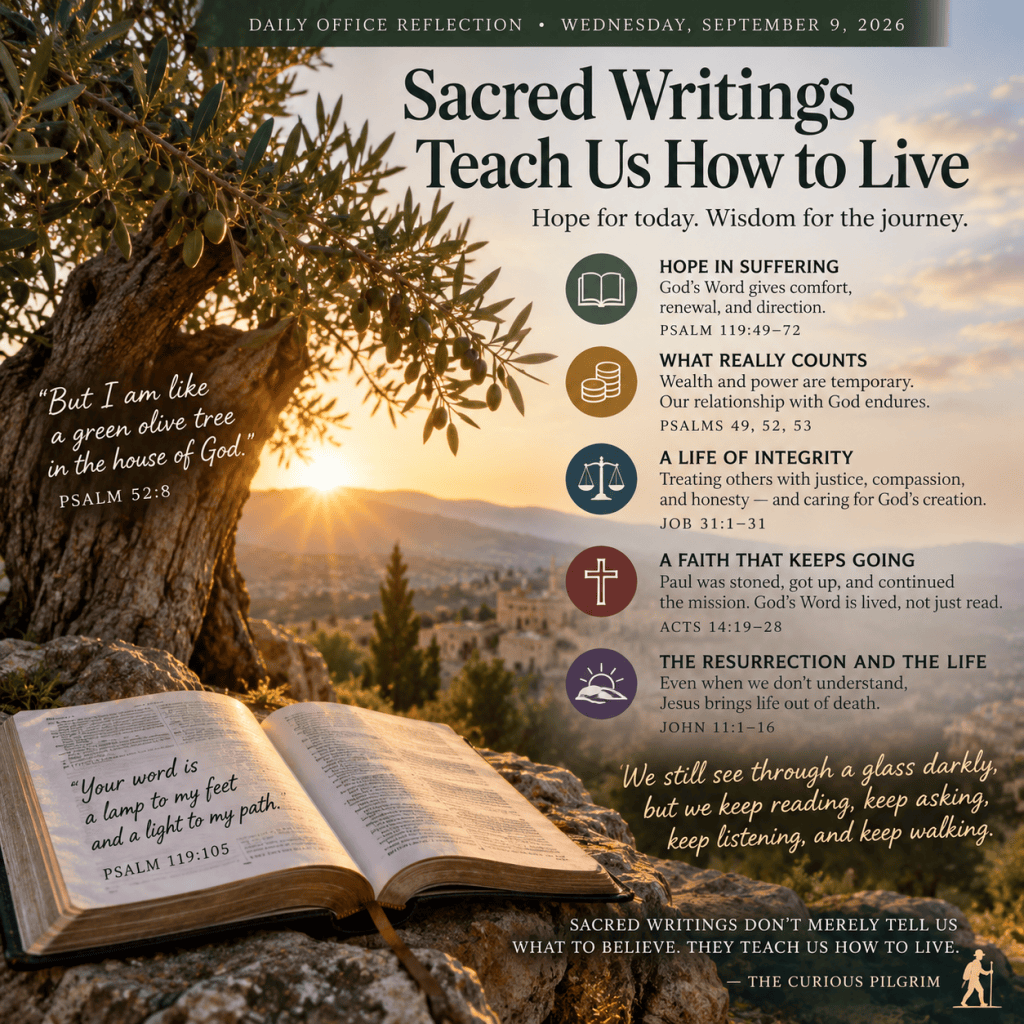
I started reading the Bible when I was eight years old. After all these years, I am still reading it, still asking questions, and still discovering things I had never noticed before.
Maybe that is part of what Paul meant when he said that we see through a glass darkly. We don’t see everything clearly. We don’t understand everything at once. We keep walking, learning, listening, and sometimes seeing something that has been there all along.
That is one reason I prefer to call the Bible the Sacred Writings. They are my primary source of truth, but they are more than a collection of doctrines and rules. They contain stories, poetry, prayers, wisdom, letters, history, and teachings that show us how to live.
Most importantly, they teach us how to live in relationship—with God, others, ourselves, and creation.
We see it from the beginning. In Genesis 1 and 2, humanity is given responsibility for God’s creation. We are stewards, entrusted with caring for what God has made.
Jesus tells us in the Great Commandments to love God with our whole being and to love our neighbor as ourselves.
The Beatitudes in Matthew 5 teach us about mercy, righteousness, humility, purity of heart, and peacemaking.
Romans 12–15 shows us what those relationships look like in everyday life: love genuinely, practice hospitality, bless rather than curse, refuse revenge, live peaceably, stop judging one another, care for the weak, and welcome one another.
Sacred Writings teach us how to live.
Rooted Like an Olive Tree
The Psalms appointed for today take us deeper.
Psalm 119 speaks repeatedly about hope and comfort. The psalmist discovers that God’s Word sustains him during suffering. God’s teachings give him direction and renew his life.
He even recognizes that suffering has taught him something.
That doesn’t mean suffering itself is good. It means suffering does not have to be wasted. We can discover things about God, ourselves, and life while walking through it.
Psalms 49 and 52 remind us that wealth, possessions, status, and human power cannot give us ultimate security. Life is temporary. We cannot purchase our way out of death.
Psalm 52 gives us a beautiful picture:
“But I am like a green olive tree in the house of God.”
I love that image.
The psalmist doesn’t describe himself as a mighty fortress because of his own strength. He describes himself as a tree because of where his roots are.
A tree receives its life. It needs soil, water, sunlight, and the creation surrounding it.
The question becomes:
Where are my roots?
The psalmist answers: I trust in the steadfast love of God.
What Does Integrity Look Like?
Job gives us another way of looking at our relationships.
In Job 31, Job examines his life. He considers his purity and faithfulness, his honesty, his treatment of the poor, widows and orphans, his attitude toward wealth, his treatment of enemies, his hospitality, and even his relationship with the land.
Job’s righteousness isn’t simply about saying, “I believe in God.”
He is saying:
Look at how I lived.
Look at how I treated people.
Look at what I did with what I possessed.
Look at how I treated the vulnerable.
Look at where I placed my trust.
Job also refuses the easy explanation offered by his friends: You are suffering, therefore you must have done something terrible.
Job wants God to weigh his integrity. He wants an answer.
Again, Sacred Writings aren’t giving us a simplistic answer to suffering. They are teaching us how to wrestle faithfully with it.
When the Word Becomes a Life
Then we come to Acts 14.
Paul and Barnabas are nearing the end of their missionary journey. Jews arrive from Antioch and Iconium and stir up the people against them. Paul is stoned, dragged outside the city, and left for dead.
Then something remarkable happens.
The believers gather around Paul.
Paul gets up.
And he goes back into the city.
The next day, Paul and Barnabas continue their journey.
Eventually, they return through the very communities where they had experienced opposition, strengthening the believers and reminding them that entering God’s Kingdom can involve suffering.
Finally, they return to Antioch in Syria, the community that had sent them out.
What do they report?
They tell the church what God had done through them.
Psalm 119 tells us that God’s Word provides hope and comfort in suffering.
Acts 14 shows us what that looks like when somebody lives it.
Paul’s battered body becomes part of his testimony.
He has suffered, but his roots are still there.
Like the olive tree, he remains rooted in God.
When Jesus Waits
Then John 11 takes us into another kind of suffering.
Lazarus becomes sick.
Mary and Martha send word to Jesus:
“Lord, he whom you love is ill.”
They know Jesus loves Lazarus. They know Jesus can heal him.
But Jesus waits.
Two more days.
Lazarus dies.
Imagine Mary and Martha during those days.
Where is Jesus?
Why hasn’t he come?
Why didn’t he do something?
Those are questions people still ask.
Jesus eventually tells the disciples they are going back to Judea. They don’t want him to go because people there have already tried to stone him.
But Jesus goes anyway.
And then Thomas—the disciple we usually remember for doubting—says something courageous:
“Let us also go, that we may die with him.”
The rest of John 11 takes us to the words we so often hear at funerals:
“I am the resurrection and the life.”
Jesus doesn’t merely say that he knows something about resurrection.
He says:
I AM the resurrection.
And before Lazarus comes out of the tomb, something else happens.
Jesus weeps.
God’s answer to human suffering isn’t always an explanation.
Sometimes God enters the suffering with us.
We Still See Through the Glass Darkly
Maybe that brings us back to something Paul wrote in 1 Corinthians 13.
We see through a glass darkly.
Mary and Martha couldn’t see what Jesus was doing.
Job couldn’t understand why he was suffering.
Paul couldn’t know everything awaiting him when he and Barnabas began their missionary journey.
And the psalmist couldn’t escape the reality that wealth, power, and human strength eventually disappear.
Neither can we.
I have been reading these Sacred Writings for nearly seventy years, and I still find things I hadn’t seen before.
I find the same thing when reading other stories.
The Pilgrim’s Progress makes me think.
The Way of a Pilgrim makes me think.
A Year with American Saints makes me think.
Charles Sheldon’s In His Steps makes me think.
Sheldon told stories that presented people with moral dilemmas and invited them to ask:
What would Jesus do?
Jesus told stories too.
Think about Jonah.
At first, we might think Jonah is simply about a man and a great fish. Keep reading, and suddenly we encounter a man angry because God showed mercy to people he didn’t think deserved it.
Then the story asks me:
Is there somebody I don’t want God to forgive?
Think about the Prodigal Son.
Maybe at one time I identify with the younger son coming home.
Another time I notice the father running down the road.
And another time I discover that I might be standing outside with the older brother, angry because somebody else received grace.
Stories become mirrors.
Sacred Writings become mirrors.
They don’t simply tell us what happened thousands of years ago.
They ask:
Where are your roots?
How are you treating your neighbor?
How are you treating yourself?
How are you caring for God’s creation?
What are you trusting?
What kind of fruit is growing from your life?
We may still see through the glass darkly.
But we keep reading.
We keep asking.
We keep listening.
We keep learning.
We keep walking.
And along the way, the glass becomes a little clearer.
Perhaps that is one reason God’s Word brings such hope and comfort.
It doesn’t merely teach us what to believe.
Sacred Writings teach us how to live.
And ultimately, Jesus gives us hope that even death cannot destroy.
He is the resurrection and the life.
So, Curious Pilgrim, keep reading.
Keep asking questions.
Keep examining your roots.
And keep walking.
There is always more to see.


Leave a Reply