
September 9, 2026 — A Year with American Saints
Charles Sheldon, February 26, 1857–February 24, 1946
What Would Jesus Do?
I first became acquainted with Charles Sheldon when I studied homiletics at Free Will Baptist Bible College.
Looking back, there is a little irony in that. Sheldon was sometimes described as a Christian socialist and became associated with what was called the Social Gospel. Neither description would have been particularly popular at Free Will Baptist Bible College in those days.
But that wasn’t why we were studying him.
We studied Charles Sheldon because he was a master storyteller.
Expository preaching was certainly the norm in my Bible college days, but we also studied different methods of sermon preparation and delivery. Sheldon fascinated me because he could tell a story from the pulpit that placed people inside a moral dilemma and made them think.
I was drawn to that.
Perhaps another seed was being planted.
What Would Jesus Do?
Sheldon’s best-known book, In His Steps, grew out of stories he told his congregation from the pulpit. His characters encountered real-life situations and faced a deceptively simple question:
What would Jesus do?
That question sounds simple until you actually try to live it.
Life is filled with decisions that don’t always come with a Bible verse attached to them.
We read Scripture. We listen to the wisdom handed down through the Christian tradition. We consider our lived experience. And God has given us minds capable of reasoning and discerning.
Somewhere in the middle of all of that, we have to choose.
What would Jesus do?
And perhaps the harder question is:
What will I do?
That is where theology becomes discipleship.
A Gospel That Changes How We Treat People
I was also attracted to Sheldon’s concern for the problems he saw around him.
He advocated equality for Black Americans and women. He welcomed Black members into his congregation. He was concerned about poverty and deprivation. He supported prohibition because he saw the destruction alcohol could bring into families and communities.
Those things mattered to me.
I grew up in the Deep South, where I saw a world in which Black people and women experienced discrimination simply because of who they were.
So when I encountered a preacher who believed following Jesus should change the way we treat people, something resonated within me.
Again, another seed was planted.
Over the years, I have read criticisms that Sheldon emphasized the Social Gospel more than personal redemption.
That doesn’t particularly trouble me.
Neither does the label “progressive Christian.”
I’ve accumulated enough labels during my pilgrimage already.
Baptist.
Nazarene.
Methodist.
Episcopalian.
Conservative.
Progressive.
Traditional.
Social Gospel.
Labels may tell us something about where a person stands, but they don’t necessarily tell us whom that person is following.
The question Sheldon planted in me goes underneath all those labels:
Am I walking in the steps of Jesus?
From a Bracelet to a Way of Life
In the 1990s, Sheldon’s question experienced an enormous revival.
WWJD.
What Would Jesus Do?
It appeared on bracelets, shirts, bumper stickers, jewelry, and all sorts of Christian merchandise. People inside and outside churches became familiar with those four letters.
I sometimes wonder what Charles Sheldon would have thought about that.
I’m not sure he would have been particularly impressed by the bracelet.
I think he would have been much more interested in what happened after we looked at it.
Because in In His Steps, asking “What would Jesus do?” changes people’s lives.
It affects how they use their money.
It affects their businesses.
It affects their careers.
It affects their relationships.
It affects how they treat the poor and marginalized.
It affects their churches.
It costs them something.
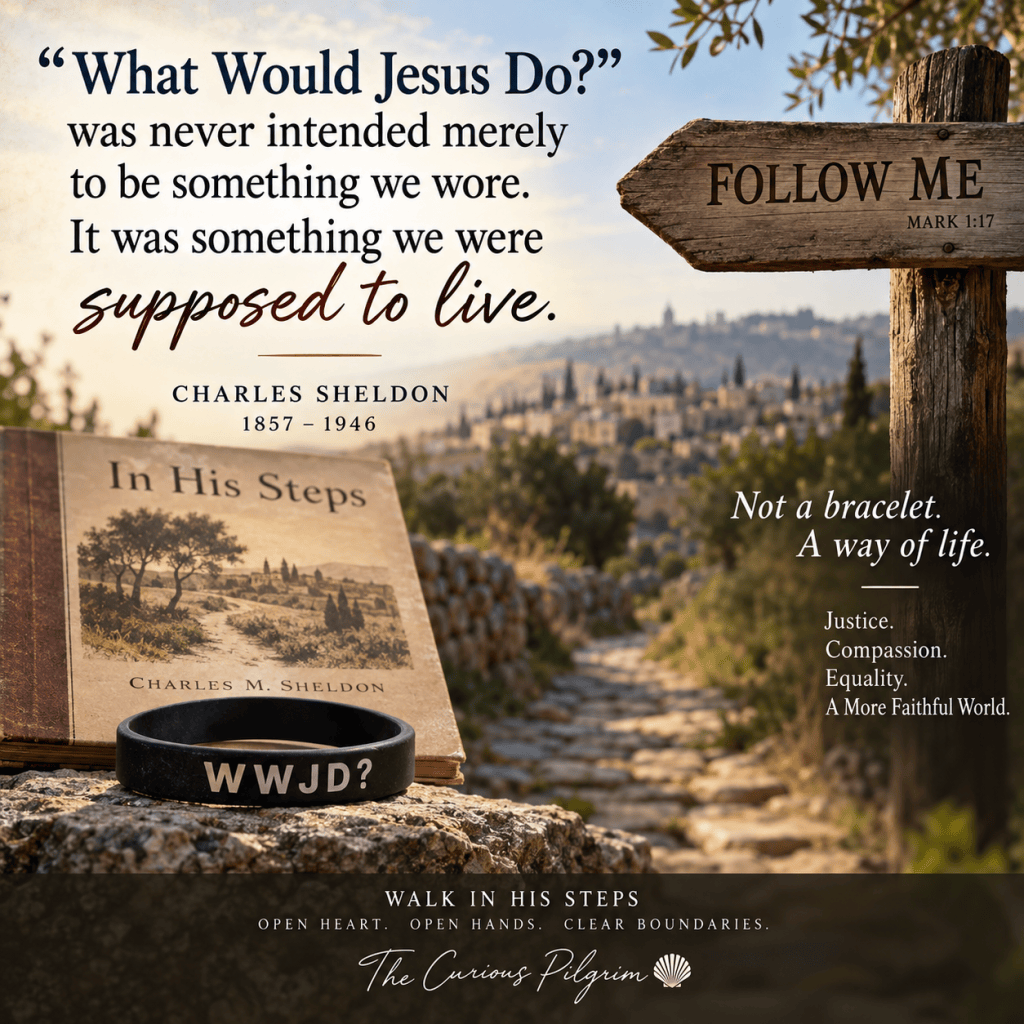
What Would Jesus Do? was never intended merely to be something we wore. It was something we were supposed to live.
Walking Where Jesus Walked
Another influence upon me has been the old hymn I Walked Today Where Jesus Walked.
There is something beautiful about imagining those places where Jesus actually walked—the roads, hills, villages, and streets of the Holy Land.
But today I see a connection I didn’t see when I was younger.
The hymn invites me to imagine walking where Jesus walked.
Charles Sheldon challenged me to consider whether I am willing to walk as Jesus walked.
Those are two very different things.
I can admire Jesus.
I can study Jesus.
I can preach about Jesus.
I can sing about Jesus.
I can wear a cross around my neck.
I can belong to a church.
I can call myself a Christian.
But Jesus said:
“Follow me.”
That requires a choice.
Another Seed Along the Journey
Looking back across nearly eight decades of life, I can see how God planted seeds long before I understood what they would become.
Charles Sheldon was one of those seeds.
A book I encountered while studying preaching became part of something much larger.
It influenced how I thought about preaching.
It influenced how I thought about the mission of the Church.
It influenced how I thought about justice.
It influenced how I approached moral decisions.
And ultimately, it contributed to the way I understand myself today.
I have become increasingly comfortable simply saying:
I am a follower of Jesus.
That doesn’t erase my past.
I learned things from the Baptists.
I learned things from the Nazarenes.
I learned things from the Methodists.
I am still learning things from the Episcopalians.
Tradition matters.
Scripture matters.
Experience matters.
Reason matters.
But none of those is the destination.
I am still a pilgrim.
And somewhere along the road, a Congregational preacher named Charles Sheldon planted a question in my heart:
What would Jesus do?
After all these years, perhaps I hear the question a little differently.
Will I walk in His steps?
Grace invites me.
Jesus says, “Follow me.”
And God gives me the freedom to choose.
So this Curious Pilgrim keeps walking.
Open heart. Open hands. Clear boundaries.
And, by the grace of God, following in His steps.


Leave a Reply