
Daily Office Readings for Thursday, September 3, 2026: Psalm 37, Job 16:16-22, 17:1,13-16. Acts 13: 1-12, John 9:1-17.
There is an old hymn that says:
“God moves in a mysterious way, His wonders to perform.”
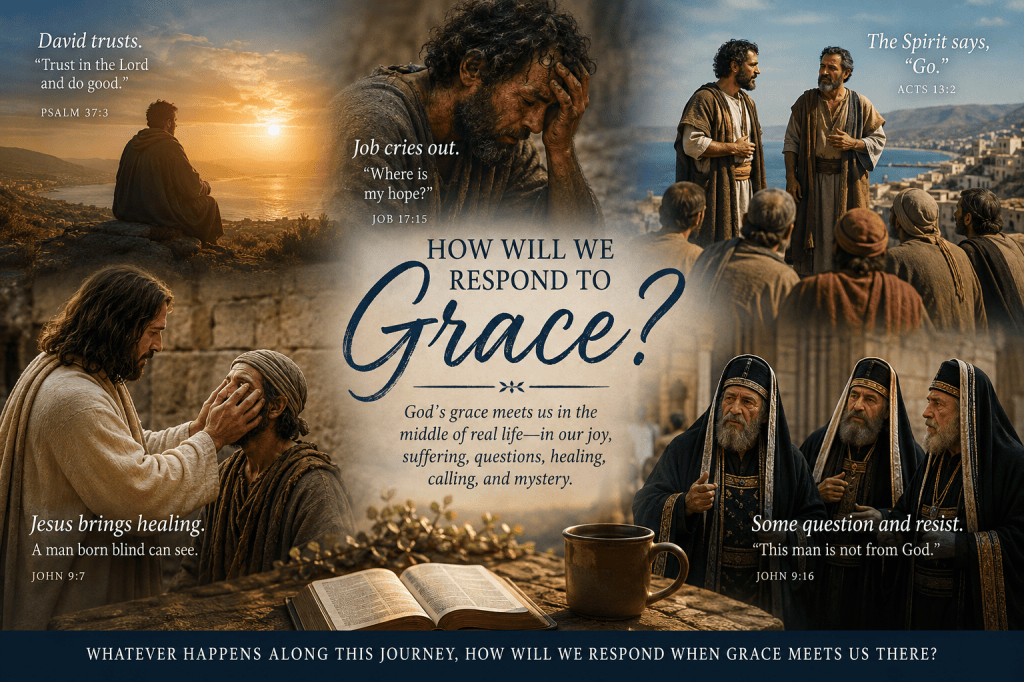
That kept coming to my mind as I read today’s Daily Office readings. They take us from David, to Job, to Paul and Barnabas, and finally to a man who had been blind from birth. These are very different stories, but together they caused me to think about God’s grace and the different ways we human beings respond to it.
Psalm 37 begins with David offering some wonderful advice:
Trust in the Lord and do good.
Take delight in the Lord.
Commit everything you do to the Lord.
Be still in the presence of the Lord.
Stop being angry.
Turn from evil and do good.
Put your hope in the Lord.
Don’t worry about the wicked.
These are words of assurance, hope, and faith.
But I have to admit that some of David’s other statements bother me.
David seems to suggest that if we trust God, we will live in safety and prosper, while the wicked will eventually disappear.
I understand what David is saying, but life has taught me that it isn’t always that simple.
I have heard similar statements in the church: “Come to Jesus and everything is going to be all right.”
There was a time when I halfway believed that.
Then Amanda Joy, our daughter, died in the womb.
Suddenly, simple answers weren’t enough.
Good people suffer. Faithful people suffer. James followed Jesus, yet Herod had him killed. Stephen faithfully proclaimed Christ and was stoned. Jesus himself was crucified.
There is also the matter of human freedom. God has given us the ability to choose, and our choices affect other people. Sometimes we suffer because of our own choices. Sometimes we suffer because of someone else’s choices. And sometimes things happen that nobody chose.
Then I turned from Psalm 37 to Job.
What a contrast!
David seems to be on a spiritual high, confidently telling us to trust God.
Job is at a spiritual low.
Job believes he has done nothing to deserve what is happening to him. He says his prayer is pure, yet he has cried until dark shadows surround his eyes. He feels crushed. His spirit is broken. Death seems near.
And he asks:
Where is my hope?
I appreciate Job’s honesty.
He doesn’t pretend everything is all right when it isn’t. He doesn’t manufacture a testimony because he thinks that is what a person of faith is supposed to do.
He tells God the truth.
Maybe that is faith too.
Sometimes faith says with David, “Trust in the Lord.”
Sometimes faith cries with Job, “Where is my hope?”
Then we come to Acts 13, and the scenery changes again.
The church at Antioch is worshiping, praying, and fasting when the Holy Spirit calls Barnabas and Saul to a new work. They listen and go.
Almost immediately, they encounter opposition.
A Jewish sorcerer named Bar-Jesus, also called Elymas, attempts to prevent the governor, Sergius Paulus, from hearing their message. Paul, filled with the Holy Spirit, confronts him, and Elymas is temporarily struck blind.
Sergius Paulus sees what happens and believes, astonished by the teaching about the Lord.
Once again, people encounter God’s grace and respond differently.
Paul and Barnabas follow it.
Sergius Paulus receives it.
Elymas opposes it.
Then we arrive at John 9.
Jesus encounters a man who has been blind from birth.
The disciples immediately want an explanation.
“Who sinned, this man or his parents?”
There it is again—the assumption that suffering must mean somebody did something wrong.
Jesus refuses that explanation.
Then Jesus heals the man.
You would think everyone would rejoice. A man who couldn’t see can see!
Instead, the Pharisees are upset because Jesus healed him on the Sabbath.
They begin questioning what happened. They question the man. They even question whether he had really been blind.
Why?
Because what God had done did not fit their understanding of how God was supposed to work.
I have met people like that.
Sometimes we become so certain about what God can do, whom God can use, where God can work, and how God’s grace is supposed to appear that when grace shows up outside our boundaries, we try to explain it away.
And suddenly I see something connecting all these readings.
God’s grace encounters humanity, and humanity responds.
David trusts.
Job cries out.
Paul and Barnabas go.
Sergius Paulus believes.
Elymas resists.
The blind man receives.
The Pharisees question and argue.
And perhaps that is where the mystery lies.
God’s grace does not mean everything that happens to us will be good. It does not mean faithful people will never suffer. It does not mean we will always understand what God is doing.
Grace isn’t a transaction where I give God my faith and God guarantees me a trouble-free life.
Grace is God’s presence and activity meeting us in the middle of real human life—with all its freedom, suffering, joy, questions, opposition, healing, loss, and mystery.
Sometimes I may be David, confidently saying, “Trust in the Lord.”
Sometimes I may be Job, crying, “Where is my hope?”
Sometimes I may be Paul and Barnabas, hearing, “Go.”
Sometimes I may be the blind man, surprised by grace I never expected.
And if I am not careful, I might even become like the Pharisees—so certain that I understand God that I fail to recognize grace standing right in front of me.
Maybe the question isn’t:
“If I trust God, will everything be all right?”
Maybe the better question is:
“Whatever happens along this journey, how will I respond when grace meets me there?”
That is a question this Curious Pilgrim needs to keep asking.
Prayer
Gracious God,
Teach me to trust when I am confident like David
and to speak honestly when I am broken like Job.
Give me courage to go when your Spirit calls,
eyes to recognize grace when it appears,
and humility to admit when you are working beyond the boundaries of my understanding.
When I cannot understand what is happening,
keep me from easy answers.
When others suffer,
keep me from assuming I know why.
When grace appears somewhere I did not expect to find it,
give me enough humility to rejoice rather than explain it away.
And wherever this mysterious journey takes me,
help me remain open to your grace
and respond with faith, love, mercy, and hope.
Amen.
“Trust in the Lord and do good; dwell in the land and enjoy safe pasture.” — Psalm 37:3


Leave a Reply