
Daily Office Reflection — Wednesday, September 2, 2026
Psalm 38; Psalm 119:25–48; Job 12:1, 14:1–22; Acts 12:18–25; John 8:47–59
Sometimes when I read the Daily Office, the readings seem unrelated at first. One passage speaks of suffering. Another speaks about God’s commandments. Job is lamenting the frailty of human life. Herod is sitting on his throne accepting the praise of the people. Jesus is arguing with people who are convinced that they understand God.
But when I sit with these passages and listen, I begin to hear a conversation taking place among them.
And perhaps that is the point.
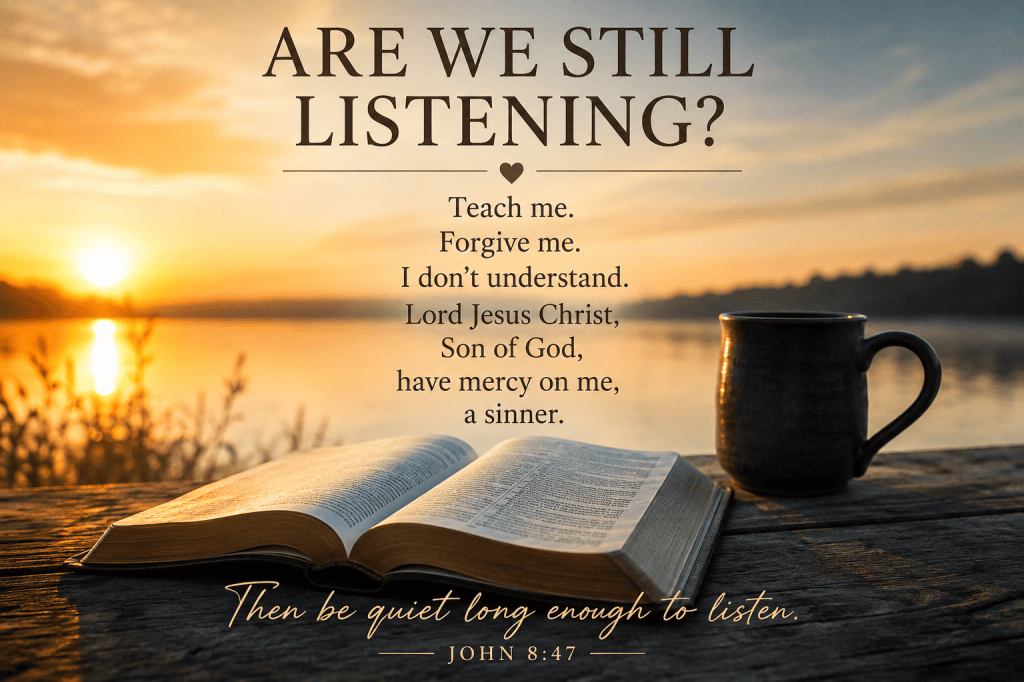
Are we still listening?
Psalm 38 gives us David suffering physically and emotionally. He recognizes that some of his suffering is connected with his own choices. He doesn’t make excuses. He doesn’t try to hide from God.
He confesses.
He is deeply sorry.
And then he cries for God to come quickly and help him.
As I read David’s prayer, I hear something that reminds me of the Jesus Prayer:
Lord Jesus Christ, Son of God, have mercy on me, a sinner.
David lived long before Jesus walked the roads of Galilee, but he knew what it meant to cry out for mercy.
There are times when we suffer because of our own choices. But that isn’t the only reason we suffer.
Sometimes we suffer because of the choices of others. David knew that kind of suffering too. His family was torn apart by violence, betrayal, and rebellion. He experienced war and the loss of people he loved.
And sometimes suffering comes simply because we live in a fragile world. There are floods, fires, famines, disease, accidents, aging, and death.
That brings us to Job.
Job says:
“How frail is humanity! How short is life, how full of trouble!”
Job doesn’t understand what has happened to him. Unlike David in Psalm 38, Job cannot simply point to something he has done and say, There is the reason for my suffering.
Job asks why.
He laments.
He even looks at a tree and says that the tree seems to have more hope than he does. Cut down a tree and, at the scent of water, it may sprout again.
Yet buried within Job’s lament is an extraordinary hope. Job imagines God calling and himself answering. He imagines God yearning for the creature God’s own hands have made. He imagines his sins being placed in a pouch and covered.
That reminds me of an illustration attributed to Corrie ten Boom. She pictured God casting our forgiven sins into the depths of the sea and putting up a sign:
No fishing allowed.
Stop dragging back up what God has forgiven.
Then Psalm 119 gives us another voice.
The Psalmist repeatedly asks God to teach, guide, strengthen, and give understanding.
We often read references to God’s “word” in Psalm 119 and immediately think of the Bible as we possess it today. But the Psalmist did not have a sixty-six-book Christian Bible. The Psalm speaks of God’s Torah—God’s instruction, commandments, statutes, promises, and ways.
It is about listening to what God communicates and learning how to live accordingly.
The Psalmist makes a statement that can sound strange to modern ears:
“I will walk in freedom, for I have devoted myself to your commandments.”
We sometimes think freedom means having no commandments.
The Psalmist sees it differently.
God’s ways show us how to become free.
The Jewish tradition speaks of 613 commandments in Torah, but Jesus later takes us to the heart of them: love God with all your heart, soul, mind, and strength, and love your neighbor as yourself.
Repentance, then, is more than feeling sorry. It means turning. It means allowing God’s mercy to change the direction in which we are walking.
And then we come to Herod in Acts.
Herod has exercised tremendous power. James has been killed. Peter has been imprisoned. After Peter escapes, the guards pay for it with their lives.
Then Herod puts on his royal robes and addresses the people.
They shout:
“It’s the voice of a god, not of a man!”
And Herod accepts their praise.
Here is the irony.
Job knows that he is frail.
Herod has forgotten that he is frail.
Job questions God because he doesn’t understand.
Herod listens to people telling him exactly what he wants to hear.
Acts tells us that Herod dies under God’s judgment.
But then Luke adds something wonderful:
The word of God continued to spread.
Herod could kill James.
He could imprison Peter.
He could execute guards.
But Herod could not stop the Gospel.
And that brings us finally to John.
Jesus says:
“Anyone who belongs to God listens gladly to the words of God.”
The people standing before Jesus believe they understand God. They know their religious tradition. They claim Abraham as their father. They are certain of their interpretation.
Yet the Gospel of John began by telling us:
“In the beginning was the Word.”
Jesus is the Logos.
The Living Word is standing in front of people who believe they understand God’s Word—and they cannot hear him.
Jesus finally declares:
“Before Abraham was even born, I AM!”
And instead of stopping to listen, they pick up stones to kill him.
That frightens me more than Job’s questions.
Job can say:
I don’t understand.
David can say:
I have sinned. Have mercy on me.
The Psalmist can say:
Teach me.
But Herod listens to the voices that flatter him, while the people confronting Jesus are so certain that they already understand God that they cannot hear the Living Word standing in front of them.
Perhaps certainty without humility is more dangerous to our spiritual lives than questions.
There are always voices speaking.
Religious voices.
Political voices.
Cultural voices.
Voices telling us what we want to hear.
Voices confirming what we already believe.
And somewhere among all that noise, God continues to speak.
Perhaps that is why silence matters.
Perhaps that is why listening matters.
Perhaps sometimes we need to stop defending what we already think we know and simply pray:
Teach me.
Forgive me.
I don’t understand.
Lord Jesus Christ, Son of God, have mercy on me, a sinner.
And then be quiet long enough to listen.
Because the question may not be whether God is still speaking.
The question may be:
Are we still listening?
Prayer
Living God,
quiet the voices that keep us from hearing you.
When we have sinned, give us the humility to confess.
When we are suffering, give us the freedom to lament.
When we do not understand, give us the courage to ask why.
When we think we already know, give us the humility to listen again.
Teach us your ways.
Lead us in your truth.
Keep us from voices that flatter us and from certainty that closes our hearts.
Lord Jesus Christ, Son of God, have mercy on us.
And in the silence, teach us to listen.
Amen.
“Anyone who belongs to God listens gladly to the words of God.” — John 8:47


Leave a Reply