
Remembering the grace that brought me here
In Psalm 77, the writer struggles to find comfort. Remembering earlier mercies initially makes the present silence even harder to bear. Yet he continues remembering, turning toward the story of God leading the people through the sea.
I understand something of that movement. Looking back, I remember the prompting to begin reading the Bible when I was eight. I remember the call to ministry at fourteen, followed by Bible college and seminary. Those are places where I can recognize God’s grace.
I also see grace in the years when I veered off course.
There came a time when I brought a simple confession to God: I am wounded, and I need healing. As I opened myself to that healing, the Holy Spirit helped me see my life more clearly. Grace had been at work through more of my story than I had understood.
That remembrance gives me hope for tomorrow. I cannot see the whole road ahead, but I can remember the faithfulness that has accompanied me this far.
Learning to live in prayer
There is a family story about my great-grandfather being asked to offer the closing prayer at a church service. He told the preacher to do it because that was what the preacher was paid to do.
That story makes me smile, but it also makes me sad. How many of us grow up around prayer without discovering its importance in our own lives?
Psalm 79 brings a devastated community into conversation with God. Psalm 80 returns repeatedly to a plea for restoration. These people pray from the middle of their wounds. They give us permission to do the same.
Prayer is the art of communication with God. Through the Jesus Prayer and the pilgrimage writings I have been reading, Paul’s invitation to pray without ceasing has taken on deeper meaning for me. Prayer can accompany our breathing, our work, our silence, and our encounters with others.
My whole self belongs in that communion: physical, emotional, spiritual, and rational. My body breathes. My emotions find expression. My mind learns to attend. My heart opens to God.
I am discovering how prayer participates in the renewing of the mind. We bring our emotional baggage into God’s presence and become more able to recognize what needs healing. Grace can work through that prayer, through other people, and through the steps we learn to take.
Psalm 80’s vine gives me an image for this growth. Roots draw nourishment; the vine sustains the branches; leaves help nourish developing fruit. Maturity takes time and a living connection. As I remain open to God, I trust grace to nurture the fruit of patience, kindness, compassion, and love.
Finding grace among the ruins
Joel describes a land devastated by locusts. Food, livelihood, and the offerings of worship are affected. The people are called to lament together.
Reading this, I remember Hurricane Katrina. Some people claimed the storm was punishment for the evil of New Orleans. I cannot claim to know God’s purposes in that way, and I do not believe suffering gives us permission to condemn its victims.
What I can tell you is what I witnessed in Laurel, Mississippi. People crossed racial boundaries and worked together to recover. Through shared labor and mutual care, a closer community began to grow.
I saw miracles of grace in that recovery. The devastation was real. So were the acts of love that followed it.
Lament can open us to our neighbors’ suffering. Prayer can move our hands toward the work of restoration.
Whose place are we preparing?
Revelation’s picture of Babylon asks difficult questions about wealth and power. Those who profited from its luxury mourn its fall. The reading ends by exposing violence and the blood of those who were slain.
It makes me examine the contradictions in our own lives. We grumble about unfairness while admiring wealth and influence. We can make life harder for the poor, the hungry, the widow, and the prisoner while calling ourselves faithful.
I have to let that question reach me, too. Whose suffering am I overlooking? What am I willing to support because it protects my comfort?
Wealth cannot guarantee a seat at God’s table.
In Luke, Jesus tells his host to invite people who cannot repay him. Then he tells of a banquet whose invited guests make excuses. The invitation goes out to people usually left outside, and still there is room.
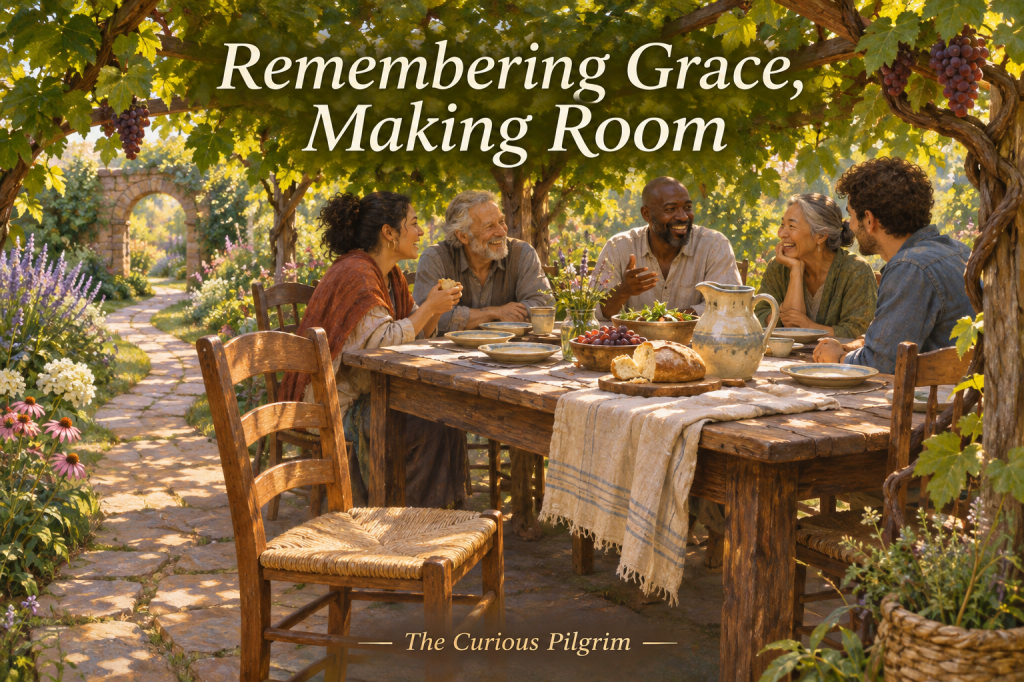
The table represents so much in my understanding of God. I believe God’s welcome reaches toward anyone and everyone. That belief asks something of the way I live.
Part of my Jesus Prayer has become: Lord Jesus Christ, teach me to welcome those who cross my path.
This is not always easy. After nearly seventy-seven years, I know how old wounds, assumptions, and fears can narrow a person’s welcome. I still need wisdom, clear boundaries, and a heart willing to learn.
So I return to prayer. I remember the grace I have received. I ask God to keep tending the vine and bringing its fruit to maturity in me.
Today, that fruit may begin with making room for one more person.
I will, with God’s help.
A prayer
Lord Jesus Christ, help me remember the grace that has carried me. Heal what is wounded, renew my mind, and keep me rooted in your love. Teach me to see with compassion, listen with wisdom, speak with love, and discern what is true and loving. Open my hands to serve, and teach me to welcome those who cross my path. With your help, may my life make room for others at your table. Amen.
—The Curious Pilgrim


Leave a Reply