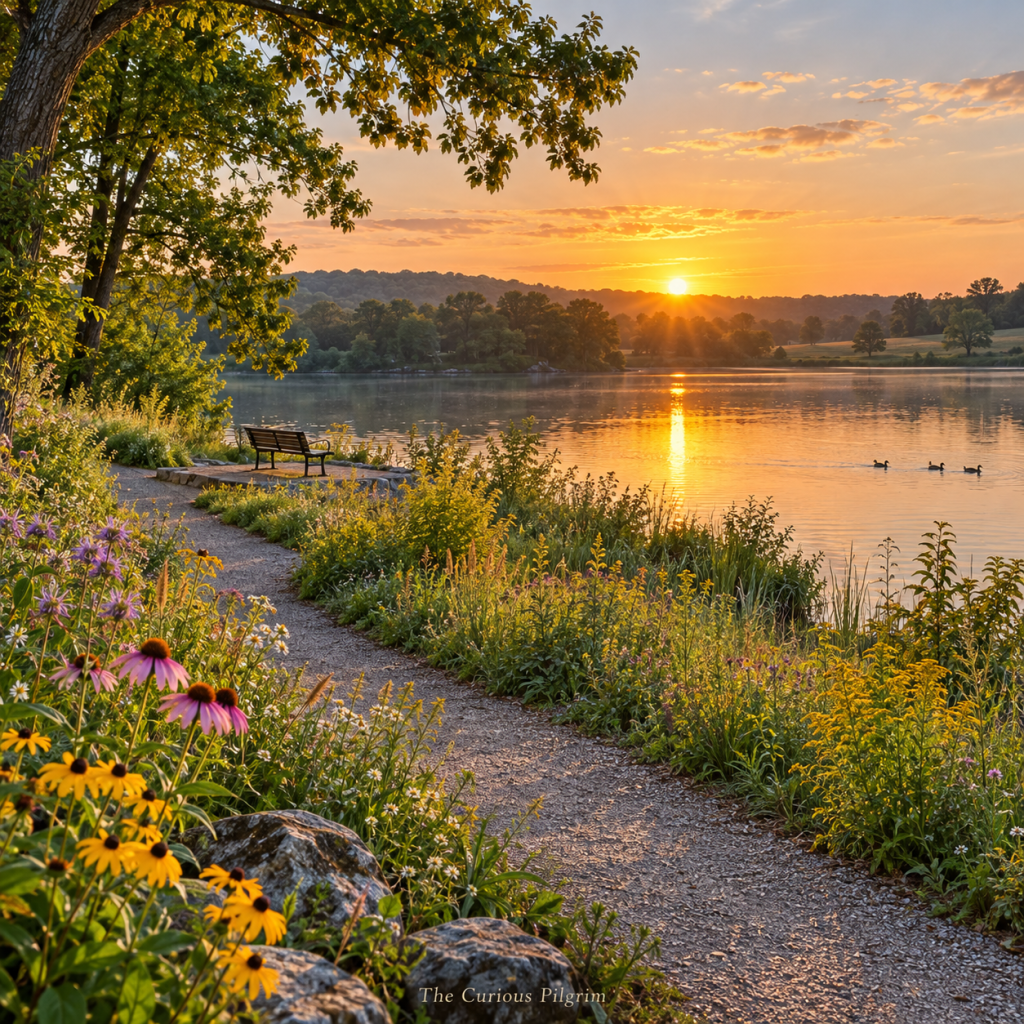
Early one morning, I walked around Sequiota Park, where I live. The park was quiet, with few people about. In summer, the lake is filled with ducks. As I walked beside it, I prayed, “Lord Jesus Christ, have mercy on me. Lord Jesus Christ, have mercy on me.”
No bolts of lightning or voices from the sky. Instead, as the sun rose in the east, peace came quietly. I sat on a bench for a few minutes and thanked God for peace and joy amid so much confusion and division in our country and our world. What a beautiful sunrise!
From the lake, I walked toward the Galloway Trail, which runs for miles through southeast Springfield. I marveled at the trees and plants along the path. I stopped to breathe in their scents and take in the view: so many kinds of plants growing alongside one another.
That sight brought back a memory of my sister taking me into a meadow filled with wildflowers. I was so concerned about coordinating my clothes that she wanted me to see something larger. When we stood in the middle of the meadow, she asked, “What do you see?”
“Flowers,” I answered.
“Ah,” she said, “but do you notice the array of colors and the variety of plants? This is how God made us. Does it matter in eternity if your shirt matches your pants after seeing this?”
I have never forgotten her question.
In Chapter Two, “Walking,” of The Road to Emmaus: Pilgrimage as a Way of Life, Jim Forest invites us to see walking as more than getting from one place to another. Our bodies and spirits belong together. Jesus walked on this earth in a human body; his feet touched the ground. And our everyday physical lives can become places where the spiritual and the ordinary meet.
As I walked and prayed, I began to understand that walking can help me pay attention—to my breath, to the path beneath my feet, to the beauty around me, and to God’s presence in the moment. It doesn’t have to be a long journey. A pilgrim can be surprised on a familiar trail.
G. K. Chesterton is often credited with saying, “I am astonished at the people who are not astonished.” Forest writes that part of a pilgrim’s work is to be surprised. My sister helped me see that wonder: not merely that there were flowers, but that there were so many colors and kinds, each adding to the beauty of the meadow.
Maybe walking helps open our eyes again. We notice that creation is not all one color, that different forms of life share the same ground, and that beauty can be waiting along an ordinary path. We breathe, pray, look, and allow ourselves to be surprised.
What might we see if we slowed down enough to notice the world beneath our feet?
Source: Jim Forest, The Road to Emmaus: Pilgrimage as a Way of Life (Maryknoll, NY: Orbis Books, 2007), chapter 2, “Walking.”


Leave a Reply