“Set up road markers for yourself;
make yourself signposts;
consider well the highway,
the road by which you went.”
—Jeremiah 31:21
I have begun reading The Road to Emmaus: Pilgrimage as a Way of Life by Jim Forest. Chapter One, “The Road,” opens with these words from Jeremiah. Forest describes roads as “the circulatory system of the human race and the original information highway.”
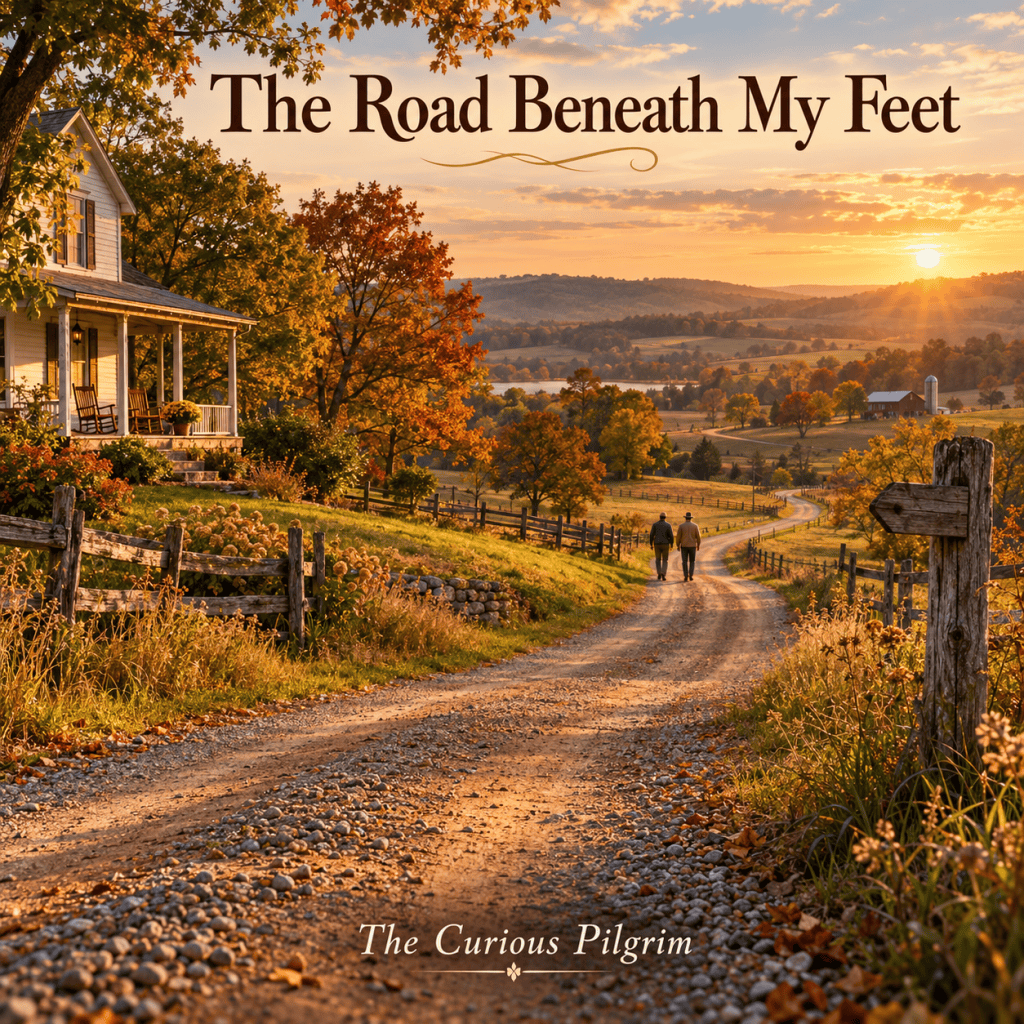
Those of us who grew up in rural America during the 1950s and 1960s can understand that observation. I remember roads made of gravel or clay. Our nearest neighbor was a mile away. When a car came down the road or someone walked by, we noticed. Often, they stopped for a brief chat. Sometimes they came up on the porch, sat down with my parents, and stayed for a conversation.
The road brought the world to our doorstep.
It also took us to church, school, and town, and sometimes to the fields where we grew crops. Along those roads we learned about our neighbors, heard the news, and shared the ordinary business of living.
Over time, roads were paved. Some became concrete. Others disappeared. The landscape changed, and so did we.
Reading Jeremiah’s words, I find myself looking back at more than the roads of my childhood. I am considering the road by which I have come—the people I have met, the choices I have made, the turns I have taken, and the places where I have needed to begin again.
I call myself the Curious Pilgrim because I am still traveling, still learning, and still following Jesus. Some of my traveling now takes place while I sit quietly, read the Sacred Writings, or pray. There is still much for God to help me see.
Jesus spoke of a broad road leading to destruction and a narrow way leading to life. I have thought about those roads since I was young. I remember studying Robert Frost’s “The Road Not Taken” and comparing it with Jesus’ teaching. Both brought me face to face with the importance of choices.
Frost’s poem also reminds me how uncertain a choice can feel when we stand before it. We cannot see the whole road ahead. Later, we look back and try to understand what that choice has meant.
I have done plenty of that.
There have been times when I was certain I knew where I was going. There have been other times when I hardly knew which way to turn. Looking back, I can see things I could not understand while I was living them.
The narrow way asks something of us. Following Jesus can require sacrifice, truthfulness, forgiveness, and the willingness to change. But I do not believe hardship alone tells us we are on the right road. I need to ask what my walking is producing. Am I becoming more loving? More merciful? More willing to listen? Can I acknowledge when I am wrong?
Then I think about the roads in the stories of our faith.
Two disciples walked toward Emmaus, carrying disappointment and trying to make sense of what had happened. The risen Jesus joined them, but they did not recognize him. He listened, spoke with them, and opened the Scriptures. Later, in the breaking of bread, their eyes were opened.
That gives me hope. There may be times when I wonder where Jesus is, only to discover that he has been walking beside me.
Paul traveled toward Damascus convinced that he was doing what was right. On that road, he encountered Christ, and his life changed direction.
That gives me something to consider. Being certain does not mean I have understood everything. I need to remain open to correction. Sometimes the next faithful step begins with admitting that I need to turn around.
And then there is the son who went away, lost so much, and finally started home. While he was still far off, his father saw him and ran to meet him.
That gives me courage. The road home is still open. I can acknowledge where I am, rise, and begin walking toward the One whose mercy is greater than my failures.
Jeremiah’s words about road markers belong to a promise of return. Remember the way. Set up signposts. Come home.
What might those signposts look like in my life?
I think of a passage of Scripture that helped me through a difficult season. A person who listened when I needed to speak. Someone whose kindness helped me understand the love of God. A mistake that taught me humility. A prayer I could barely whisper but prayed anyway.
These are places where I can pause and remember: God met me here.
Reading the Sacred Writings, praying, worshiping, serving, and sharing life with others help me pay attention to the road beneath my feet. Sometimes another person sees something I have missed. Sometimes I need to slow down long enough to hear.
Perhaps that is another lesson from those childhood roads. We made room for people to stop. We listened to their stories. We welcomed them onto the porch.
I wonder how often God still meets us in those ordinary encounters.
I do not know every turn that lies ahead. But I can consider the road by which I have come, give thanks for the grace I have received, and ask for guidance for the next step.
Lord Jesus Christ, have mercy on me. Teach me to see. Help me recognize you beside me, receive correction when I need it, and trust your love when it is time to come home.
What are the road markers in your life? Where can you look back and say, “God met me there”?
—The Curious Pilgrim
Source: Jim Forest, The Road to Emmaus: Pilgrimage as a Way of Life, Chapter One, “The Road” (Maryknoll, NY: Orbis Books, 2007). Scripture connections: Jeremiah 31:21; Matthew 7:13–14; Luke 24:13–35; Acts 9:1–19; Luke 15:11–32.


Leave a comment