
At 77, I am discovering that something I learned many years ago still has more to teach me.
I have studied love, preached about love, and tried to live a loving life. I loved my wife and love my children very much. I have known wonderful friendships and the warmth of belonging among people who welcomed me as family. Those loves have helped make me who I am.
Yet lately, love has been reaching places in my heart that definitions alone never reached.
Richard Bach wrote, “Your friends will know you better in the first minute you meet than your acquaintances will know you in a thousand years.”
John D. MacDonald expressed a similar thought: “You can be with a person for three hours of your life and have a friend. Another will remain an acquaintance for thirty years.”
Those words help me understand how an encounter can awaken something within us. We may feel understood in a way that surprises us. We find ourselves listening more closely, speaking more freely, and allowing someone to see parts of us we usually keep tucked away.
But what do we mean when we say, “I am falling in love”?
Years ago, I learned Greek words that help us explore that question. Eros speaks of romantic desire and attraction. Philia speaks of affection and friendship. Philadelphia speaks of brotherly and sisterly love—the warmth of recognizing one another as family. Agape speaks of love that seeks another’s good.
These understandings overlap. Friendship can hold affection, belonging, and generous care. Romantic love can contain all of them. The Sacred Writings give us much to reflect upon, although they do not arrange love into four tidy compartments.
I could explain those ideas long ago. Now I am beginning to understand them more deeply through experience.
Someone helped teach me what agape looks like by showing it to me. In the care this person offered, I saw Jesus. I encountered patience, attention, and a concern for my well-being that invited me to open my heart.
Love received can teach us how to love.
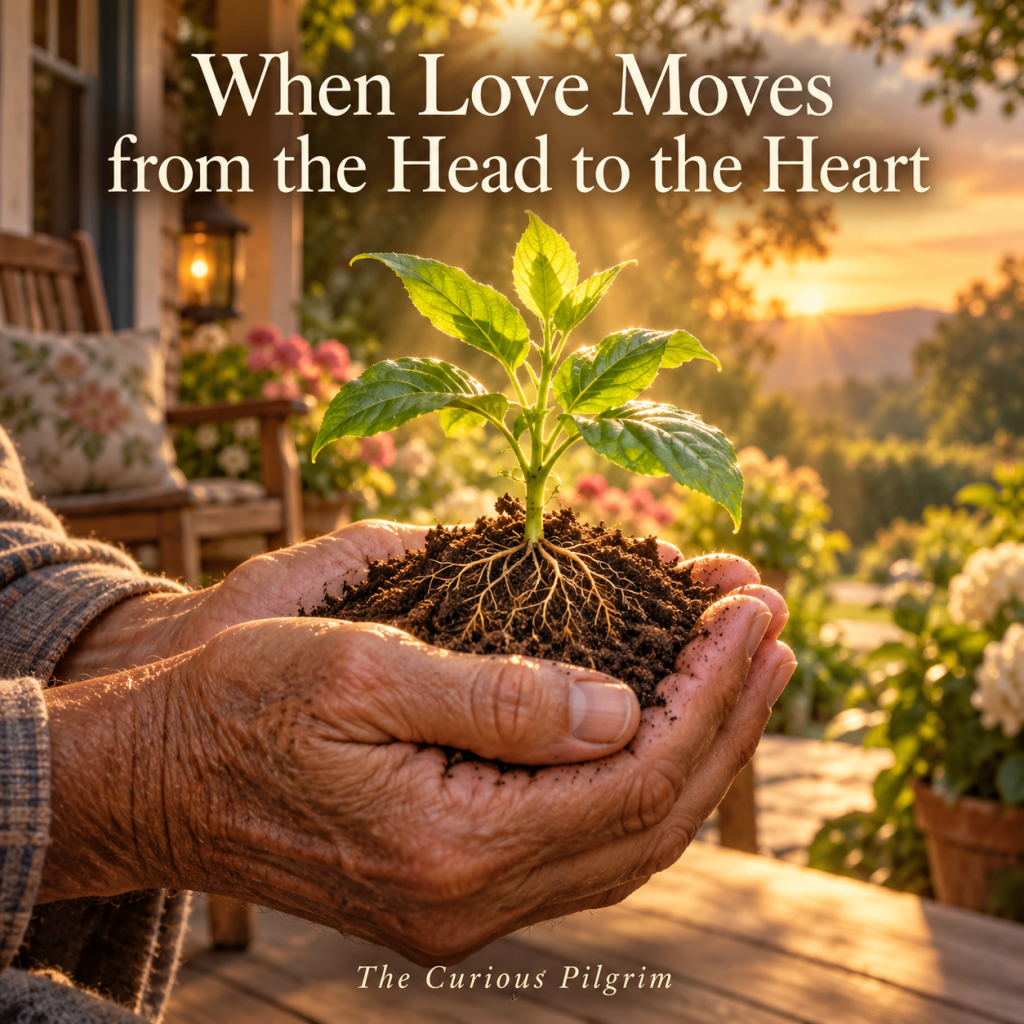
I think of agape as a seed planted within us by God’s grace. We may carry that seed for years, and its growth may surprise us even late in life. At 77, I am discovering new shoots.
For that love to keep growing, I need to remain connected to its source. God is love. Through prayer, I turn toward the One whose love sustains us and learn to receive what I hope to give.
Reconnecting with God does not mean God has withdrawn. Sometimes my attention has wandered. Sometimes fear, old wounds, or my desire to control an outcome have narrowed my vision. Prayer opens me again.
The Jesus Prayer has become deeply personal for me:
Lord Jesus Christ, teach me to see with compassion as you see.
Lord Jesus Christ, teach me to hear with wisdom.
Lord Jesus Christ, teach me to speak with love.
As I pray, I find that this lesson reaches into every relationship. I want to see my family more clearly. I want to listen to my friends more patiently. I want to meet a stranger with compassion before making a judgment.
Unconditional love is becoming something I practice in ordinary moments: allowing someone to be themselves, listening without preparing my defense, caring without making affection a reward for agreement. I am learning that love can be generous while still speaking truth and keeping clear boundaries.
I believe agape endures because its source is God. Feelings and circumstances change. Our ways of expressing love may change, too. Yet the love rooted in God can continue to grow, teaching us to seek another’s good through each season.
There is still much for me to learn. But I am grateful that my heart remains capable of learning it.
At 77, knowledge I have carried for decades is becoming heart knowledge and lived experience. Someone’s kindness helped me see Jesus, and now I am asking Jesus to help me see others.
Has someone’s love helped you understand something your head already knew? What might grow if you brought that experience into prayer?
The Curious Pilgrim
Sources: Richard Bach, Illusions: The Adventures of a Reluctant Messiah (1977); John D. MacDonald, Bright Orange for the Shroud (1965).


Leave a comment