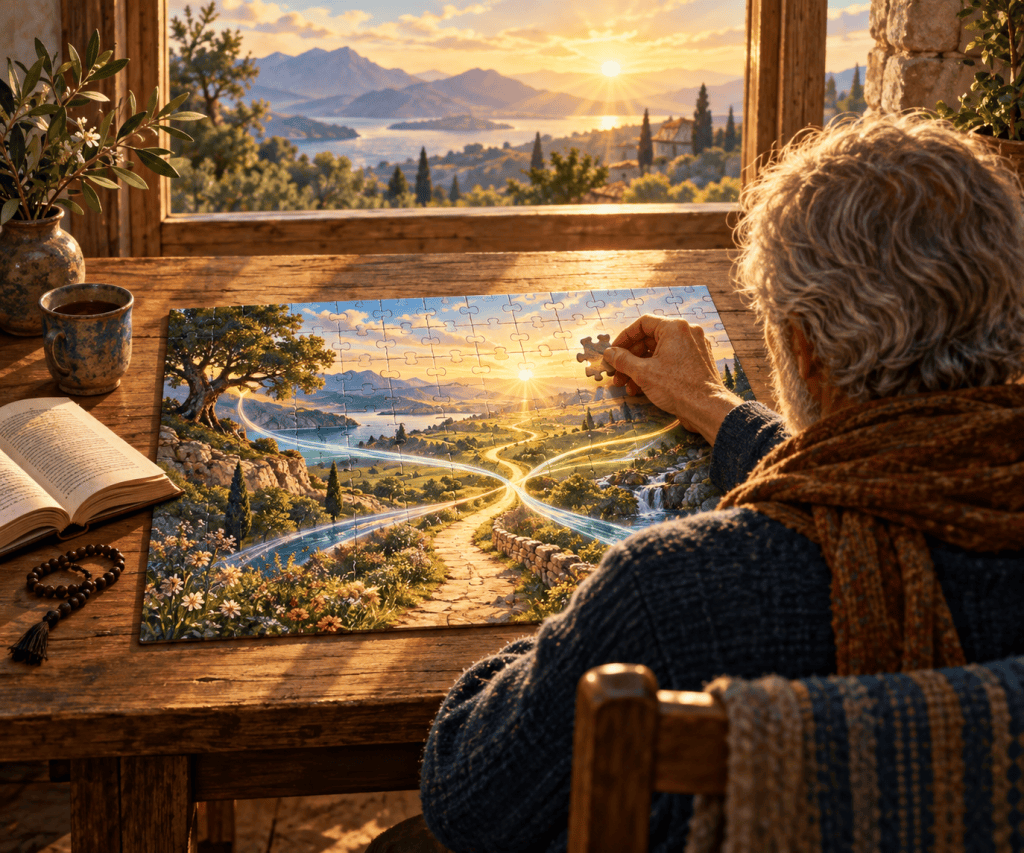
Forrest Gump said life is like a box of chocolates. I have discovered that life is more like a crossword puzzle. It gives us clues, and we spend our lives discovering the answers. Sometimes it is like a 500-piece jigsaw puzzle: the pieces look so much alike, but somewhere they fit together to form the picture on the box.
When I became a pastor, I preached about giving our lives to Jesus, taking up our cross, and following him. I meant it, though I am not sure I understood what it would mean for my whole life.
At Bible college, I learned that life is about relationships: with God, others, ourselves, and the universe God created. Jesus taught us to love God with all our heart, soul, mind, and strength. I began to see that I have an emotional, spiritual, rational, and physical self. First John 4 gave me another piece: God is love, and I cannot claim to love God while refusing to love others.
But I still struggled. I had learned that JOY meant Jesus, Others, Yourself, in that order. How could I love my neighbor as myself if I believed loving myself was selfish? How could I love God with my whole being when the parts of me seemed to be pulling in different directions?
I came to understand that I am part of God’s good creation and worthy of God’s love. Even so, the struggle within me continued. My emotional, spiritual, physical, and rational selves were not working together. I was out of balance.
Then I read The Pilgrim Continues His Way. The professor and the pilgrim are trying to understand salvation. They meet a monk and a priest, and the monk reads to them about unceasing prayer and union with God. The professor wonders how anyone can pray without ceasing when prayer seems to require a quiet place. The priest wonders whether repeated words can truly come from the heart. The monk explains that prayer practiced with the lips can become prayer of the heart, continuing even in sleep.
Then I encountered the piece I had been missing: the fractured mind.
As I understood what I was reading, the fall left the human person divided. The nous, our spiritual capacity to know God, became caught in the dianoia, our reasoning mind, and separated from the heart—the deep center of our being, where the Holy Spirit dwells. I recognized that fracture in the struggle I had lived with for years.
Unceasing prayer reconnects what has been divided. Prayer moves from the lips to the heart. Through the Holy Spirit, the nous and the reasoning mind are reunited with the heart. My emotional, rational, spiritual, and physical life can come into balance in union with God.
This is the truth I found. It has given me a way to understand what Paul meant by being transformed through the renewing of the mind in Romans 12:2. When I pray without ceasing, I live in continuing relationship with God—my Creator, Redeemer, and Sustainer. God is making me whole.
I can see how the sources of truth have worked together in this discovery. Scripture opened the door through Jesus’ commandment to love and Paul’s words about renewal and freedom. Tradition introduced me to the monk’s understanding of unceasing prayer. Reason helped me see how the pieces fit. Experience let me recognize God’s grace at work in my own life. I could say, “This is what has been happening in me.”
“For freedom Christ has set us free,” Paul writes in Galatians 5:1. I now understand that liberty in a way I did not before. Christ’s freedom reaches into the divided places within us. As truth opens our eyes and prayer joins our hearts to God, we can be made whole.
I am sharing a discovery from my own journey. You may describe your experience differently or find another path into understanding it. I hope you will look for the freedom Christ gives and recognize the grace already at work in your life.
Today this Curious Pilgrim is looking at the puzzle with new eyes. And I cannot keep that joy to myself.


Leave a comment