
Saint for September 26, 2026
Abby Kelley Foster (January 15, 1811–January 14, 1887)
Quaker, Abolitionist, and Advocate for Equality
Source: A Year with American Saints by G. Scott Cady and Christopher L. Webber, Church Publishing, 2001
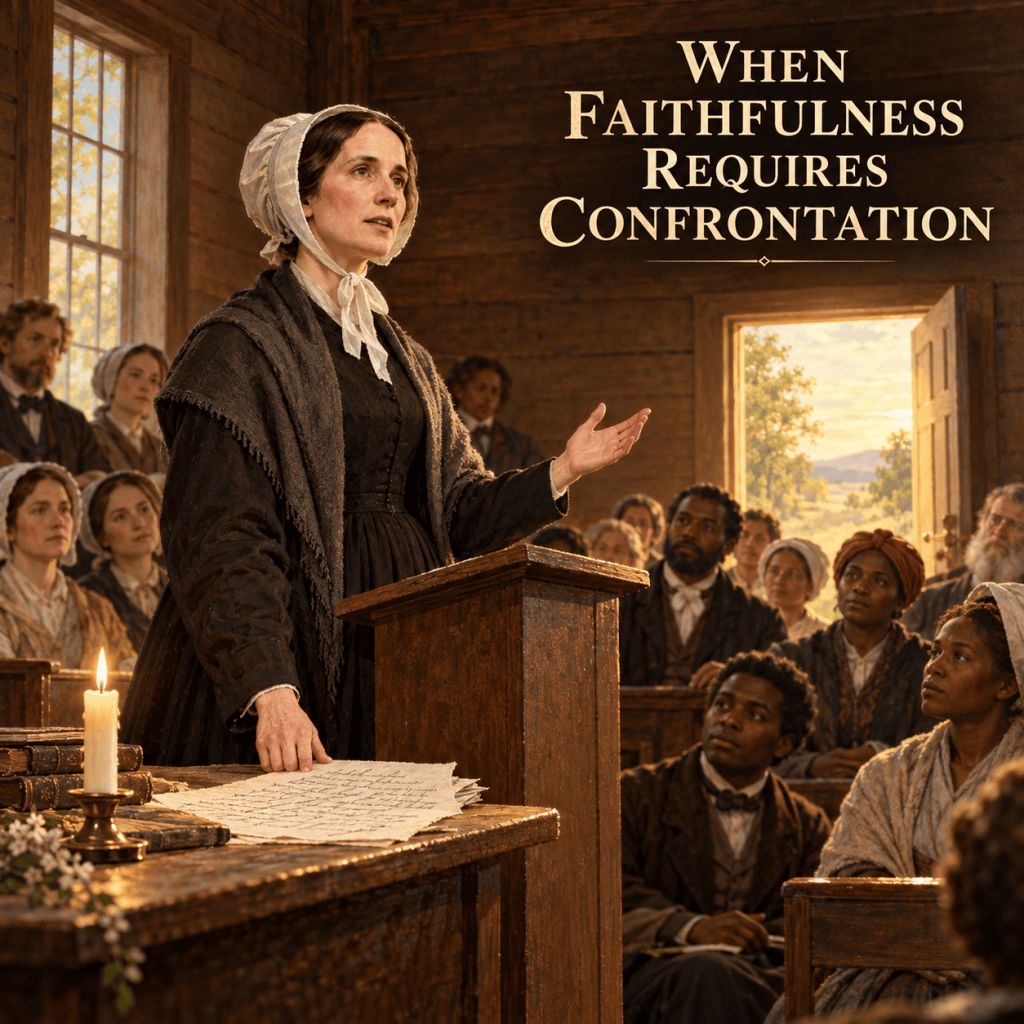
Abby Kelley Foster was raised in a loving but strict Quaker family. As a young woman, she became a teacher. After hearing abolitionist William Lloyd Garrison speak, she joined the Female Anti-Slavery Society of Lynn, Massachusetts. In 1837, she collected the signatures of nearly half the women in Lynn for a petition calling upon the federal government to end slavery in the District of Columbia.
Abby did not stop with collecting signatures. She became a lecturer, fundraiser, and organizer for the American Anti-Slavery Society. She spoke publicly when women were not expected—or considered qualified—to address audiences that included men. She worked beside Black abolitionists and insisted upon full civil equality for Black people.
Her convictions brought opposition from several directions. She was condemned for being a woman who spoke publicly. She was attacked for demanding the abolition of slavery and racial equality. She was ridiculed and called a “Jezebel” because her message threatened the accepted social order.
Abby also encountered resistance within her own religious community. In 1841, she separated from the Quakers after they refused to allow antislavery speakers to use their meetinghouses. She did not abandon the deepest truth of her faith. Instead, she followed that truth beyond the boundaries her religious community was willing to cross.
Jesus also confronted the religious community that formed him. He challenged religious leaders when traditions were used to exclude people, protect privilege, or place burdens upon those already struggling. Paul confronted prejudice and division within the early church, declaring:
“There is no longer Jew or Greek, there is no longer slave or free, there is no longer male and female; for all of you are one in Christ Jesus.”
—Galatians 3:28
Like Abby, I have sometimes found it necessary to confront beliefs held by religious communities and individuals. Growing up in Mississippi during the 1960s, I encountered racial prejudice not merely in history books but among the people and communities around me.
When I was fifteen or sixteen, I visited the home of a man I had known while growing up. I did not know that he was a member of the Ku Klux Klan. Pointing to a pistol lying on the table beside him, he told me, “That is what I trust in.”
I have never forgotten that moment.
His words revealed the terrible contrast between trusting in violence and trusting in the God of love. They also helped me recognize how fear, prejudice, religion, and culture can become entangled. People can profess faith in God while placing their real trust in weapons, power, racial superiority, and the threat of violence.
Today, I am deeply touched by what I have learned about the Trail of Tears and about the millions of Indigenous people who died through conquest, displacement, disease, and colonization throughout North and South America. I grieve the enslavement of Africans and the continuing oppression of people because of their race, religion, or nationality.
These are not merely events from a distant past. Their wounds remain among us. Their consequences can still be seen in our institutions, communities, churches, and relationships. When I remember the prejudice I witnessed while growing up in Mississippi, I must acknowledge that I, too, was formed within a culture shaped by some of these distorted beliefs.
Remembering this history is not about remaining imprisoned by guilt. It is about allowing truth to lead us toward repentance, healing, and change. Repentance means more than feeling sorry. It means turning around. It means listening to people whose stories were ignored or silenced. It means examining what we were taught, confronting prejudice when we encounter it, and choosing a different path.
Abby Kelley Foster declared:
“I rejoice to be identified with the despised people of color. If they are to be despised, so ought their advocates to be.”
Her words remind me of Jesus identifying himself with those who were hungry, thirsty, strangers, poorly clothed, sick, or imprisoned. Jesus did not merely offer help from a safe distance. He said, “Just as you did it to one of the least of these…you did it to me.”
Abby faced overlapping obstacles: resistance from her religious community, opposition to her antislavery convictions, and condemnation because she was a woman. Nevertheless, she continued to speak. She refused to allow religious tradition, social custom, or public criticism to silence the truth she had discovered.
Her life asks me a difficult question:
When faith, culture, and prejudice become entangled, will I defend what is familiar, or will I follow God’s love wherever it leads?
Jesus confronted his religious community. Paul confronted prejudice within the early church. Abby confronted slavery, racism, violence, and the exclusion of women. I, too, have been called to confront prejudice—not because I possess all the answers, but because God’s love will not allow me to remain silent when another person’s dignity is denied.
We cannot heal what we refuse to remember. We cannot repent of what we will not acknowledge. And we cannot follow the way of love without confronting the prejudices we have inherited.
Lord Jesus Christ,
teach me to see.
Heal what is wounded within me
and within the communities that formed me.
Give me wisdom to recognize prejudice,
courage to confront injustice,
humility to listen to those whose stories were silenced,
and love to walk beside those who have been despised.
Teach me to speak with love,
act with justice,
and follow you wherever your grace leads.
Amen.


Leave a comment