
Saint for September 22, 2026: Samuel Eli Cornish
Presbyterian Minister, Abolitionist, Publisher, and Journalist
1795–November 6, 1858
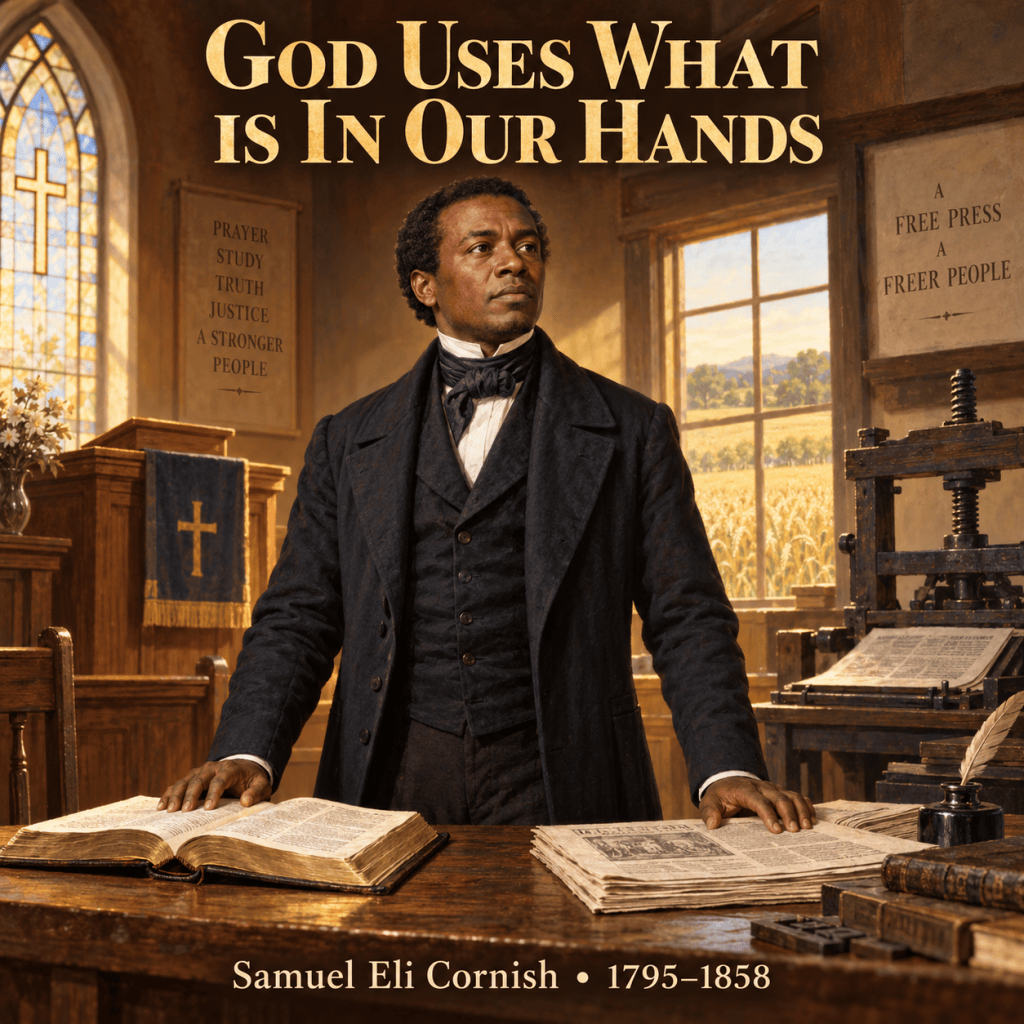
“God moves in a mysterious way, His wonders to perform.”
When I read the story of Samuel Eli Cornish, I am reminded that God’s calling is not limited to a church building or a pulpit. God calls people from every walk of life and uses the gifts, experiences, occupations, and opportunities already placed in their hands.
Paul was a tentmaker. Peter, Andrew, James, and John were fishermen. My father was a farmer as well as a preacher. Their ordinary work was not separate from their calling. God used what they knew and what they had.
We can see God’s mysterious work all around us. Music can comfort a grieving heart. Books can educate children and open their minds to new possibilities. Movies can help us see life through another person’s eyes. Computers and phones can carry words of hope around the world. Works of art reveal beauty. Fields of grain provide bread for the hungry. Clothing covers and protects us.
We need food, clothing, and shelter, but we also need truth, beauty, dignity, relationship, and hope.
We recently lost Dolly Parton, a woman who used the gifts God placed in her hands. She wrote and sang music, but her calling did not end with the songs. She used the money and influence her music produced to distribute books to children, support education in her Appalachian community, protect eagles, and meet other human needs. Her music became a means of grace.
Samuel Eli Cornish also used what God had placed in his hands. Born to free parents of mixed race in Delaware in 1795, Cornish became a Presbyterian minister, abolitionist, publisher, and journalist. He could have accepted the status quo, but he did not. He heard the call of God and used whatever means were necessary to serve the people entrusted to his care.
He created a place to worship.
Cornish recognized that Black Christians needed more than admission into white-controlled churches. They needed a congregation where their dignity, leadership, gifts, and calling would be fully recognized. In 1822, he helped establish the New Demeter Street Presbyterian Church, the first Black Presbyterian congregation in New York City.
He did not merely invite people into an institution that denied their full humanity. He helped create a place where they could worship God, build community, develop leaders, and answer God’s call for themselves.
He created a place to speak.
Cornish also recognized that Black Americans needed more than white people speaking about them or for them. They needed the freedom to tell their own stories.
In 1827, Cornish and John Russwurm founded Freedom’s Journal, the first Black-owned and operated newspaper in the United States. It allowed Black Americans to speak for themselves, report on the concerns of their communities, oppose slavery, and answer the racist portrayals appearing in white-owned newspapers.
Cornish had a pulpit, but he also had a pen and a printing press. All three became instruments of his ministry.
He persisted when institutions failed.
Cornish eventually left Freedom’s Journal. When its direction changed, he returned and attempted to continue its original mission under a new name, The Rights of All. That effort did not last, but Cornish did not stop speaking. He continued working as a minister, editor, abolitionist, and organizer.
When one effort ended, he looked for another way to serve. Failure did not silence his calling.
Jesus said, “For mortals it is impossible, but for God all things are possible.”
That does not mean the work will always be easy or that everything we attempt will succeed. Cornish encountered racism, opposition, disagreement, and disappointment. Yet he continued to believe that something could be done. He saw the needs of his people, heard God’s call, and used what was available to him.
Paul had his tentmaking tools. The disciples had their boats and nets. My father had his Bible, his fields, and his farming hands. Dolly Parton had her songs and the resources they produced. Samuel Eli Cornish had his pulpit, his pen, and the printing press.
God takes what is already in our hands and transforms it into a means of grace.
Perhaps the question is not simply, “What position has God given me?” Perhaps we should ask:
What gifts, experiences, tools, and opportunities has God placed in my hands?
What do the people around me need?
Am I willing to use what I have to help meet that need?
Samuel Eli Cornish saw a people who needed a place to worship, so he helped establish a congregation. He saw a people who needed a place to speak, so he helped establish a newspaper. When institutions failed, he persisted.
He could have accepted the world as it was, but he heard the call.
May we hear it too.
Lord Jesus Christ, teach me to see what your people need. Teach me to recognize what you have placed in my hands. Be present with me as I go, and give me the courage to use my gifts in the service of love, truth, dignity, beauty, and justice. Amen.
Source: G. Scott Cady and Christopher L. Webber, A Year with American Saints (Church Publishing, New York).
 The Curious Pilgrim
Leave a comment