
Remembering Sojourner Truth
September 21, 2026
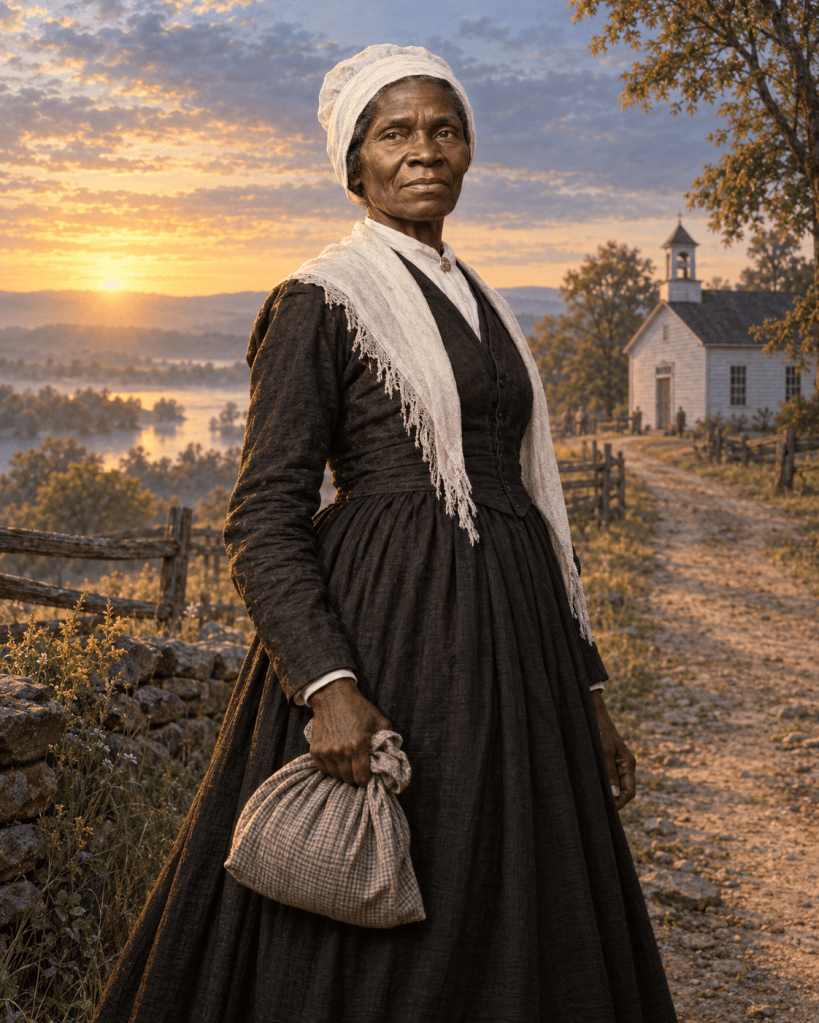
Some saints inherit wealth, education, and influence. Sojourner Truth began life with none of these.
Born Isabella Baumfree around 1797, she entered the world enslaved in New York. Dutch was her first language. When she was about nine years old, she was sold at auction with a flock of sheep for one hundred dollars. She endured beatings, sexual violence, separation from those she loved, and the sale of her children.
Yet her mother taught her to pray.
That small seed of faith survived everything intended to destroy it.
In 1826, after her enslaver broke his promise to free her, Isabella took her infant daughter Sophia and walked away. She later explained:
“I did not run off, for I thought that wicked, but I walked off, believing that to be all right.”
She understood a truth the law and her enslaver had denied: she belonged to God, not to another human being.
When Isabella learned that her young son Peter had been illegally sold into Alabama, she took the matter to court. With help from Isaac and Maria Van Wagenen, she fought against a white man in a legal system controlled almost entirely by white men—and she won. Her son was returned to her.
But personal freedom was not the end of her journey.
On Pentecost Sunday in 1843, Isabella Baumfree became Sojourner Truth. She believed the Holy Spirit was calling her to travel and proclaim the truth.
“The Spirit calls me, and I must go.”
She gathered a few possessions in a pillowcase and started walking.
The name she chose became her mission. She would be a sojourner, traveling wherever God sent her, and she would speak the truth about slavery, racism, women’s rights, poverty, and human dignity.
She possessed little formal education and could not read, but she could listen, remember, reason, and speak. She had heard Sacred Writings and recognized the difference between Scripture and the ways people distorted it to justify oppression. When others used Eve to argue that women were inferior, Sojourner pointed to Jesus, who never turned women away.
She knew from experience that a person could quote the Bible and still fail to see the image of God standing directly in front of them.
Sojourner Truth is often remembered for the speech later called “Ain’t I a Woman?” Yet the familiar version was published twelve years after the event and gave her a Southern dialect she did not speak. An earlier report recorded her declaring:
“I am a woman’s rights.”
She spoke as a Black woman in movements that did not always recognize the whole of her identity. Some advocates for women overlooked racism, while some men opposing slavery overlooked the burdens carried by women. Sojourner refused to separate what society had joined together in her own experience.
She challenged slavery and segregation. She advocated voting and property rights for women. She recruited Black soldiers during the Civil War, worked among newly emancipated people, sought land for formerly enslaved families, resisted segregated streetcars, attempted to vote, supported prison reform, and opposed capital punishment.
For her, freedom was never merely an idea. Freedom had to reach the courtroom, streetcar, hospital, home, workplace, and polling place.
Her courage did not mean she was never afraid. At a camp meeting in Northampton, a group of young men threatened to burn the tents. Knowing she was the only Black person present, Sojourner hid behind a trunk. Then she made a choice.
She stepped out and began singing about the resurrection of Jesus.
Her powerful voice gathered the mob and quieted it. She continued singing, preaching, and praying until the young men finally agreed to leave.
That is courage—not the absence of fear, but the refusal to allow fear the final word.
Sojourner’s faith was not a perfectly straight path. She became involved with mistaken religious movements and sometimes followed leaders who proved unreliable. Like every pilgrim, she had to learn discernment through experience. Yet disappointments did not silence her calling. She continued listening, learning, and traveling.
After one exhausting journey, she stood before an audience and said:
“Children, I have come here like the rest of you, to hear what I have to say.”
There is humor in those words, but there is also humility. She trusted that the Spirit who called her would remain present as she spoke.
During her final years, Sojourner was cared for by two of her daughters. The woman whose family had been torn apart by slavery was surrounded by family as her earthly pilgrimage ended. She died at her Battle Creek, Michigan, home on November 26, 1883. Nearly one thousand people attended her funeral.
The child sold with sheep had become a respected preacher, abolitionist, advocate, and witness to the power of truth.
Sojourner Truth reminds me that God does not free us merely from something. God also frees us for something.
Grace freed her to claim her God-given identity.
The Spirit called her to use her voice.
Love sent her into the world to seek freedom for others.
Her life was not perfect, but it was faithful. Sainthood does not require perfect understanding. It means allowing grace to work through a real human life until that life brings truth, courage, justice, and healing into the world.
Sojourner Truth understood that freedom is relational. My freedom cannot rest upon your bondage. My comfort cannot depend upon your silence. Your dignity does not diminish mine. When one person is denied dignity, the whole community is wounded. When relationships are restored through truth, justice, mercy, and love, the whole creation begins to heal.
She chose her own name.
She discovered her own voice.
She answered her own calling.
Then she used her freedom to seek freedom for the whole human family.
Lord Jesus Christ, teach me to see the people whose dignity is still being denied. Teach me to listen with wisdom, to speak the truth with love, and to follow wherever your Spirit leads. Give me the courage to walk in freedom and to seek freedom for others. Heal what is wounded, restore our broken relationships, and have mercy upon us all. Amen.
Source: G. Scott Cady and Christopher L. Webber, A Year with American Saints (Church Publishing, New York, 2001).
 The Curious Pilgrim
Leave a comment