
Daily Office Reflection — Sunday, September 20, 2026
Proper 21, Year Two
Psalm 66, 67, 19, 46; Hosea 2:2–14; James 3:1–13; Matthew 13:44–52
Source: The Book of Common Prayer
Lord Jesus Christ, teach me to see.
I have read Hosea before.
But this morning I saw something I had never really seen.
Hosea describes Israel as having wandered away from God. The prophet uses the painful picture of a broken marriage to describe a broken relationship. Israel has chased after other gods and looked elsewhere for what God had already provided.
I understand wandering.
I have made choices in my life that took me places I wish I had never gone. There have been times when I felt as though I had wandered off the road and into a wilderness. Doubt became strong. The competing voices became loud. There were times when I could not see the road ahead.
For years, I could easily have looked at such wilderness places primarily in terms of failure or punishment.
Then this morning I read Hosea again.
God says:
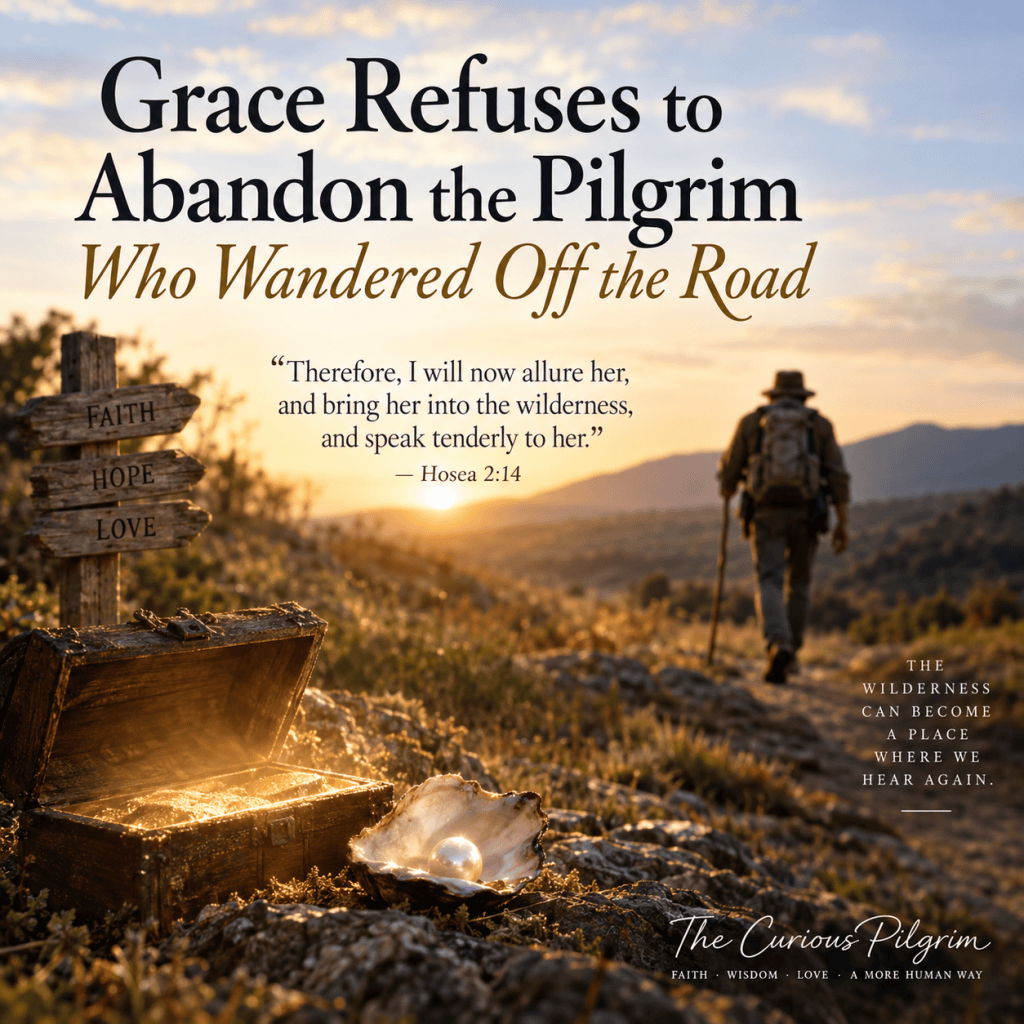
“Therefore, I will now allure her, and bring her into the wilderness, and speak tenderly to her.”
— Hosea 2:14
Speak tenderly.
Those words stopped me.
What if the wilderness is not merely punishment?
What if the wilderness can become a place where we hear again?
That does not mean God caused every painful thing that happened to us. Some wildernesses come from our own choices. Some come from choices other people make. Some come simply because we live in a world where suffering happens.
But wherever the wilderness came from, God can meet us there.
And suddenly I saw something:
Grace refuses to abandon the pilgrim who wandered off the road.
Grace does not pretend that I never wandered. Grace does not erase consequences. Grace does not call wrong choices right.
But neither does grace stand at the edge of the wilderness shouting condemnation.
God enters the wilderness and speaks tenderly.
That is hope.
That is faith.
That is love.
“And now faith, hope, and love abide, these three; and the greatest of these is love.”
Then Psalm 46 says:
“Be still, then, and know that I am God.”
Perhaps sometimes the wilderness becomes quiet enough for us to hear what all the competing voices had drowned out.
And when we begin hearing again, James asks us to consider how we speak.
James 3 reminds us that the tongue is small but powerful. Words can wound. Words can heal. Words can destroy relationships, and words can help restore them.
James also tells us that wisdom is demonstrated through humility and good conduct.
So perhaps learning to see is not enough.
The pilgrim must learn to listen with wisdom and speak with love.
Lord Jesus Christ, teach me to see.
Teach me to listen with wisdom.
Teach me to speak with love.
Then Jesus tells us about treasure hidden in a field and a merchant searching for a pearl of great value.
Something else struck me.
The treasure was already there.
The pearl was already there.
What changed?
Someone recognized its value.
That is what happened to me with Hosea this morning.
I have read these words before. They were there all along. But this morning I saw something I had not seen before.
Maybe this is part of what Jesus means when he talks about bringing out treasures “new and old.”
Sometimes we return to an old passage of Sacred Writings and suddenly discover a treasure we have walked past many times.
That is why I remain a Curious Pilgrim.
There is still more to see.
There is still more to learn.
There is still more treasure to discover.
And even when I wander off the road, the journey is not necessarily over.
Grace comes looking.
Grace meets me in the wilderness.
Grace speaks tenderly.
Grace teaches me to hear again.
And then grace invites me to take another step.
Lord Jesus Christ, teach me to see.
Give me wisdom to understand what I see.
Teach me to speak about what I discover with love.
Faith. Hope. Love.
And the greatest of these is love.
— The Curious Pilgrim
 The Curious Pilgrim
Leave a comment