
Robert Lewis Dabney (1820–1898)
Lord Jesus Christ, Teach Me to See
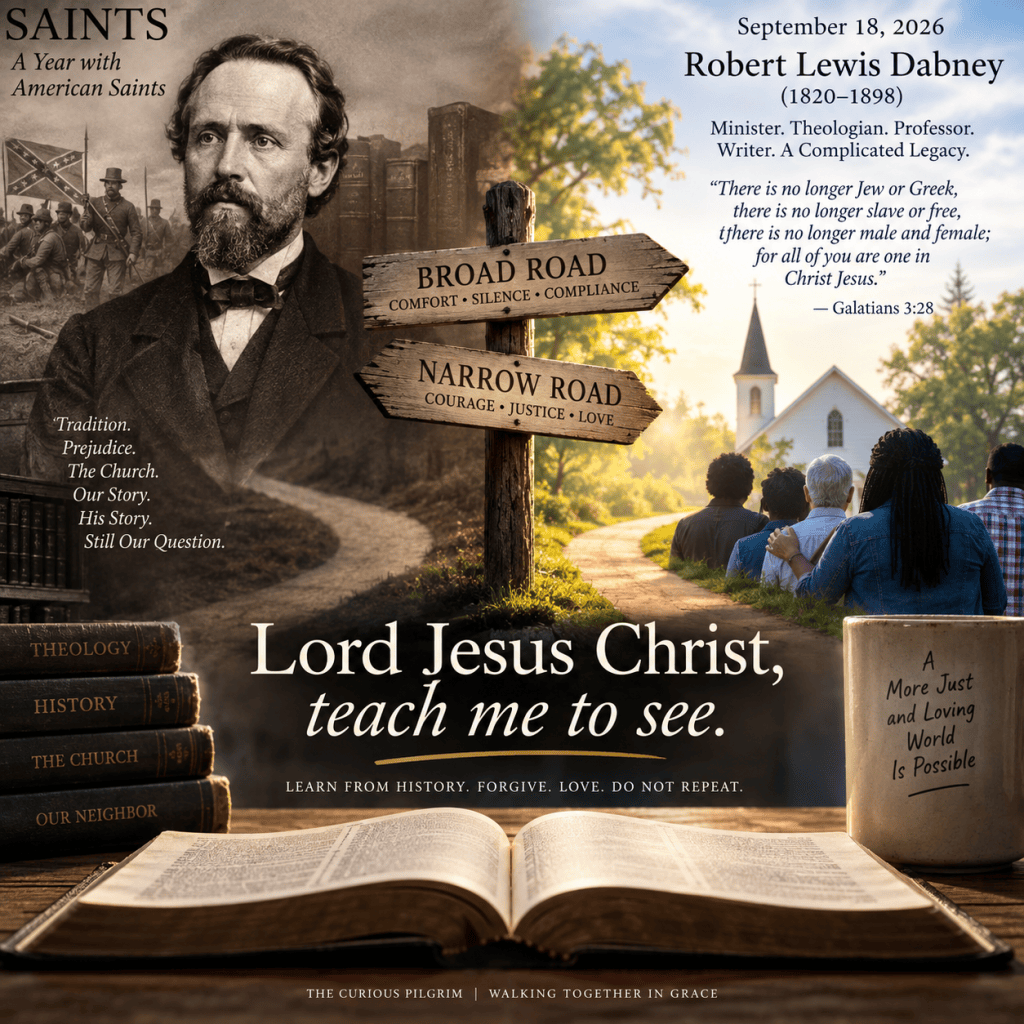
Come sit with me on the front porch for a while. This may not be the most comfortable conversation we have had.
Robert Lewis Dabney was a remarkable man in many ways. Born in Virginia in 1820, he became a Presbyterian minister, theologian, professor, writer, educator, Confederate chaplain, and for a short time chief of staff to Stonewall Jackson. He taught generations of students and wrote extensively on theology.
He also defended slavery and white supremacy.
After the Civil War, Dabney opposed racial equality within the Presbyterian Church. In 1867, he addressed the Synod of Virginia against what he called the “ecclesiastical equality” of Black ministers. He advocated separate Black churches and opposed Black Christians sharing governing authority with white Christians in Presbyterian church courts. His address was published the following year.
That troubles me.
But I don’t want to sit on my front porch in 2026, point my finger at a man who lived in the nineteenth century, and congratulate myself because I can see something he could not—or would not—see.
I need to look in the mirror.
When Tradition Becomes Blindness
Dabney raises a difficult question for a series about saints.
Why should we call someone a saint when that person believes and practices things contrary to the teachings of Jesus?
Perhaps part of the answer is that saints have never been perfect people. But that cannot become an excuse for ignoring sin, particularly when sin becomes embedded in theology, churches, institutions, and culture.
This is where tradition becomes complicated.
Tradition can preserve wisdom. Tradition can teach us the faith. Tradition can connect us with generations of Christians who walked this road before us.
But tradition can also preserve prejudice.
I know something about that.
I grew up in Mississippi in the Free Will Baptist Church. My brother Ted once proposed at an associational meeting that the association establish a scholarship to help students attend Free Will Baptist Bible College in Nashville.
A minister stood in opposition.
He said that we didn’t want our students attending a school with Black students—although he used a racial slur—and receiving federal money.
There was a problem.
The school was all white, and it wasn’t accepting the federal assistance he was talking about.
The facts didn’t matter because prejudice had already supplied its own facts.
That experience taught me something I have never forgotten:
Ignorance and prejudice can feed each other, and both can find a home inside the Church.
When Do We Stand Up?
Jesus talked about a broad road and a narrow road.
That raises another uncomfortable question.
When do I stand up and say, “This is wrong. This is not what Jesus taught”?
It is easy to take the narrow road when everybody around me applauds.
But what happens when taking that road costs me something?
For a white pastor in Mississippi during the struggle over segregation, standing against the prevailing culture could mean conflict with the congregation, loss of position, rejection by friends and neighbors, or worse.
Jesus asked:
“What will it profit them to gain the whole world and forfeit their life?”
—Mark 8:36
What will I exchange for my soul?
My position?
My reputation?
My friends?
My comfortable place in the community?
My pulpit?
Sometimes following Jesus means standing against something our own people have taught us.
I Have Seen Change
But I have also lived long enough to see something else.
Grace.
When I joined the United Methodist Church in Mississippi in the 1990s, Black churches and white churches were part of the same Annual Conference. Black and white pastors served within the same conference.
One of the students with whom I attended seminary later became District Superintendent of the Hattiesburg District—the district to which I belonged.
I was elated.
I also remember being at Annual Conference when white clergy were honored for the stands they had taken during a difficult period of Mississippi’s racial history.
The Church had not become perfect.
It still hasn’t.
But I had lived long enough to see change.
That taught me something else:
Tradition can change. Churches can repent. Relationships can be healed. Grace can work not only in individuals but through communities and institutions.
And We Still Have Work to Do
We should not fool ourselves.
American churches remain divided in many ways. Racial prejudice has not disappeared. Neither have prejudices based on class, nationality, sex, education, denomination, politics, economic status, or any of the countless other ways human beings divide ourselves into “us” and “them.”
Then I hear Paul’s words:
“There is no longer Jew or Greek, there is no longer slave or free, there is no longer male and female; for all of you are one in Christ Jesus.”
—Galatians 3:28
That doesn’t mean our differences disappear.
It means our differences cannot determine our worth before God or whether we belong at Christ’s table.
And suddenly Dabney’s story isn’t merely about race.
It is about relationships.
The Four Relationships
My relationship with God asks whether I will allow God to transform me—or whether I will try to make God defend what I already believe.
My relationship with others asks whether I can recognize the image of God in someone whom my culture has taught me to fear, reject, dismiss, or consider inferior.
My relationship with myself requires enough humility to ask:
Where am I blind?
And my relationship with the world around me asks whether I will simply accept injustice because “that’s the way things are,” or whether I will help build communities that reflect love, justice, mercy, and grace.
This is why Robert Lewis Dabney belongs in my journey through the saints.
Not because everything he believed was saintly.
It wasn’t.
Not because I need to pronounce judgment on his soul.
I don’t.
He belongs here because history can become one of our teachers if we are willing to listen.
The Prayer of a Pilgrim
As I have traveled with the anonymous Russian pilgrim, I have been learning the Jesus Prayer:
Lord Jesus Christ, Son of God, have mercy on me, a sinner.
Today I want to pray it another way.
Lord Jesus Christ, teach me to see.
Teach me to see the prejudices I have inherited.
Teach me to see the people my culture has taught me not to see.
Teach me to hear the voices history tried to silence.
Teach me to recognize when tradition has become an excuse for refusing to love my neighbor.
Teach me to learn from history—not so I can stand proudly in judgment over those who came before me, but so I will not repeat their sins.
Teach me to forgive.
Teach me to love.
Teach me to walk the narrow road when the broad road would be easier.
And when I am the one who cannot see my own blindness, place someone along my pilgrimage who will love me enough to help me see.
Perhaps that is one of the gifts history gives us.
Robert Lewis Dabney lived from 1820 to 1898.
But the question his life raises did not die with him.
What have I inherited from my family, my church, my denomination, my community, or my culture that Jesus is asking me to see differently?
That question belongs to every generation.
It belongs to me.
And perhaps it belongs to you.
Come, fellow pilgrim.
There is still more road ahead of us.
Lord Jesus Christ, teach us to see.
Source for today’s saint: G. Scott Cady and Christopher L. Webber, A Year with American Saints (Church Publishing, 2006).
 The Curious Pilgrim
Leave a comment