
Reflections on “The Pilgrim’s Account of the Fifth Meeting” from The Pilgrim Continues His Way
When the Pilgrim left the Russian coaching inn, he had just experienced a difficult encounter with an Old Believer.
The two men disagreed about religion. Each believed his understanding of the Church was correct. The Pilgrim decided that arguing would accomplish nothing, so he walked away.
We spent quite a bit of time with that little encounter. In fact, we managed to cover about half a page!
But the Pilgrim continued walking.
As he passed the open door of a tiny room, he noticed a man lying on a bed. The man motioned for him to come inside.
He was sick and needed help.
This time there was no argument about which church was right.
There was simply a human being who needed another human being.
The Pilgrim entered.
A Greek Monk Far from Home
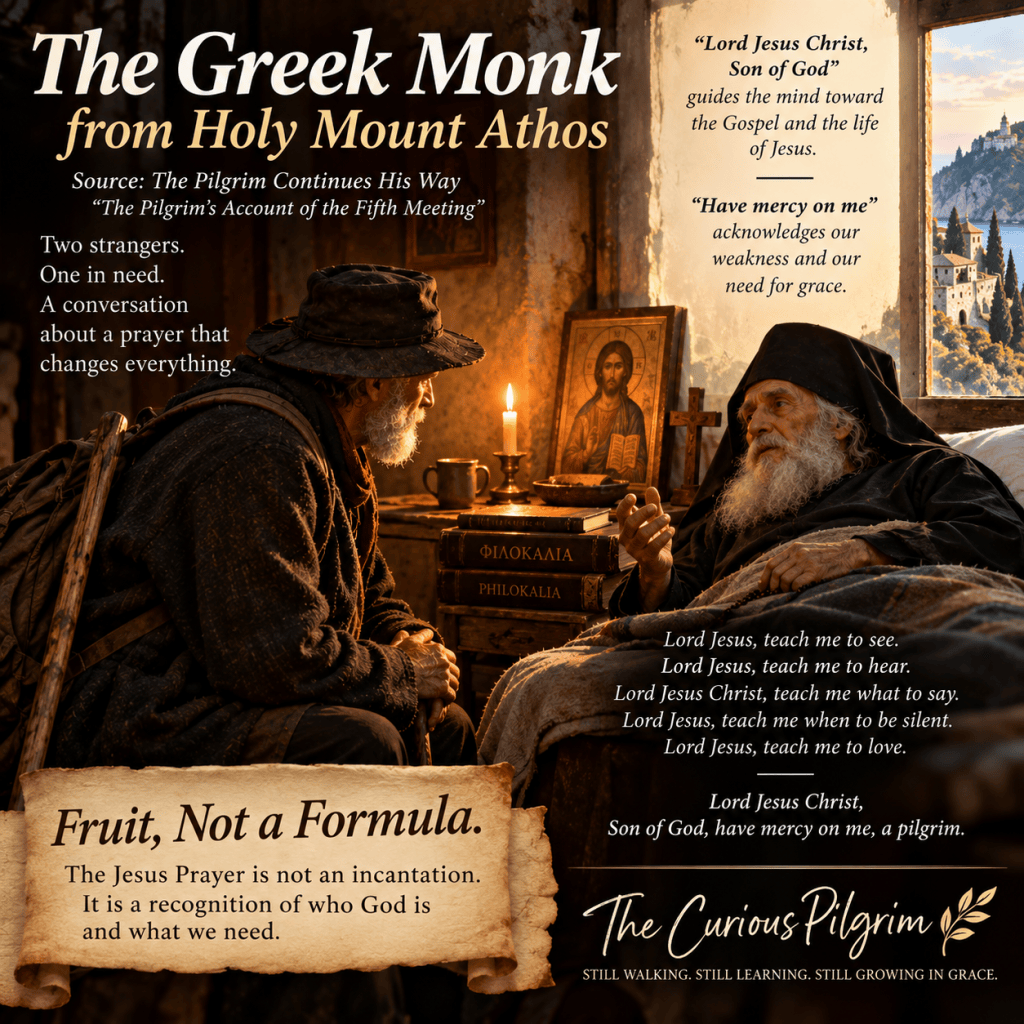
The sick man explained that he was a Greek monk from Holy Mount Athos. He had come to Russia to collect money for his monastery but had become ill with severe pain in his legs.
The Pilgrim agreed to stay and help him recover.
Here were two strangers whose paths had crossed.
One needed help.
The other was able to give it.
And once again, a relationship began.
The monk had a Greek-language copy of the Philokalia, the collection of spiritual writings that had become so important to the Pilgrim. The monk also spoke Russian fluently.
Most importantly, he practiced unceasing prayer.
Naturally, the conversation eventually turned toward the prayer that had become the center of the Pilgrim’s journey:
Lord Jesus Christ, Son of God, have mercy on me.
The Greek monk helped the Pilgrim see something deeper in those words.
Lord Jesus Christ, Son of God
The monk divided the prayer into two parts.
The first is:
Lord Jesus Christ, Son of God.
According to the monk, these words guide the mind toward the Gospel and the life of Jesus Christ.
That caught my attention.
The Jesus Prayer isn’t an incantation.
We aren’t repeating certain words because the words themselves possess some magical power.
We are turning our attention toward a Person.
Jesus Christ.
When I say his name, I am reminded of the one I am following.
I remember his life.
His teachings.
His compassion.
His mercy.
His death.
His resurrection.
His love.
The prayer directs my attention away from myself and toward Christ.
Then comes the second part.
Have Mercy on Me
Have mercy on me.
The monk explains that these words recognize human weakness and our need for God’s mercy.
He contrasts this with simply praying:
Forgive me.
Release me from my sins.
Absolve my trespasses.
Those prayers can easily become focused upon escaping punishment.
But “have mercy on me” reaches deeper.
I am not merely asking God to cancel a penalty.
I am acknowledging my need for God.
I cannot manufacture grace.
I cannot transform myself through sheer determination.
I cannot conjure up the Holy Spirit through the correct religious technique.
I need mercy.
Lord Jesus Christ, Son of God—
this is who You are.
Have mercy on me—
this is what I need.
Perhaps the whole spiritual journey is contained within those two truths.
The Spirit Prays Within Us
The monk then connects prayer with Paul’s teaching about the Holy Spirit interceding for us with groanings that cannot be expressed in words.
Prayer is not simply something I do toward God.
Something is also happening within me.
The Holy Spirit is at work.
And the monk says that the Spirit bestows gifts of grace according to each person’s strength and capacity.
That statement stopped me.
Because after more than seventy-six years around churches and religious people, I have discovered something:
No two people experience God in exactly the same way.
There may be similarities.
There may be shared practices.
There may be common experiences.
But they are never identical.
And perhaps that’s because grace is personal.
I Have Tried the Formulas
Over the years I have read plenty of books and heard plenty of sermons that essentially said:
Do this.
Follow these steps.
Pray this way.
Read this much Scripture.
Use this method.
Follow this program.
And this will happen.
I have tried some of them.
Sometimes they helped.
Sometimes they didn’t.
For years I wondered why someone else’s spiritual method didn’t produce the same experience in me that the author or preacher described.
I’m beginning to understand.
God isn’t a formula.
Neither is grace.
There are no incantations or rituals that can conjure up the work of the Holy Spirit.
That doesn’t make spiritual practices unimportant.
Prayer matters.
Scripture matters.
The Eucharist matters.
Silence matters.
Meditation matters.
Tradition matters.
The Jesus Prayer matters.
But these are ways of opening ourselves to grace.
They do not control grace.
The Same Scripture, A Different Day
I’ve experienced this while reading Scripture.
I can read a verse today and almost nothing happens.
I understand the words.
I may know what the passage means.
I finish reading and continue with my day.
Then tomorrow I can read exactly the same words—
and tears fill my eyes.
My heart fills with joy.
Something speaks directly into what I am experiencing at that moment.
The Scripture hasn’t changed.
Something in me has.
Perhaps I am finally ready to hear what I couldn’t hear yesterday.
Perhaps circumstances have opened something within me.
Perhaps the Holy Spirit is taking familiar words and speaking them into a need I didn’t even recognize before.
That’s part of the mystery of grace.
Teach Me to See. Teach Me to Hear.
This connects beautifully with what I learned from the Pilgrim’s previous encounter with the Old Believer.
There I found myself praying:
Lord Jesus, teach me to see.
Lord Jesus, teach me to hear.
Lord Jesus Christ, teach me what to say.
Now the Greek monk helps me understand something deeper about that prayer.
Prayer isn’t merely talking.
Prayer also involves listening.
That is why silence and meditation have become increasingly important to me.
I can recite prayers.
I can read the Sacred Writings.
I can pray the Daily Office.
I can repeat the Jesus Prayer.
But somewhere along the way, I also need to become quiet.
Listen.
Wait.
Allow the words to move from my mind toward my heart.
Fruit, Not a Formula
This keeps bringing me back to something I have been learning throughout this pilgrimage:
Fruit, not a formula.
If I pray the Jesus Prayer thousands of times but become more judgmental, something is missing.
If I read Scripture every day but become less compassionate, something is missing.
If I receive the Eucharist every week but cannot recognize Christ in the person standing beside me, something is missing.
If I study theology until I can win every argument but cannot love my neighbor, something is missing.
The question isn’t merely:
Am I performing the practice correctly?
Perhaps the better question is:
What is the Holy Spirit producing within me through this practice?
Love.
Joy.
Peace.
Patience.
Kindness.
Goodness.
Faithfulness.
Gentleness.
Self-control.
Those are fruits.
And fruit grows.
We cannot pull on a branch and make fruit grow faster.
We provide soil.
Water.
Sunlight.
Care.
And then something mysterious happens.
Life produces fruit.
Grace is like that.
A Prayer That Tells the Truth
I think I understand the Jesus Prayer a little differently now.
Lord Jesus Christ, Son of God, have mercy on me.
It isn’t a formula for getting God’s attention.
God is already present.
It isn’t an incantation for producing a spiritual experience.
The Holy Spirit cannot be manipulated.
It isn’t a method for making my experience resemble somebody else’s.
God knows me.
God knows where I am.
God knows what I need.
The prayer simply brings me before God with two great truths:
This is who You are.
And:
This is what I need.
Jesus Christ.
Mercy.
And somewhere between those two realities—
grace happens.
Not always in the way I expect.
Not always when I expect.
Not always in the way somebody else’s book tells me it should.
But grace keeps meeting this pilgrim along the road.
Sometimes through Scripture.
Sometimes through silence.
Sometimes through the Eucharist.
Sometimes through another person.
Sometimes through an old Russian pilgrim.
And sometimes through a simple prayer repeated until the words become part of the heart:
Lord Jesus Christ, Son of God, have mercy on me.
And perhaps today I will add:
Lord Jesus, teach me to see.
Lord Jesus, teach me to hear.
Lord Jesus Christ, teach me what to say.
Lord Jesus, teach me when to be silent.
Lord Jesus, teach me to love.
Lord Jesus Christ, have mercy on me, a pilgrim.
Amen.
Still walking. Still learning. Still growing in grace.


Leave a Reply