
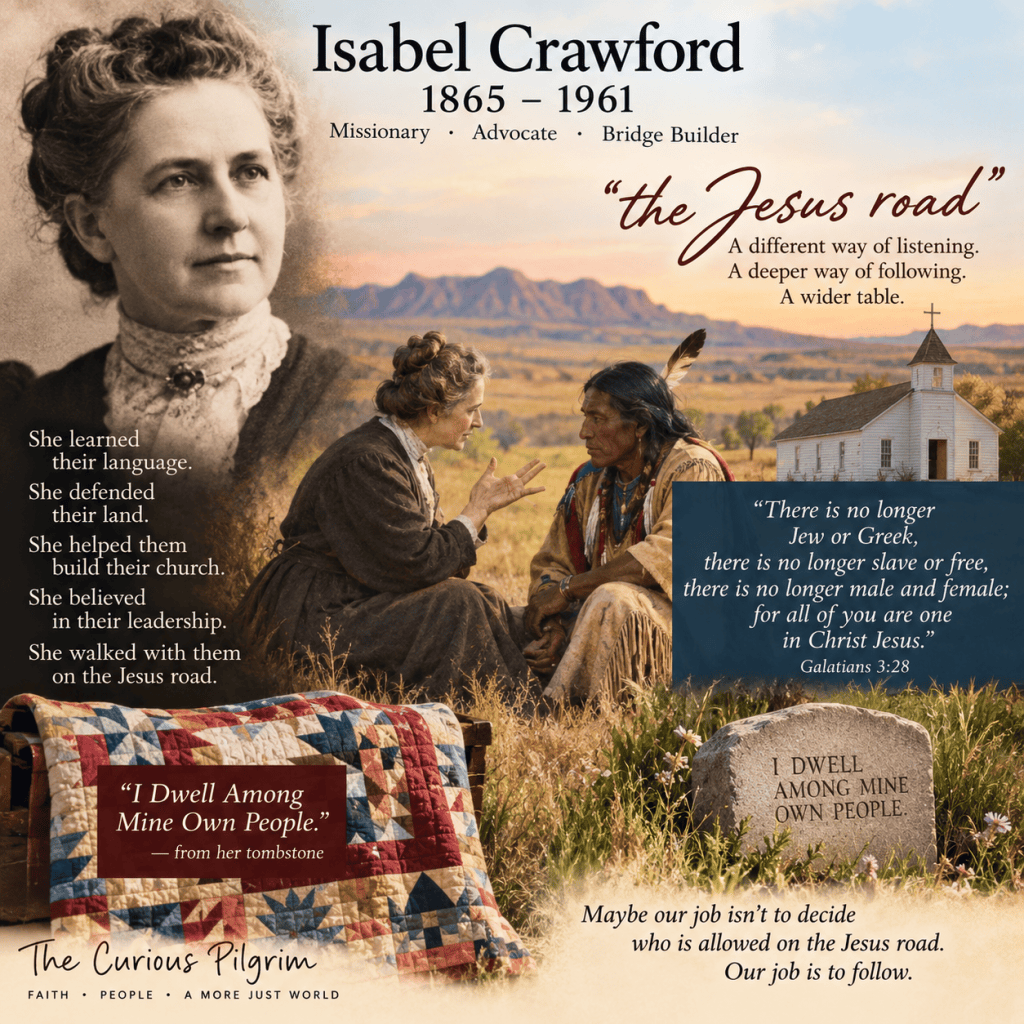
Sometimes when I read about one of the saints, I discover somebody whose story crosses several paths I have been walking myself. Isabel Alice Hartley Crawford is one of those people.
Crawford was born in 1865, the daughter of a Baptist pastor who had served in the Canadian Northwest and the Dakotas. She inherited something of her father’s missionary spirit. After attending the Baptist Missionary Training School in Chicago, she hoped she would be sent overseas as a missionary.
Instead, God sent her to Oklahoma Territory.
Before going there, however, she had already learned something important about ministry. While serving as a student missionary in Chicago, she worked in the red-light district. There she encountered poverty and people living on the margins of society. Rather than turning away from them, she developed compassion for them.
Maybe God was already preparing her for what was ahead.
Crawford was nearly deaf because of a childhood illness. When she began working among the Kiowa, communication was difficult. She sometimes depended upon an interpreter, lip reading, or a hearing device she wore around her neck.
Then a Kiowa man named Koptah taught her Plains Indian Sign Language.
Crawford learned to communicate the Gospel through signs. She called the Christian way “the Jesus road.”
I love that expression.
The Jesus road.
It sounds less like joining an institution and more like following someone.
As Crawford lived among the Kiowa, she also began standing with them. She spoke against pioneer settlers who hunted the game on Kiowa lands and depleted the natural resources upon which the people depended.
She wasn’t simply interested in converting people.
She cared about what was happening to them.
Eventually Crawford was assigned to Saddle Mountain. When Kiowa converts wanted to become members of a Baptist church, they had to travel about seventeen miles to Rainy Mountain Church.
So they decided they needed a church of their own.
Crawford helped secure land. The Kiowa contributed money. The women made quilts and sold them. Together they raised the money necessary to build Saddle Mountain Baptist Church, which opened on Easter in 1903.
Then something happened that got Crawford into trouble.
The church had no pastor, but the people wanted to celebrate the Lord’s Supper. Crawford told them to choose one of their own people to lead the service.
They chose Lucius Aitsan.
The denominational authorities did not approve.
The congregation continued worshiping and celebrating Communion when a visiting pastor wasn’t available, and eventually the church was censured for departing from what the denomination considered the orderly Baptist practice of administering the Lord’s Supper.
Crawford resigned her position at Saddle Mountain.
I find myself wondering about that.
The Kiowa had heard about Jesus. They had believed. They had sacrificed their own money. Women had sewn quilts. They had built their own church. They gathered around the Lord’s Table.
And the institution said they weren’t doing it correctly.
Sometimes I wonder whether we Christians can become so concerned about maintaining proper religious order that we fail to recognize what God is already doing.
There is another reason Isabel Crawford’s story speaks to me.
She was a woman exercising significant spiritual leadership in an age when women were usually denied such opportunities. She may even have been the first Baptist woman to serve Communion.
I have never had a problem with women teaching, preaching, or serving as pastors.
Part of the reason comes from my own experience.
One of the finest professors I had at Free Will Baptist Bible College was Laura Belle Barnard. She was the first missionary appointed by the reorganized National Association of Free Will Baptists in 1935.
I took her class With Christ in the School of Prayer.
Laura Belle Barnard knew how to teach.
More importantly, she knew how to pray.
There were times when prayer filled much of our class period. There were tears. There was silence. There was fervency. Sometimes when we walked out of that classroom, we felt as though we had been in the presence of God.
Nobody needed to explain to me whether God could use a woman to teach.
I had experienced it.
Later, while serving on the staff of Southwest Church of the Nazarene in St. Louis, I had the privilege of hearing Dr. Mildred Wynkoop, a professor at Nazarene Theological Seminary, preach several times.
She was dynamic.
She possessed both head knowledge and heart knowledge.
Years later, at King’s Way United Methodist Church in Springfield, Missouri, I worshiped under the leadership of two women pastors.
Again, I didn’t have to debate whether women could minister.
I watched them do it.
That is why I keep coming back to Paul’s words:
“There is no longer Jew or Greek, there is no longer slave or free, there is no longer male and female; for all of you are one in Christ Jesus.” — Galatians 3:28
Christians continue debating what those words mean for ministry.
I understand there are Christians who sincerely interpret Scripture differently than I do.
But my own journey has brought me to this conclusion:
If God calls someone, I am reluctant to tell God whom God is allowed to call.
Maybe we should look at the fruit.
Does this person’s ministry produce love?
Joy?
Peace?
Patience?
Kindness?
Goodness?
Faithfulness?
Gentleness?
Self-control?
Jesus told us we would know a tree by its fruit.
Isabel Crawford’s life also challenges me because she stood with Native Americans when settlers were exploiting their land and resources. She learned their language rather than demanding that they learn hers. She helped them establish their own congregation rather than simply keeping them dependent upon missionaries.
She came to minister to the Kiowa.
But somewhere along the Jesus road, she began walking with them.
Crawford retired in 1929 and returned to Canada. Before leaving Saddle Mountain, however, she said that she would rather be buried among the tall weeds of the Indian cemetery there than in any other burial ground in the world.
When she died in 1961 at the age of 96, the Kiowa honored that wish.
They buried her near some of her first converts.
Her tombstone contains these words:
“I Dwell Among Mine Own People.”
Think about that.
She arrived as an outsider.
She died as one of them.
Perhaps that tells us something about genuine mission.
Maybe following Jesus isn’t about standing above people and telling them what they must become.
Maybe it means walking beside them long enough that there is no longer an us and a them.
There are simply God’s beloved children walking together.
Isabel Crawford called it the Jesus road.
I think I like that.
And perhaps the question for this Curious Pilgrim isn’t simply whether women should be allowed to preach, whether denominations have the right rules for Communion, or even whether Isabel Crawford always got everything right.
The deeper question is this:
What happens when God calls someone our religious system says God isn’t supposed to call?
Christian history suggests that sometimes the institution continues debating the question while the person God has called is already out there praying, teaching, preaching, serving, defending the oppressed, breaking bread—
and walking the Jesus road.
Maybe our job is not to decide who is allowed on the road.
Maybe Jesus has already taken care of that.
Our job is to follow.
 The Curious Pilgrim
Leave a comment