
This evening I was reading a few more pages from The Pilgrim Continues His Way. I came to the chapter called “The Pilgrim’s Account of the Fifth Meeting,” and something in the story caused me to stop.
The Pilgrim travels to Bila Tserkva, where he meets another traveler, a merchant. Together they stay in the home of a prosperous innkeeper named Yeveinov.
Yeveinov has quite a story.
He had been Jewish and had studied to become a rabbi. In fact, he had learned arguments specifically intended to refute Christianity. One day, while walking through a Christian cemetery, he came upon a human skull. In contempt, he mocked and desecrated it.
That night he had a disturbing experience. A stranger appeared to him and confronted him about what he had done to the remains of a Christian.
The experience would not leave Yeveinov alone.
Eventually he sought out a Christian he knew. That conversation led to others. He began learning about Christianity, sought baptism, joined the Church, married a Christian woman, and became a devoted Christian himself.
The Pilgrim was amazed by the mysterious way God’s grace had worked in this man’s life.
So was I.
But then the story continued.
Another traveler joined them, a non-commissioned officer in the army. The next morning the church bells rang. The Pilgrim and the merchant decided to attend worship, but the officer declined.
He essentially asked, “What good does it do God if we go to church?”
So the officer continued on his way.
Later he discovered that although he still had all his money, his passport was missing. He hurried back to the inn and eventually found the passport lying among hay and rubbish. In his frantic search and hurried return, he injured his foot badly.
When he returned to the others and told them what had happened, the Pilgrim and the merchant connected his misfortune with his refusal to attend church.
That is where I stopped.
Did God really cause this to happen because the man didn’t go to church?
Or did a man misplace his passport, panic, run too fast, and hurt his foot?
I found the judgment of the Pilgrim and the merchant rather harsh.
Perhaps that is because I have lived long enough to become cautious about explaining why things happen to other people.
The disciples once encountered a man who had been blind from birth and immediately wanted an explanation.
“Who sinned, this man or his parents?”
Jesus refused their explanation.
When people told Jesus about terrible things that had happened to others, he also refused the assumption that those who suffered must have been worse sinners than everybody else.
And then there is Job.
Job’s friends were certain they could explain his suffering. Something terrible had happened to Job, so surely Job must have done something to deserve it.
They were wrong.
Maybe we human beings have a tendency to connect dots that God never connected.
Something bad happens after someone makes a decision we disagree with, and we say, “See! God was trying to teach them a lesson.”
But how do we know?
I don’t.
There have been many things in my own pilgrimage that I once thought I understood. Looking backward, I see them differently now.
Some things happened because of choices I made.
Some things happened because of choices other people made.
Some things happened simply because we live in a world where things happen that nobody controls.
Yet through all of it, I can see grace.
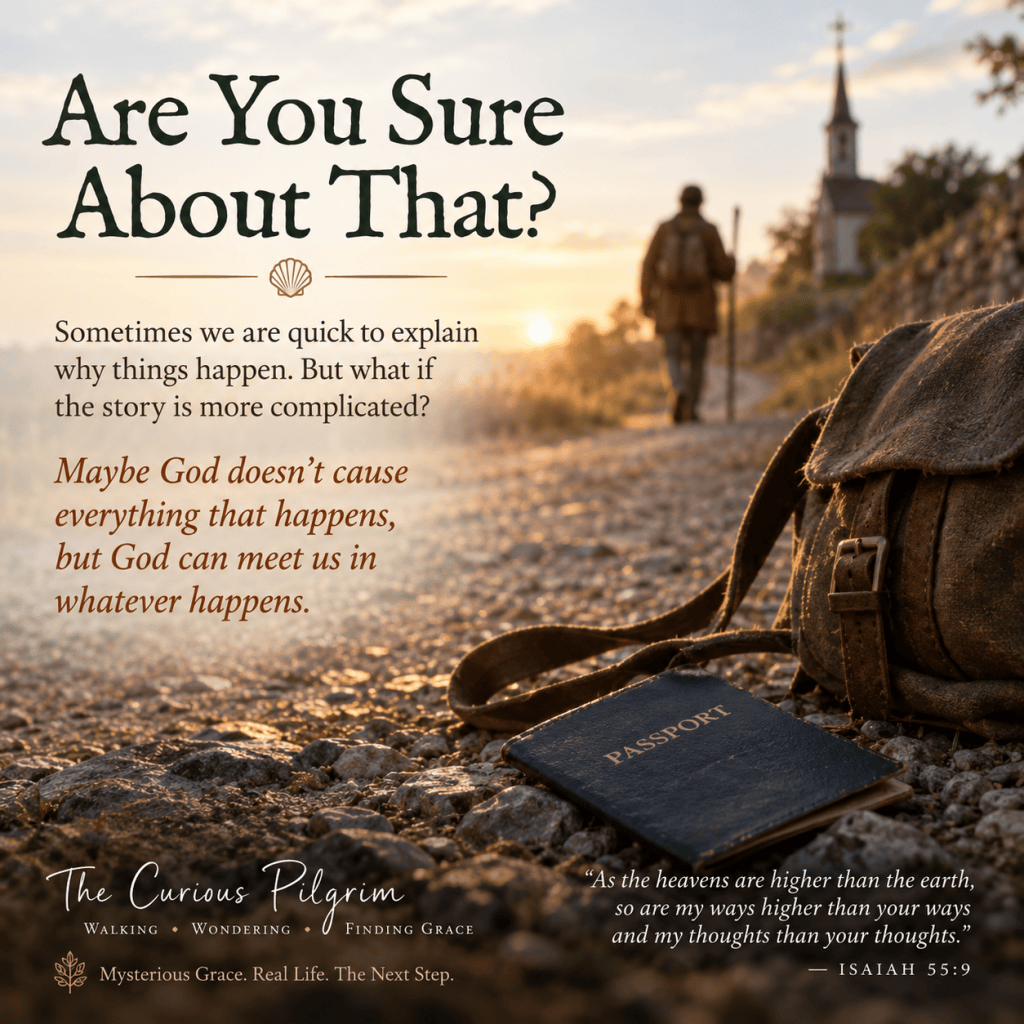
That doesn’t mean God caused every painful thing that happened to me.
It means God met me there.
And perhaps that is the distinction I am learning to make.
There is a tremendous difference between saying:
“God did this to you.”
and saying:
“God can meet you in this.”
I don’t think attending church earns us protection from scraped feet, lost passports, illness, disappointment, tragedy, or suffering.
And I don’t believe God needs me to attend church because God somehow benefits from my presence.
Maybe I am the one who needs to be there.
I need to hear the Scriptures.
I need the prayers.
I need the Eucharist.
I need the community.
I need those moments when I become quiet enough to remember that I am not walking this road alone.
The army officer may have been wrong when he asked what good attending church could possibly do God.
But perhaps the Pilgrim and the merchant were also too quick to explain his injured foot.
And here I am, generations later, walking alongside all three of them and asking questions.
Maybe that is part of being a pilgrim.
We listen.
We learn.
We wonder.
And sometimes we even turn to the pilgrims walking beside us and ask:
“Are you sure about that?”
I don’t have to understand everything that happens along the road.
I only need to keep watching for grace.
Not a grace that explains everything.
Not a grace that turns every misfortune into punishment.
But that mysterious grace that meets us wherever we happen to be.
Even when we’ve lost our passport.
Even when we’ve scraped our feet.
Even when we’ve taken the wrong road.
God is still there.
Scripture for the Journey
“As the heavens are higher than the earth,
so are my ways higher than your ways
and my thoughts than your thoughts.”
— Isaiah 55:9
Prayer
Gracious God,
Forgive me when I am too quick to explain the journeys of others.
Keep me from assuming that I know why another person suffers or what You are doing in someone else’s life.
Give me enough humility to say, “I don’t know.”
Teach me to recognize Your grace without trying to explain every mystery.
When I stumble, meet me there.
When I wander, walk with me.
When I encounter another traveler who has fallen along the road, help me offer compassion before judgment.
And when I cannot understand the road ahead, remind me that I do not have to understand everything in order to keep walking with You.
Lord Jesus Christ, have mercy on me, a pilgrim.
Amen.


Leave a Reply