
Daily Office Reflection — Job 12:1–6, 13–25
Sometimes a few words in Sacred Writings stop me, and I know I need to stay with them awhile.
That happened today while reading Job.
Job is responding to Zophar and the other friends who have been trying to explain his suffering. They have answers. They believe they understand how God works. If Job is suffering, there must be a reason, and they are convinced their understanding of God can explain it.
Job isn’t convinced.
Then Job says something remarkable:
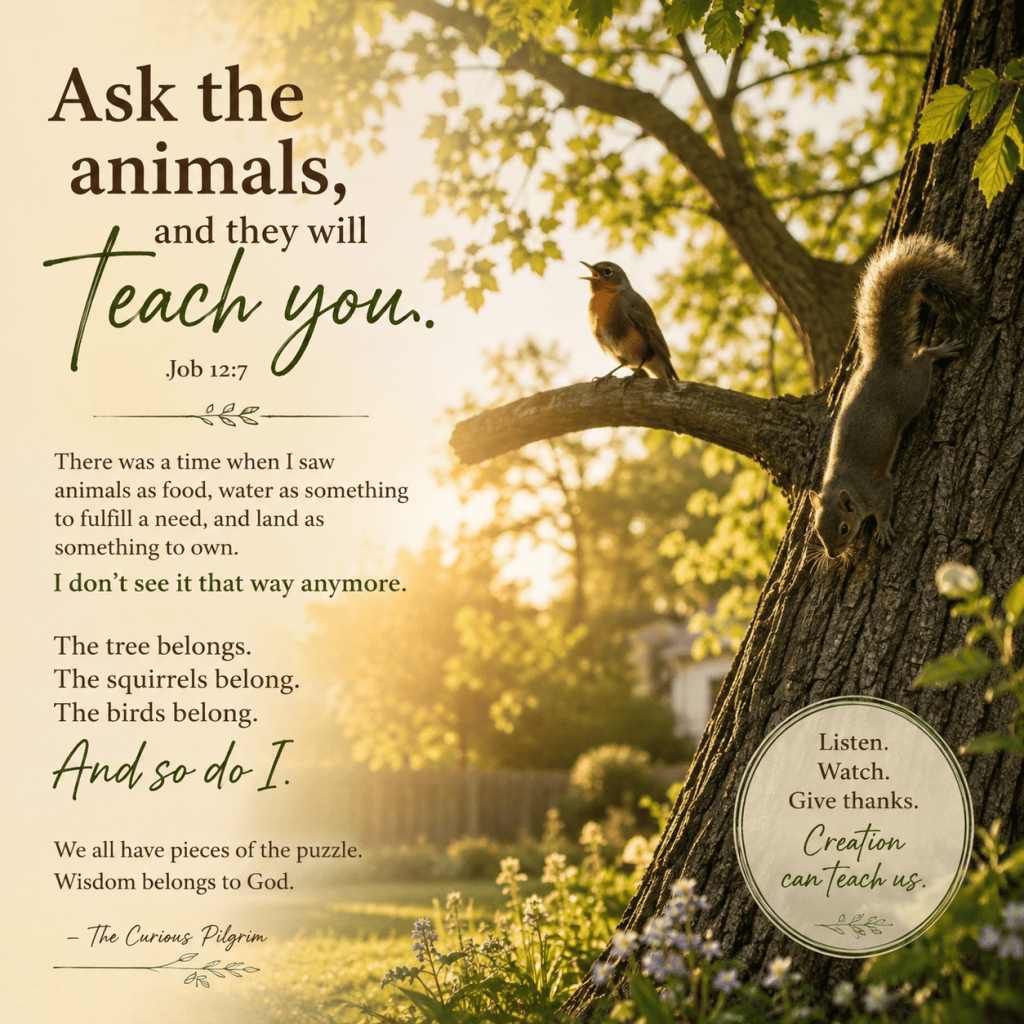
“Ask the animals, and they will teach you;
the birds of the sky, and they will tell you.
Speak to the earth, and it will instruct you.
Let the fish of the sea speak to you.”
I stopped.
Ask the animals?
Let the earth teach us?
Listen to the fish?
Job is beginning to recognize something his friends have missed.
We don’t know nearly as much as we think we know.
We human beings have a tendency to look at everything through our own wants, desires, fears, and what we perceive to be our needs. We look at creation and ask what we can get from it.
The land becomes something to own.
The forest becomes lumber.
Water becomes something to satisfy our thirst.
Animals become food or commodities.
Sometimes even other human beings become something to use for our own purposes.
We become so focused upon ourselves that we no longer see the relationships around us.
But Job says:
Stop and look again.
Creation has something to teach us.
That brought to mind something I learned from Michael T. Garrett and J. T. Garrett in my reading about Cherokee wisdom. In Walking on the Wind, Michael Garrett includes a prayer called “Giving Thanks.”
The prayer gives thanks to the Great One for life and then moves through Earth, Water, Fire, Wind, the directions, ancestors, creation, beauty, laughter, knowledge, and finally harmony and balance.
I see something here that I don’t want to overlook.
The Cherokee listened to creation and learned something about relationship, gratitude, harmony, and balance.
And Job tells us:
Listen to creation. It can teach you.
These traditions are different, but that doesn’t mean we should ignore the truth we can recognize when they speak alongside one another.
In fact, Job tells us where wisdom ultimately comes from:
“With God are wisdom and strength;
he has counsel and understanding.”
That has become increasingly important to me.
Wisdom doesn’t belong exclusively to one culture, one denomination, one religious institution, or one individual.
Wisdom belongs to God.
Perhaps that is why we can encounter pieces of truth in unexpected places throughout the human family.
None of us holds the entire puzzle.
We have pieces.
And sometimes another person’s piece helps us recognize something that has been lying in front of us all along.
That happened to me with Job today.
The Cherokee teaching didn’t replace Job.
It helped me hear Job.
And I have to admit something else.
I haven’t always seen creation this way.
There were times in my life when I saw animals primarily as food, water as something provided to fulfill our needs, and land as something to be owned.
In many ways, I looked at creation according to what it could provide for me.
I don’t see it that way anymore.
Today I increasingly see these things as gifts from God—gifts that were never intended for me alone.
I have even discovered a love for animals that I didn’t once have.
And I give thanks to God for changing the way I see.
Today I can look through my window at the big elm tree in my yard.
I watch the squirrels scampering up and down its branches.
I listen to the birds singing.
And I realize that none of this exists merely for me.
The tree belongs within God’s creation.
The squirrels belong.
The birds belong.
And so do I.
For a moment, I don’t need to explain it.
I don’t need to possess it.
I don’t need to control it.
I don’t need to determine what it is worth according to what it can do for me.
I can simply watch.
Listen.
Give thanks.
And know that God is here.
Perhaps this is part of what Job is beginning to discover.
His friends have pieces of truth, but they mistake those pieces for the entire puzzle.
They know God is just.
They know righteousness matters.
They know our choices have consequences.
But then they take those truths and construct a system that says Job’s suffering must mean Job has done something wrong.
Job’s experience doesn’t fit their system.
Instead of questioning their understanding, they question Job.
How often do we do the same thing?
We inherit beliefs, traditions, and customs. Some contain great wisdom. But sometimes we turn the wisdom of those who came before us into rigid systems. We preserve the words while forgetting the relationships those words were intended to teach us.
Then something happens that doesn’t fit our understanding, and rather than admitting that our understanding may be incomplete, we try to force reality into our explanation.
Job refuses to do that.
His suffering has forced him to ask deeper questions.
And perhaps that is part of what suffering does to all of us.
We want to know why.
Why did this happen?
Why did God allow it?
Why didn’t God stop it?
What did I do?
What am I supposed to learn?
Sometimes there are answers.
Sometimes there aren’t.
Paul would later write that we see through a glass darkly.
We see pieces.
Our understanding is shaped by our culture, our experiences, our desires, our fears, our education, our religion, our history, and our relationships.
None of us sees the whole picture.
I have spent much of my life searching for understanding.
My study of theology opened doors.
My love of history opened others.
Genealogy opened still more.
Sacred Writings have continually challenged me.
People from cultures and religious traditions different from my own have helped me see things I might otherwise have missed.
And life itself has taught me lessons no classroom could ever have taught me.
My hunger for knowledge has taken me down many roads.
Somewhere along this journey I have discovered something important:
Knowledge and wisdom are not the same thing.
Knowledge can tell me what happened.
History can help me understand how we arrived where we are.
Genealogy can help me understand those who came before me and the relationships that helped shape us.
Experience can teach me what it means to actually live through something.
Other cultures can help me see what my own culture has overlooked.
Sacred Writings can challenge what I thought I already understood.
And creation itself can teach me.
But none of these gives me possession of wisdom.
Wisdom belongs to God.
Perhaps that is one of the things Job’s friends needed to learn.
Perhaps it is something humanity still needs to learn.
And perhaps it is something I will spend the rest of my journey learning.
We don’t have to possess everything.
We don’t have to control everything.
We don’t have to understand everything.
Sometimes we need to become quiet enough to listen.
Listen to Sacred Writings.
Listen to creation.
Listen to those who came before us.
Listen to people whose experiences are different from ours.
Listen to wisdom wherever we encounter it.
Test what we hear.
Remain humble.
And remember:
Wisdom belongs to God.
So perhaps tomorrow morning—or even later today—I will look out that window again.
The elm tree will still be there.
Perhaps the squirrels will be running along its branches.
The birds may be singing.
And instead of simply looking through the window, perhaps I will remember Job:
“Ask the animals, and they will teach you.”
I am still learning.
I hope I never stop.
After all, I am only a Curious Pilgrim walking along the road, picking up pieces of the puzzle and occasionally discovering that something I thought was new had been waiting there for me all along.
A Pilgrim’s Prayer
God of all wisdom,
thank you for the gift of life
and for the creation of which I am a part.
Forgive me for the times I have looked at your creation only according to what it could provide for me.
Thank you for changing the way I see.
Teach me to listen.
Let the animals teach me.
Let the birds speak to me.
Let the earth instruct me.
Let the waters remind me that life is a gift.
Teach me to recognize the relationships you have woven throughout creation.
Give me humility to recognize wisdom when I encounter it, even when it comes from somewhere I did not expect.
Help me receive the wisdom of those who came before me without turning their wisdom into walls that prevent me from learning.
When suffering comes and explanations fail, keep me from offering easy answers.
Remind me that I see only in part.
Restore the relationships we have damaged through greed, fear, ignorance, and our desire to control.
Teach us again gratitude, relationship, harmony, and balance.
And when I look at the tree,
watch the squirrels,
and hear the birds sing,
remind me:
They belong.
I belong.
We are all part of your creation.
The completed puzzle does not belong to me.
Wisdom belongs to you.
Keep me curious.
Keep me humble.
Keep me listening.
Amen.
 The Curious Pilgrim
Leave a comment