
Daily Office — Proper 17, Year Two
Psalms 25, 9, 15; Job 12:1–6, 13–25; Acts 11:19–30; John 8:21–32
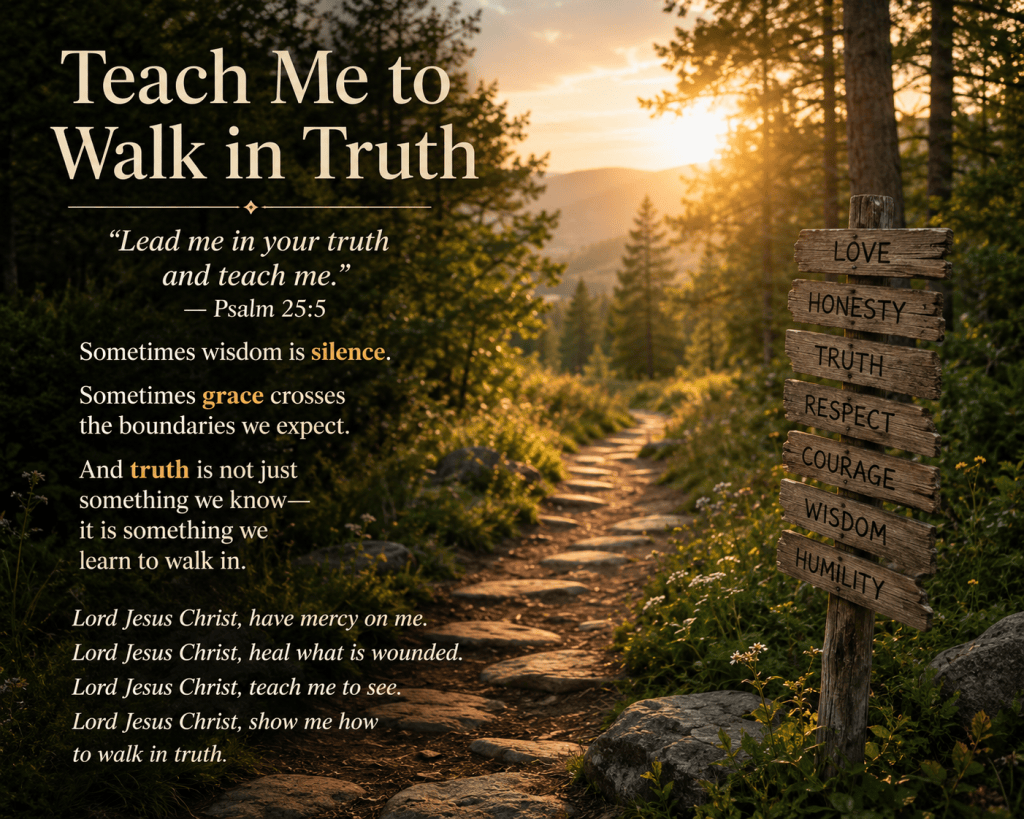
Sometimes when I read the Daily Office, one word or phrase seems to follow me from one reading into another. Today that word was truth.
Psalm 25 begins with a prayer that has become increasingly important to me:
“Show me your ways, O Lord,
and teach me your paths.
Lead me in your truth and teach me.”
David is not simply asking God, “Tell me what to believe.” He is asking, “Teach me how to walk.”
That is different.
Truth is not merely something to know. Truth becomes a way of living—in relationship with God, with other people, with ourselves, and with creation.
David is honest about himself. He asks God to forgive his sins. He asks for mercy. He acknowledges that he needs to be taught. He trusts that God is good and that God leads the humble in doing what is right.
As I read Psalm 25, I thought about the Seven Sacred Teachings I have been learning about from Indigenous traditions: Love, Honesty, Truth, Respect, Courage, Wisdom, and Humility.
I am not suggesting that Psalm 25 and the Seven Sacred Teachings are the same. They arise from different peoples, histories, and sacred traditions. But I believe we can listen respectfully when wisdom from different traditions causes us to see something more clearly.
Psalm 25 certainly speaks of truth and humility. David demonstrates honesty by acknowledging his sin. He seeks wisdom by asking God to teach him. He trusts God’s love and mercy. And it takes courage to look honestly within ourselves and ask God to show us what needs healing.
That brought me back to the prayer I have been praying:
Lord Jesus Christ, teach me to see.
Lord Jesus Christ, heal what is wounded.
Lord Jesus Christ, have mercy on me.
Maybe I should add another line:
Lord Jesus Christ, show me how to walk in truth.
Sometimes Wisdom Is Silence
Then I came to Job.
Job has had enough of his friends and their explanations. He becomes almost sarcastic with them. They seem to think they know everything, so Job tells them that surely wisdom will die when they die!
He calls their arguments worthless. Their platitudes are like ashes.
Job doesn’t want another explanation from his friends. He wants to plead his case before God.
He asks God, in effect, “What have I done? Show me my sin. Tell me why this is happening.”
That reminded me of something that happened years ago at a funeral.
One of my parishioners was standing beside the casket of her roommate and friend, overcome with grief. I tried to console her. I said the things a pastor says when trying to help someone through such a painful moment.
Later she told me about another woman who came to her, put her arms around her, and said nothing.
She told me that meant more to her than all the words I had said.
I understand that now better than I did then.
Sometimes people don’t need us to explain their suffering. They need us to sit with them in it.
Job’s friends actually understood that at first. They sat with him in silence. Their trouble began when they decided they could explain why all of this had happened.
There is wisdom in knowing what to say.
There may be even greater wisdom in knowing when there is nothing to say.
When Grace Crosses Our Boundaries
Then Acts takes us to Antioch.
The followers of Jesus are spreading out, preaching and teaching about Christ. Something unexpected begins happening: Gentiles are responding in large numbers.
The church in Jerusalem hears about it and sends Barnabas to see what is happening.
I love what happens next.
Barnabas arrives, sees the grace of God, and rejoices.
He recognizes that God is doing something beyond the boundaries they had previously known.
Then Barnabas finds Saul, and together they teach this growing community. Antioch becomes the place where the disciples are first called Christians.
But their faith doesn’t remain something they merely believe or teach.
They hear that a famine is coming and that their brothers and sisters in Judea are going to suffer. So they collect what they can and send help.
Grace becomes action.
Love becomes food for hungry people.
They didn’t merely say they cared. They did something.
Once again, truth becomes a way of walking.
The Truth Will Make You Free
Finally, I came to John 8.
Jesus is being questioned about who he is. He tells those listening that when they have “lifted up the Son of Man,” they will know “I AM.”
Those words caught my attention.
“I AM” echoes the language used for God in the Sacred Writings. And Jesus says they will begin to understand when the Son of Man is lifted up—when he is crucified.
Then Jesus says words many of us have heard throughout our lives:
“You will know the truth, and the truth will make you free.”
Suddenly I was back where I started.
“Lead me in your truth and teach me.”
Psalm 25 asks for truth.
Job refuses easy answers and demands truth.
The church at Antioch recognizes the truth of God’s grace working among people they had not expected.
And Jesus says that when we continue in his word, we will know the truth—and that truth will make us free.
Maybe truth isn’t something I possess.
Maybe truth is something I am continually learning to walk in.
And perhaps that requires all those things I encountered today: love, honesty, truth, respect, courage, wisdom, and humility.
It requires enough humility to say, “Teach me.”
Enough honesty to say, “Forgive me.”
Enough courage to say, “Heal what is wounded.”
Enough wisdom sometimes to sit beside a hurting person and say nothing.
Enough love to recognize God’s grace when it appears somewhere we did not expect it.
And enough faith to keep following Jesus into a truth that sets us free.
I am still learning.
I am still walking.
I am still a Curious Pilgrim.
And so tonight my prayer is:
Lord Jesus Christ, have mercy on me.
Lord Jesus Christ, heal what is wounded.
Lord Jesus Christ, teach me to see.
Lord Jesus Christ, show me how to walk in truth.
Amen.
 The Curious Pilgrim
Leave a comment