
“Not having a righteousness of my own… but one that comes through faith in Christ.” — Philippians 3:9
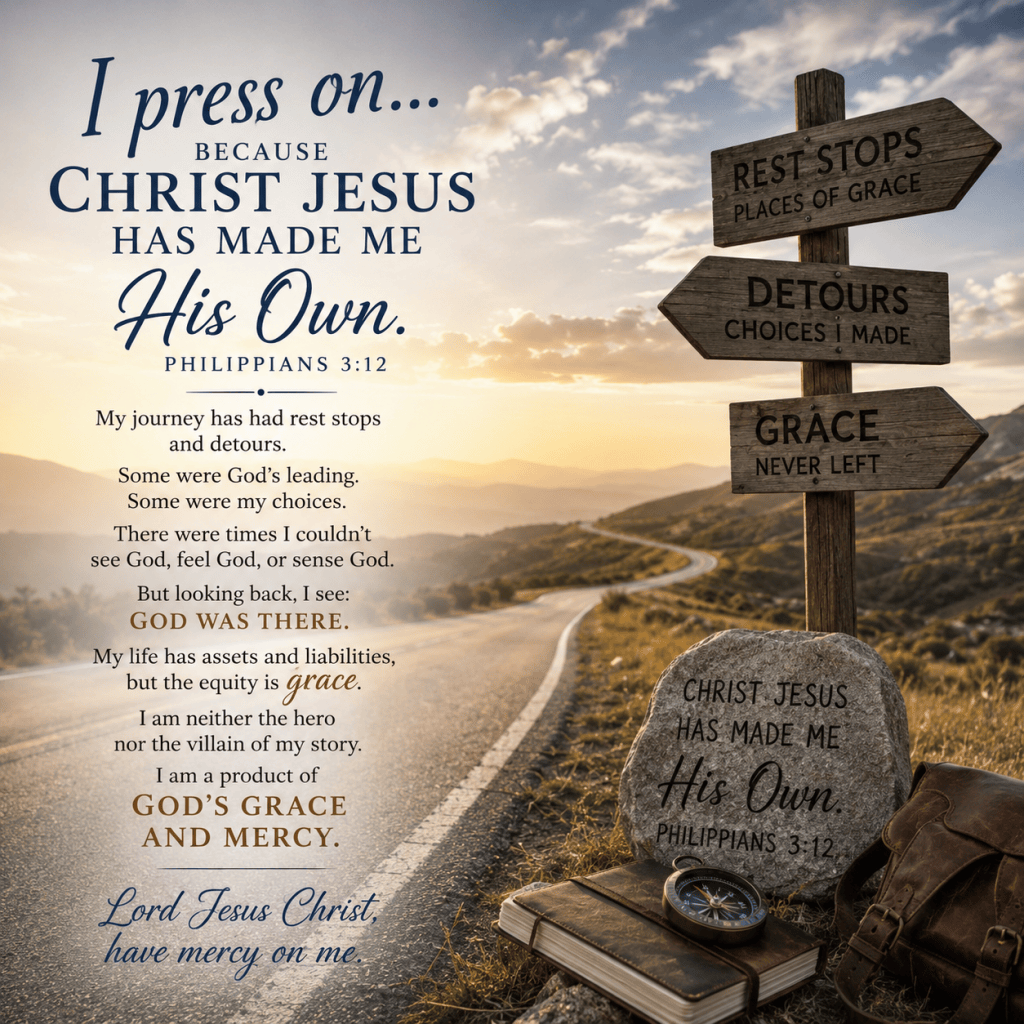
As I have been reading Philippians alongside The Way of a Pilgrim, I have been thinking about grace and how God has worked in my life. I began with prevenient grace—the grace that was there before I understood what God was doing. Looking back, I can see it in Sunday School, church, Mama and Daddy singing, Daddy preaching, and all those early experiences that helped shape me.
I responded to God even when I did not fully understand what I was responding to.
But the journey did not follow a straight road.
There were times when I thought I knew the way and trusted my own judgment. There were rest stops along the way—places where I served, learned, grew, and was prepared for another part of the journey. There were also detours. Those were choices I made myself. I do not want to justify those choices or pretend that everything I did was God’s will. Some choices had painful consequences for me and for people I loved.
There were times when my children needed more from me than I was able to give them. There were times when I felt helpless. There were times when I felt as though I had left the trail completely.
And there were times when I felt abandoned by God.
Yet looking back now, I can see something I could not see then.
God was there.
I spent years working in business and accounting, and sometimes I felt guilty because I wasn’t doing what I believed God had originally called me to do. I thought being a pastor was the trail and perhaps accounting meant I had gotten off it.
Now I see those years differently.
Accounting provided an income that allowed me to serve small churches that needed someone to serve them. It opened the door for me to teach accounting, and teaching gave me opportunities to influence students and help others. My love of teaching was there whether I was standing in a classroom or behind a pulpit.
That doesn’t mean every choice that brought me there was the right choice. It means God’s grace was greater than my ability to get everything right.
I used to preach a sermon based on something every beginning accounting student learns:
Assets = Liabilities + Owner’s Equity
A balance sheet has to balance.
I compared that balance sheet to my life. I have assets, but I also have liabilities. There are things for which I am grateful and things I deeply regret. If my standing before God depended upon my ability to accumulate enough assets to offset my liabilities, I would never get the books to balance.
But Paul writes:
“Not having a righteousness of my own.”
There it is.
The equity on the balance sheet isn’t something I created. It is grace.
Through the death and resurrection of Jesus Christ, the debt has been dealt with. I don’t have to hide the liabilities, inflate the assets, or cook the books to make myself look righteous.
My righteousness is not my own.
Then Paul says something that has become even more meaningful to me:
“I press on to make it my own, because Christ Jesus has made me his own.” — Philippians 3:12
Christ made me his own.
Looking back over my life, I don’t have to make myself either the hero or the villain of the story.
I am neither.
I am a product of God’s grace and mercy.
There was a long period in my life that I now think of as my transformation—my metamorphosis, a renewing of my mind. It did not happen all at once. It happened in spurts.
There were stretches of road followed by rest stops. There were times of learning and serving. There were times when I got on the road again. And there were detours I chose myself.
Through some of those years, I could not feel God’s grace. I could not see it, taste it, smell it, or touch it. Sometimes all I could do was trust that somehow grace was still there.
Today I can look backward and see God in places where I could not see God at the time.
That may be one of the great lessons of my pilgrimage.
Sometimes we recognize grace only when we look back down the road.
The rest stops were not the end of the journey. The detours were not beyond the reach of grace. Even when I thought I had gotten off the trail, God continued working.
Philippians begins with Paul’s confidence that “the one who began a good work among you will bring it to completion.”
Now I understand those words differently.
God began the work before I understood it.
God continued the work when I couldn’t see it.
God worked through the rest stops.
God found me on the detours.
And God is still working.
I have not arrived. Paul hadn’t either. He simply said, “I press on.”
So do I.
Not because I have finally gotten everything right.
Not because my balance sheet shows a perfect life.
Not because I have earned my place on the road.
I press on because Christ Jesus has made me his own.
That, for me, is justifying grace.


Leave a Reply