
Daily Office Readings: Psalm 1, 2, 3, 4, 7; Job 4:1; 5:1-11, 17-21, 26-27; Acts 9:29-31; John 6:52-59
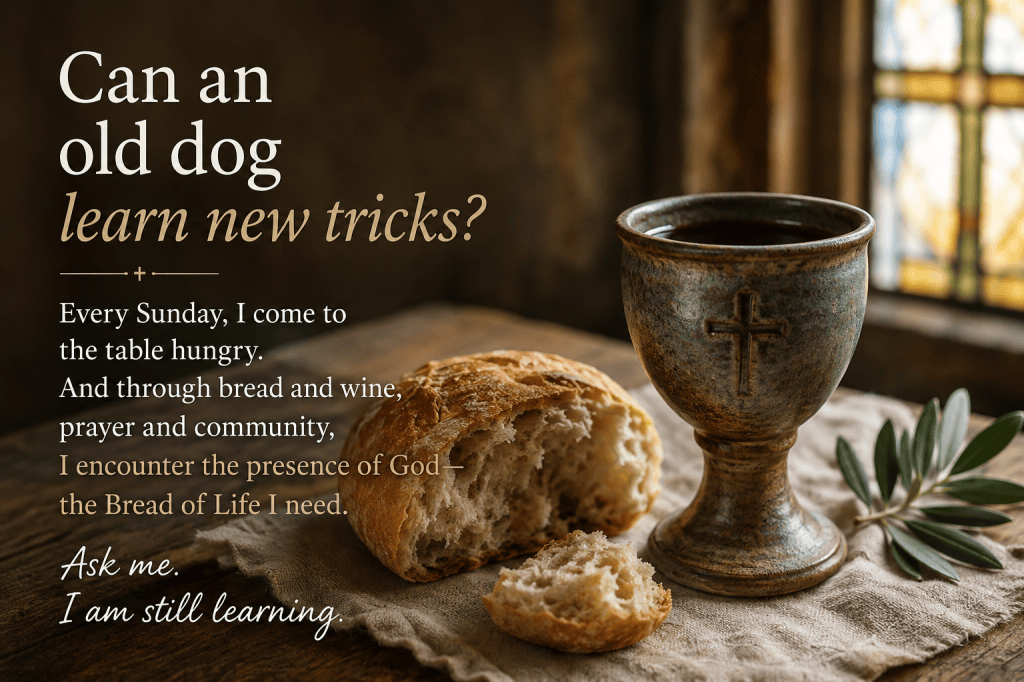
Can an old dog learn new tricks?
Ask any veterinarian.
Can an older adult still learn, grow, or change their ways?
Ask me. I am living proof.
I grew up in a church that taught that the Lord’s Supper, or Communion, was a memorial. It was something we did to remember or recall Jesus’ death for the forgiveness of our sins. I believed and accepted this until I was 50. Not quite a senior adult, but close enough!
At 50, I was accepted into the Master of Divinity program at Memphis Theological Seminary in Memphis, Tennessee. As part of the admission process, new students were interviewed and asked questions about their beliefs.
One question I will never forget:
“What is a sacrament?”
I did not know the term.
When I graduated in 2003, I knew the answer—or perhaps I should say I had begun to understand the answer.
Jesus gives us something to think about in today’s Daily Office reading.
Christians have different names for the meal Jesus gave his disciples. Some call it the Lord’s Supper. Some call it Communion. Others call it the Eucharist, a word connected with thanksgiving.
Jesus had just fed 5,000 people with bread and fish and declared to the crowd that he is the Bread of Life. Then he began talking about eating his flesh and drinking his blood.
No wonder the crowd was confused.
Bread and fish nourish the physical body. But there is another hunger within us that ordinary bread cannot satisfy.
Our spiritual selves need nourishment too.
Christians have understood Jesus’ words in different ways. Some believe the bread and wine become the body and blood of Christ. Others understand Christ’s presence differently. And some, as I once did, understand Communion primarily as a memorial—something we do to remember what Jesus has done for us.
Over the years, my own understanding has changed.
I have come to see the Eucharist as more than remembering something that happened long ago. It is an encounter with the living God.
A sacrament is an outward and visible sign of an inward and spiritual grace. Something ordinary—bread and wine—becomes a place where we encounter something extraordinary: the grace and presence of God.
That is one of the things I have learned along the way.
Today, I attend a church where every Sunday I come to the Eucharistic table. I don’t come because I have everything figured out. I don’t come because I completely understand the mystery of what happens there.
I come because I am hungry.
And there, in bread and wine, prayer and community, I encounter God.
I come away fed by the presence of the One who truly is the Bread of Life I need.
So, can an old dog learn new tricks?
Ask me.
I am still learning.


Leave a Reply